

The 6th arrondissement of Paris has always been one of my favourite neighbourhoods to stay and explore. With its blend of historic cafés, quiet gardens, and charming streets, it’s a place I return to again and again.
Over my countless visits to Paris for over a decade, I’ve spent countless hours wandering Saint-Germain-des-Prés, people-watching from café terraces, and enjoying the neighbourhood’s understated elegance.
Whether it’s your first time here or you’re coming back for more, there’s no shortage of things to do in the 6th arrondissement. From literary landmarks to hidden courtyards, this article covers some of my favourite spots; places that make this part of Paris feel timeless, inviting, and worth lingering in.
This post may contain affiliate links, meaning I get a commission if you decide to purchase something through the links, at no additional cost to you. Read my Affiliate Disclosure.
Why the 6th Arrondissement Is One of My Favourite Areas of Paris

After many visits to Paris, I’ve found that the neighbourhoods I return to most aren’t necessarily the ones with the biggest attractions. They’re the ones I enjoy spending time in, even when I have nothing planned.
That’s what keeps drawing me back to the left bank, the 6th arrondissement.
The 6th arrondissement, or in French le 6ème arrondissement, sits on the Left Bank of the Seine, right in the heart of Paris. It lies between the 5th arrondissement, or Latin Quarter, and the 7th arrondissement, where you’ll find the Eiffel Tower.
While first-time visitors often focus on famous landmarks, I think the real appeal of this part of Paris is the atmosphere. It’s one of the few neighbourhoods where I can spend an entire day walking, sitting in cafés, browsing shops, and wandering side streets without feeling the need to do anything else.
Compared to the Latin Quarter, the 6th arrondissement feels a little more polished and less hectic. Compared to Le Marais, it feels less trendy and more established. There is a sense of permanence here that I find appealing. The neighbourhood has evolved over centuries, but it hasn’t lost its identity.
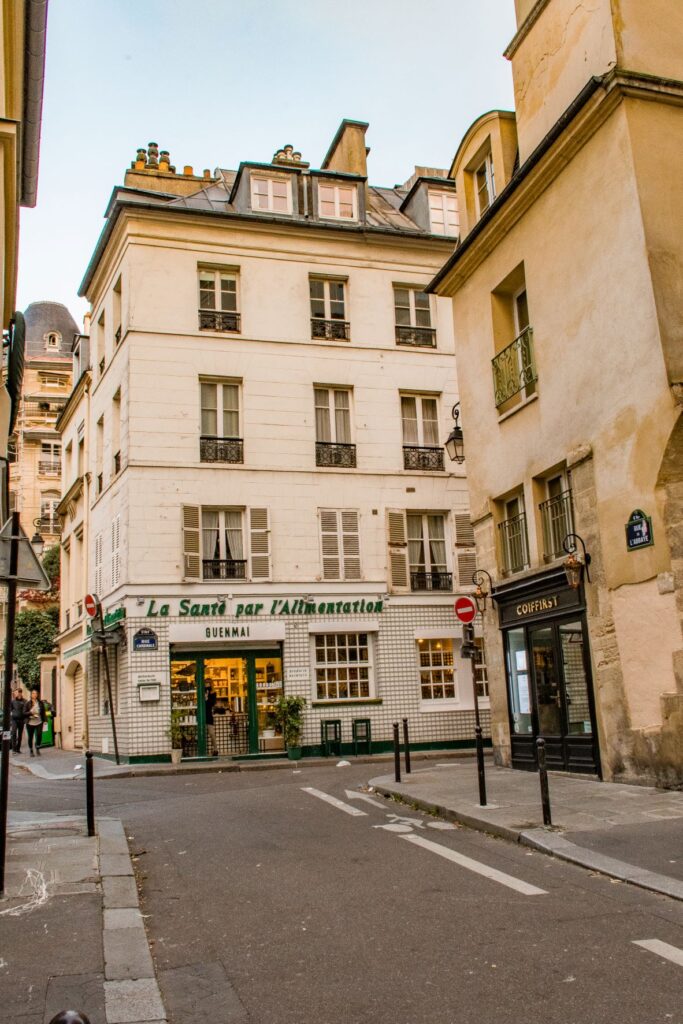
I often recommend the 6th arrondissement to travellers who enjoy walking, people-watching, independent shops, beautiful architecture, and experiencing Paris at a slower pace. It’s especially well-suited to first-time visitors who want the classic Paris they imagine before arriving, as well as repeat visitors who would rather immerse themselves in a neighbourhood than spend their days rushing between monuments.
That said, it isn’t the perfect fit for everyone. If your priority is nightlife, finding the most affordable area to stay, or being surrounded by major attractions from morning to night, other neighbourhoods may suit you better.
For me, the 6th arrondissement captures what I love most about Paris.
Whether I’m lingering over a tea or a glass of wine, wandering through a hidden courtyard, or simply people-watching along Boulevard Saint-Germain, there’s always something here that reminds me why Paris never gets old.
If you’re drawn to neighbourhoods like Saint-Germain-des-Prés and prefer experiencing Paris beyond a checklist of attractions, my ebook Experience Paris: Finding the Joy of Slow Travel shares many of the places, routines, and observations that have shaped how I explore the city after decades of returning.
Explore Saint-Germain-des-Prés, the Heart of the 6th Arrondissement
What is in the 6th arrondissement is less about famous landmarks and more about the atmosphere, a neighbourhood shaped by centuries of history, philosophy, and café culture.
Stroll Through the Literary and Historic Heart of Saint-Germain-des-Prés
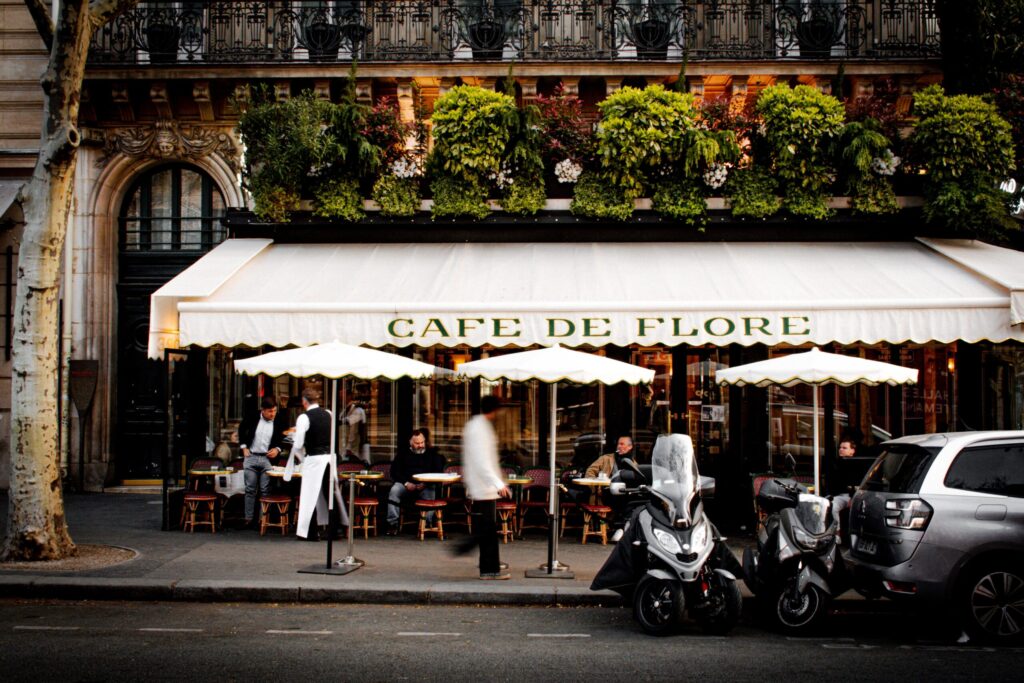
It’s easy to see why writers and thinkers like Simone de Beauvoir, Jean-Paul Sartre, and Hemingway spent their days here; there’s a rhythm to life in these streets that encourages lingering, observing, and thinking.
I like to start at Café de Flore or Les Deux Magots, two of the most famous literary cafés in Paris. Tourists fill the tables now, but it’s still worth sitting with a coffee and watching the world go by, just as the great minds of the past once did. If you’re hoping for a quiet local café experience, these probably aren’t the places. I visit them for their history rather than the coffee itself. For a slower experience, I prefer wandering a few streets away and finding a terrace filled with Parisians rather than visitors.
Across the street, Église de Saint-Germain-des-Prés, the oldest church in Paris, stands as a reminder of the city’s medieval roots. I always take a moment to step inside and be in awe.
A short walk away, down Rue de l’Ancienne Comédie, is Le Procope, Paris’s oldest café. It opened in 1686 and became a meeting place for Voltaire, Rousseau, and even Benjamin Franklin. While the café itself is now a restaurant, the history still lingers in the details: portraits of Enlightenment thinkers on the walls, antique furniture, and even an old tricorn hat said to have belonged to Napoleon.
The food isn’t why I go. If you’re looking for one of the best meals in Paris, there are better options. If you’re fascinated by Parisian history and want to sit in a place connected to Voltaire, Rousseau, and Franklin, then it’s absolutely worth the stop.
Want to explore Saint-Germain-des-Prés more deeply? My self-guided walking tour follows many of the streets, cafés, courtyards, and literary landmarks that make this one of my favourite neighbourhoods in Paris.
Discover Green Spaces and Hidden Courtyards
One of the things I love most about the 6th arrondissement is how easy it is to find a quiet spot, even in the middle of Paris. When I need a break from the city’s energy, I head to Jardin du Luxembourg. Mornings are my favourite time here when locals are out for a jog, children sail toy boats in the fountain, and the tree-lined paths feel almost empty. I like to find a green chair near the Medici Fountain and sit for a while, watching life unfold at a slower pace.
Beyond the park, the neighbourhood is filled with small, tucked-away spaces that most visitors pass right by. Cour du Commerce Saint-André is one of those places. This narrow passage, lined with old shopfronts, has a long history from its days as a meeting spot for Revolutionaries to its role in housing the printing press that first published the Declaration of the Rights of Man. I always take my time walking through, stopping to peek into the little boutiques along the way.
Not far from here is Place de Furstemberg, a small square that feels more like a quiet courtyard. It’s one of those romantic places that make you forget you’re in a big city, just a few trees, a soft glow from the old-fashioned street lamps, and a peacefulness that’s rare in Paris.
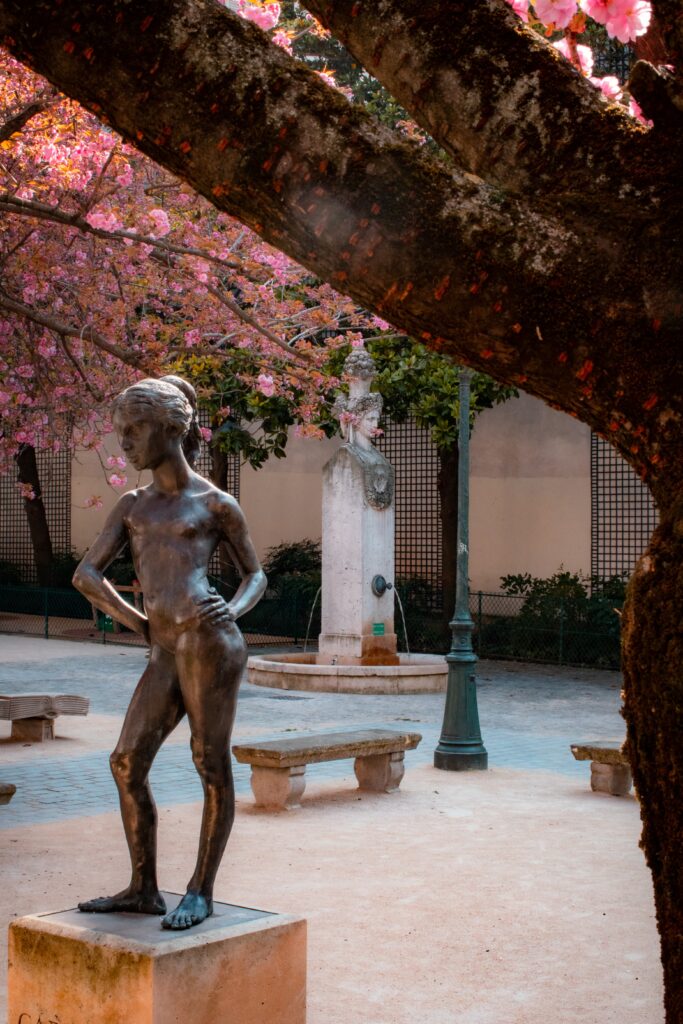
Nearby, Square Gabriel Pierné is another hidden gem. Tucked behind the Institut de France, it’s a tiny garden with cherry blossom trees shading the book-shaped benches and a beautiful bronze sculpture of a girl called Caroline at its center. It’s the perfect place to pause for a moment before continuing to explore.
These small pockets of greenery and history remind me why I love this part of Paris.
Visit Small Museums and Cultural Gems

One of the things I’ve learned from visiting Paris so many times is that the best experiences aren’t always in the big museums or famous landmarks. Some of my favourite places in the 6th arrondissement are the smaller, quieter spots that feel like little discoveries.
Tucked away on a side street near Place de Furstemberg, Musée Delacroix is one of them. Housed in the former home and studio of the Romantic painter Eugène Delacroix, it’s a small but personal museum filled with his artwork, sketches, and letters. The highlight for me is always the garden—it’s peaceful, unassuming, and feels like a hidden retreat in the middle of the city.
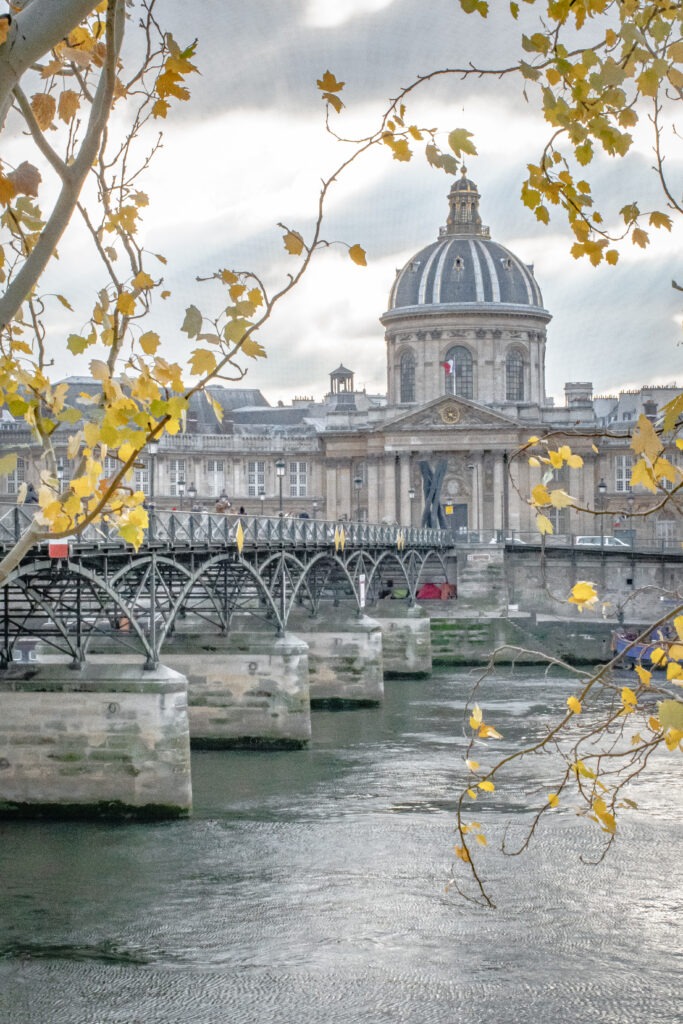
Just a short walk away, the Institut de France stands along the Seine, its domed roof marking the home of the French Academy. I always stop here for a moment, not just to admire the building, and yes, snap a photo, but to take in the view—this stretch of the river, looking out toward the Pont des Arts, is one of my favourites in Paris. It’s also where I like to browse the bouquinistes, the old bookstalls that line the riverbanks. Sifting through their collections of vintage prints, secondhand books, and old postcards is something I never get tired of. I always seem to manage to bring something back with me.
Another place I always return to is Saint-Sulpice Church. Less crowded than Notre Dame but just as impressive, it has one of the most striking interiors in Paris, with Delacroix’s massive murals and an organ that fills the space with music during Sunday concerts. Stepping inside, even for just a few minutes.
For a different kind of cultural experience, there’s Odéon – Théâtre de l’Europe. This 18th-century theatre has a history that stretches back to the time of Marie Antoinette, and it’s still one of Paris’s most important stages. Even if I’m not seeing a show, I love walking by to admire the grand columns and take in the atmosphere of this historic corner of the Left Bank.
These places may not be as famous as the Louvre or Musée d’Orsay, but that’s what makes them special. They offer a more intimate way to experience Paris, the kind of moments that stay with you long after you leave.
Some of my favourite experiences in Paris never make it here on my website. On my Substack, I share personal essays, neighbourhood discoveries, and Paris itineraries that you won’t find elsewhere.
Strolling the Best Streets for Shopping and People-Watching
One of my favourite ways to experience the 6th arrondissement is simply by wandering its streets, especially those lined with small shops, cafés, and markets. Whether I’m window-shopping, picking up a treat, or just soaking in the atmosphere, these streets always make me slow down and enjoy the moment.
There are a few that I enjoy, like Rue de Buci, a busy street where market stalls, bakeries, and cafés spill onto the sidewalks. It’s perfect for an early-morning stroll when locals are out buying fresh bread or flowers. I always stop at a café here, especially if I can find a table where I can sit and people-watch for a while.
Not far away, Rue du Bac has a completely different feel, quieter, more refined, and filled with charming boutiques. At the end of the street, Le Bon Marché, Paris’s oldest department store, is worth a stop. It’s elegant but not overwhelming, and I love browsing its fashion, homeware, and book selections. Across the street, La Grande Épicerie is my go-to for gourmet food shopping. The selection of cheeses, pastries, and chocolates is endless, and I always leave with something special to take home.
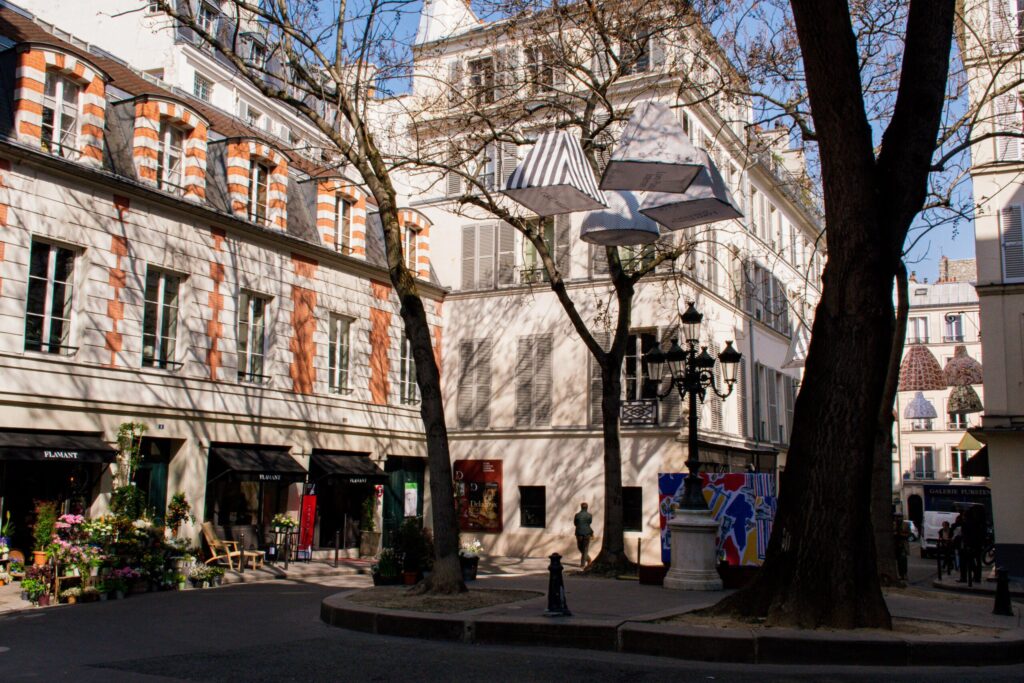
For something more tucked away, the streets around Place de Furstemberg are filled with beautiful décor shops and small galleries. I love wandering through these quiet corners, stopping in at boutiques with unique home goods, antiques, and handcrafted pieces. It’s the kind of area where I always discover something unexpected.
Of course, no walk in this neighbourhood is complete without a stroll along Boulevard Saint-Germain. While parts of it can feel busy, there are plenty of smaller side streets leading to bookshops, perfumeries, and independent designers. I always take my time here, popping into stores and enjoying the mix of old and new.
The 6th arrondissement is one of the best places in Paris to walk without a plan. Whether I’m picking up something special or just enjoying the atmosphere, these streets always make me appreciate the simple pleasure of exploring on foot.
Planning Your Paris Trip
The 6th arrondissement is often included in Paris itineraries because of its atmosphere. Some of my favourite memories here come from my visits here.
For me, Saint-Germain-des-Prés isn’t just about the past; it’s about the feeling of being in a place that has seen so much but still moves at its own unhurried pace.
Take your time here. It’s a chance to slow down, to notice the details, and to enjoy the city in a way that’s easy to miss when rushing from one landmark to the next.
If you’re currently planning a trip to Paris and struggling to decide where to stay, how many days you need, or how to structure your time, I can help. Through my trip planning services, I create personalized European itineraries designed around your interests, travel style, and pace, so you can spend less time researching and more time looking forward to your trip.


