
I had been in Paris for weeks when I left for Moulin de Rochopt, and by then I was ready for something completely different. Not another neighbourhood, not another museum, not another day of crossing the city from one side to the other, but somewhere I could settle in for a couple of nights and still be close enough to Paris to make it easy.
If you’re looking for the French countryside near Paris, Moulin de Rochopt is one of those rare stays that feels much farther away than it is. Set beside the Yerres in the town of Boussy-Saint-Antoine, this centuries-old mill has been restored into a two-bedroom home with ensuite bathrooms, a full kitchen, and enough history to make the property itself part of the reason to come. It works especially well as a two-night escape after several busy days in Paris or a countryside base to take the train into Paris.
This post may contain affiliate links, meaning I get a commission if you decide to purchase something through the links, at no additional cost to you. Read my Affiliate Disclosure.
Why Moulin de Rochopt Is Worth Leaving Paris For
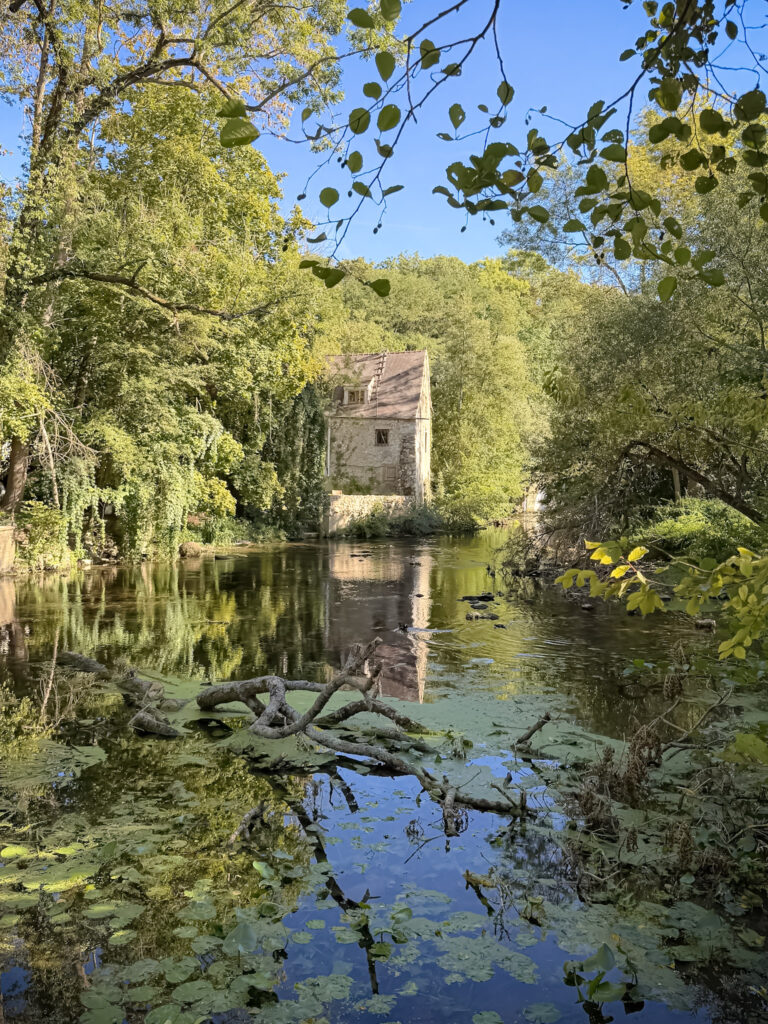
I love Paris, but after several days (or weeks in my case), I can understand the urge to step away from it for a little while. Moulin de Rochopt gives you that change without requiring another major journey. You can spend the morning in Paris and, not much later, find yourself beside the Yerres with trees outside the windows, birds overhead and an 800-year-old mill as your home for the next couple of nights.
That combination is what makes it such an interesting option if you are looking for the idyllic French countryside experience near Paris.
It’s Only About 30 Minutes From Paris
One of the biggest advantages is how little effort it takes to get here. The train ride from Paris’s Gare de Lyon is about 30 minutes and costs the same as the Paris Métro, which makes Moulin de Rochopt surprisingly easy to add to your Paris itinerary, or act as your base for exploring Paris.
For me, that matters. If I only have a short time in France, I don’t necessarily want to spend several hours on a train or lose half a day getting deeper into the French countryside for an escape.
It also means you don’t need to choose between a city trip and time in the countryside. You can enjoy a bit of both in one trip.
The Change of Pace Is Immediate
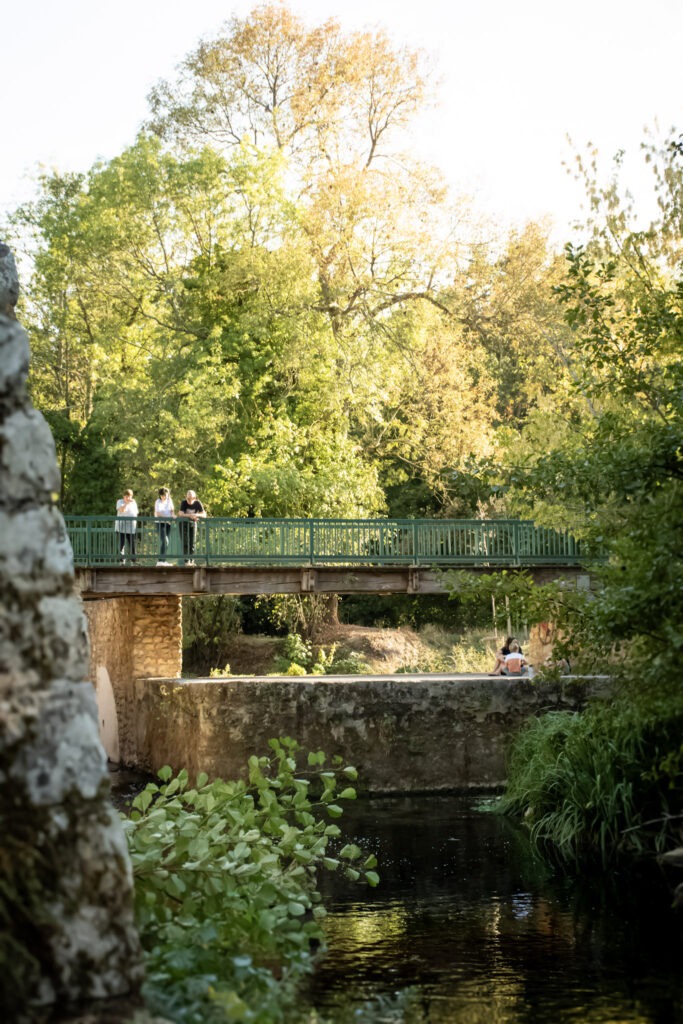
The physical distance from Paris may be small, but the difference once you arrive is much greater.
After weeks of traffic, Métro stations, busy pavements and the almost constant stimulation of Paris, I noticed the absence of city noise almost immediately. At the mill, what you hear instead is birdsong, leaves shifting in the breeze and the sound of the Yerres moving past the property.
The house is surrounded by mature trees, and walking paths follow the river into long stretches. There are places where the trees close around the path and others where the landscape opens up again. You pass fields of cows and sheep, and see the constant stream of waterfowl appear beside the water.
It’s the kind of setting that makes you naturally do less and unplug with very little effort. There’s something very restorative about having so little competing for my attention. I didn’t realize how much I needed that.
You Get a Small Taste of Village Life
Part of the pleasure of staying here is that you aren’t isolated in the middle of nowhere. The nearby village has the sort of everyday shops that make a self-catering stay in France particularly enjoyable, including a boulangerie, fromagerie, and butcher, so you can pick up what you need and bring it back to the mill.
I liked that ordinary side of the experience. You can walk into the village, buy something for lunch or dinner, then return to the house and eat outside under the pergola of the outdoor kitchen or around the long dining table.
It gives you a small glimpse of another version of life around Paris, one that feels far removed from tourism.
Its History Is Part of the Reason to Stay
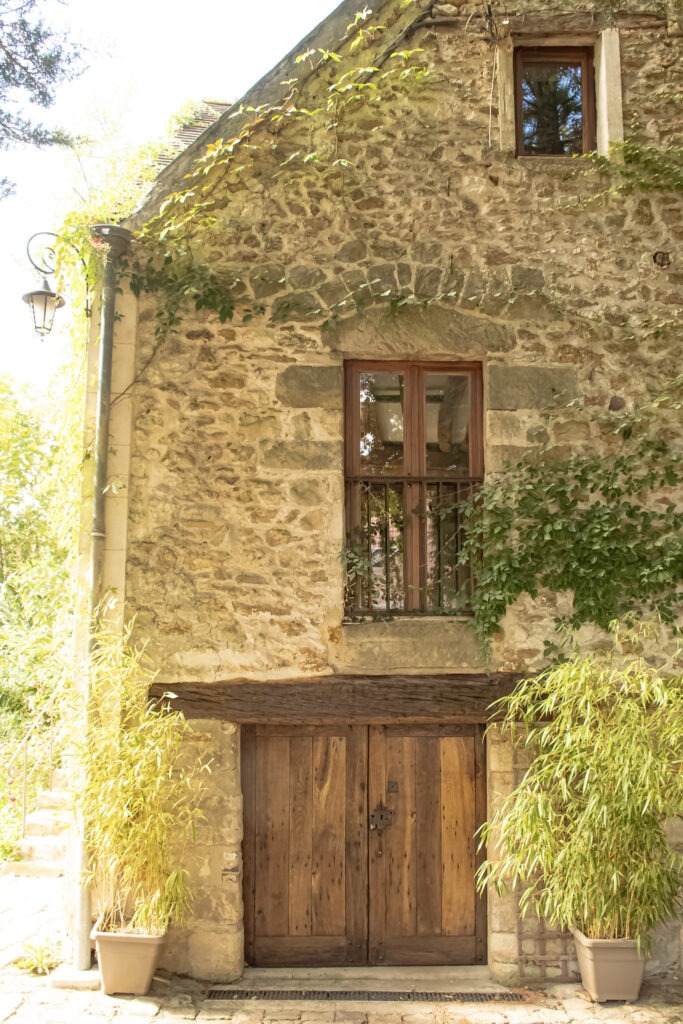
Moulin de Rochopt isn’t a modern country house styled to feel old. A mill stood on this stretch of the Yerres before the 13th century, and for centuries the river powered a large 24-paddle waterwheel that ground grain for the surrounding area.
Milling at Rochopt ended around 1847 after a newer and more efficient mill was built almost directly across the river. There’s a rather wonderful ending to that story: the newer mill was eventually demolished, while the medieval Moulin de Rochopt survived.
For anyone drawn to historic places, this will be a very special place to stay as the history gives the property meaning. From the look of the old photos of the mill hanging on the walls, not much has changed about the structure itself. It’s what lies behind the stone walls where the biggest transformation has occurred.
What It’s Like to Stay at Moulin de Rochopt
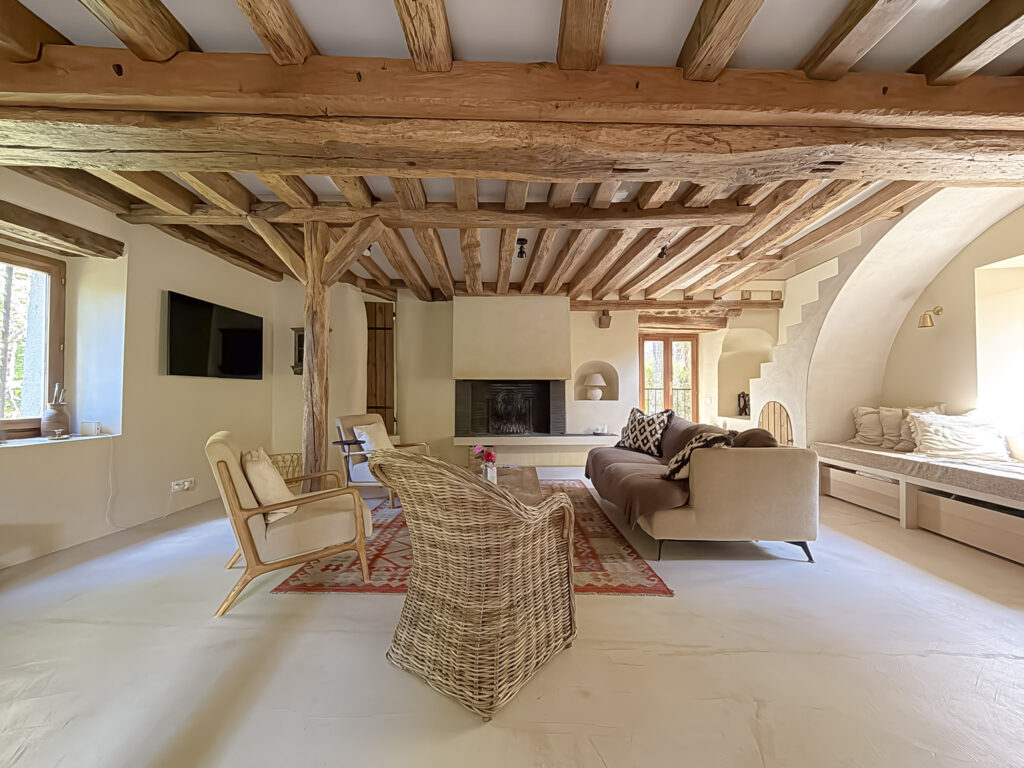
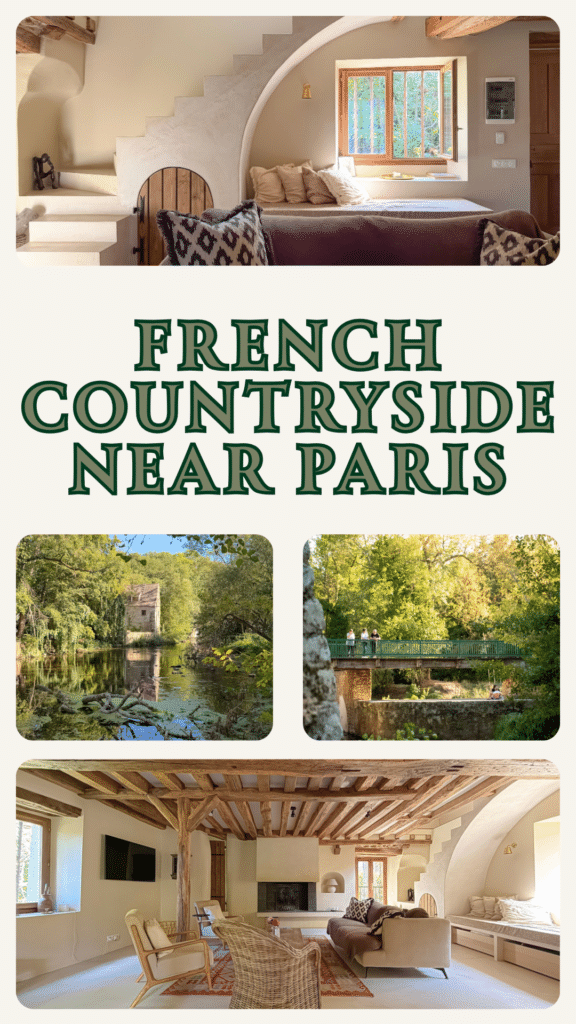
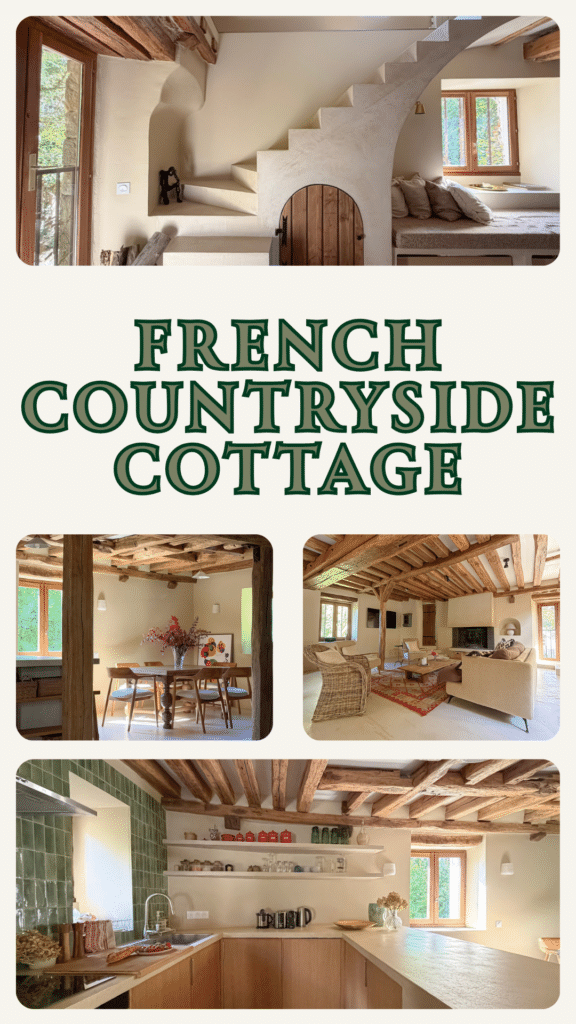
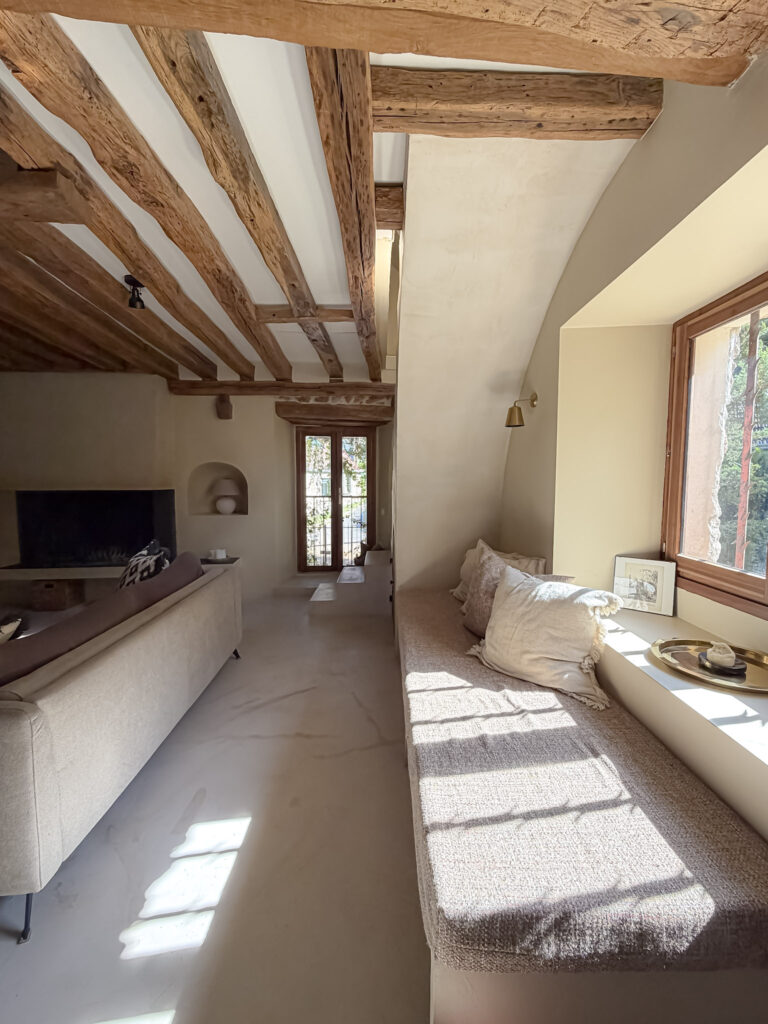
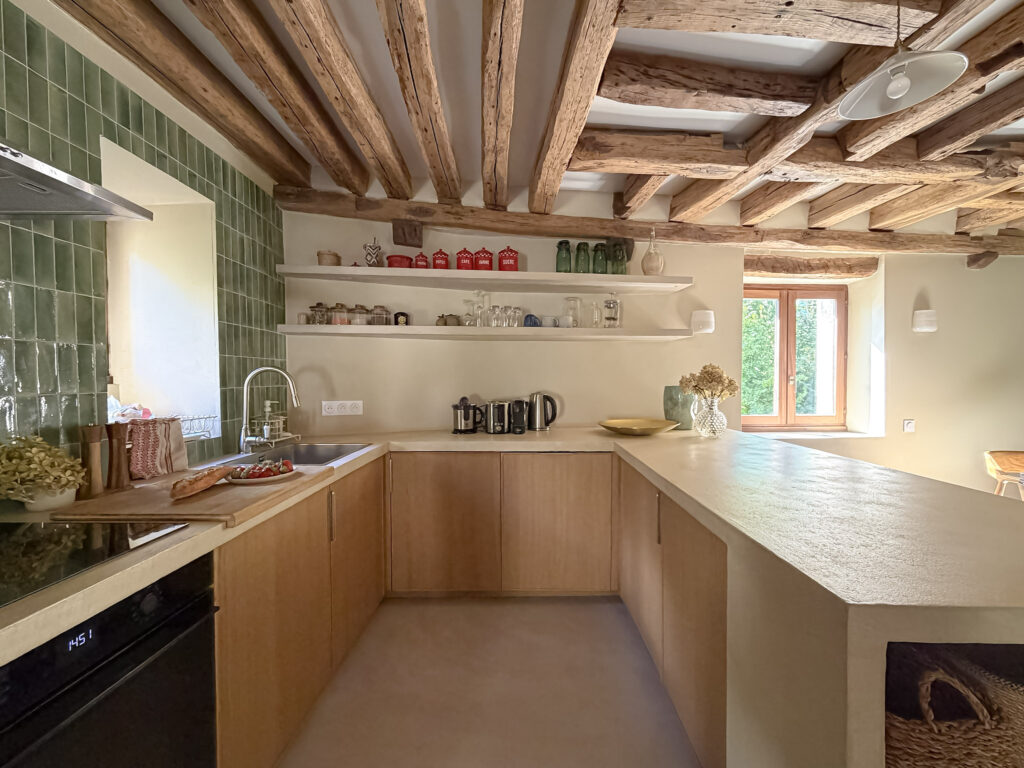
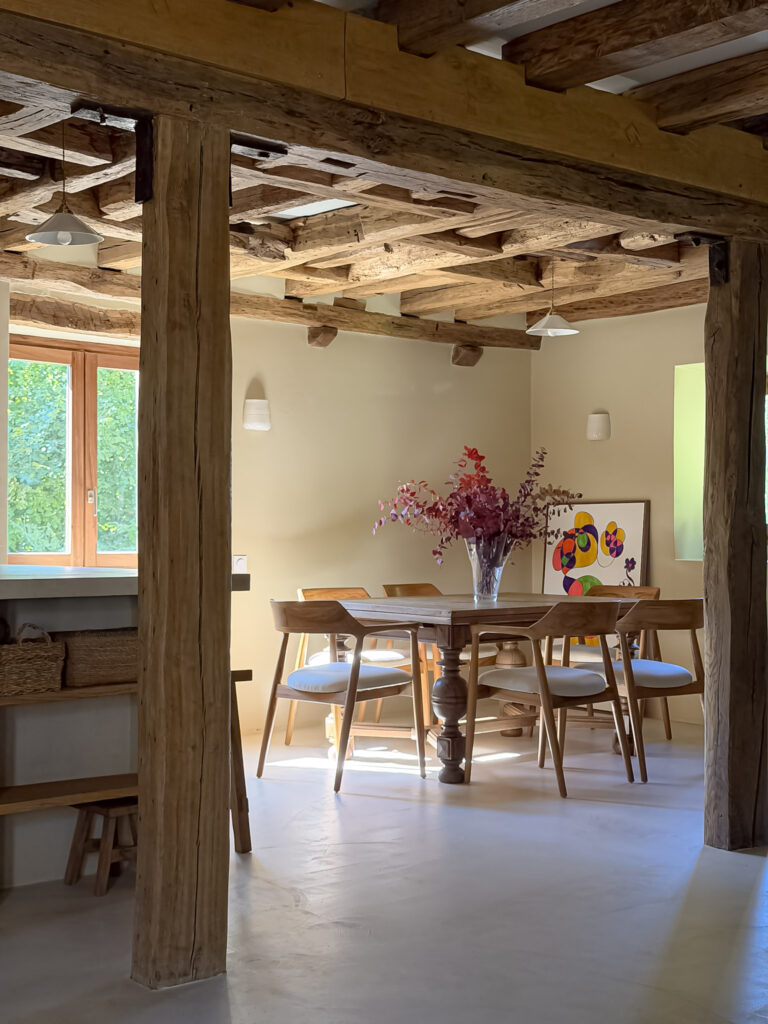
The first thing you notice inside Moulin de Rochopt is that the building does not disguise its age. The main floor is open and generous, with enormous timber beams crossing the ceiling, thick plastered walls, deep-set windows and a fireplace anchoring the sitting area, while the furnishings stay deliberately simple enough that your eye keeps returning to the structure itself. Natural wood, warm neutrals, woven textures, and a few stronger details, such as the green glazed tile in the kitchen and the polished concrete floors, give the space character without turning the mill into a version of rustic France created for us visitors.
The space is carefully curated, but in an understated way that makes it feel calm, relaxed and lived-in. Nothing feels too staged, and that balance makes it easy to settle into the house almost immediately.
My favourite spot was the window bench tucked into one of those deep walls. I would open the window and listen to the soothing sounds of Yerres. I would watch the light stream through the windows, slowly moving from morning to late afternoon.
The kitchen is fully equipped and flows directly into the dining and living areas, which makes the mill feel more like a home than somewhere you simply return to sleep. I loved being able to walk into the village, pick up a baguette, local cheese, wine and some fruit, then come back and eat outside. I welcomed swapping my cafe terrace people-watching views in Paris for the distinct sounds of nature.
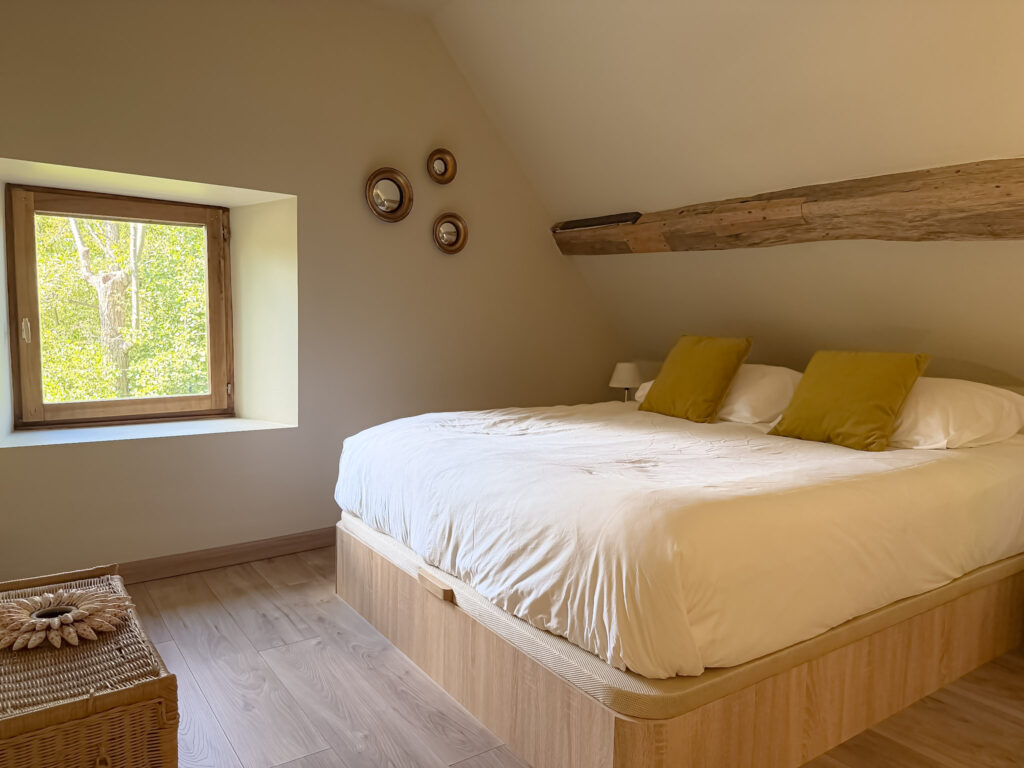
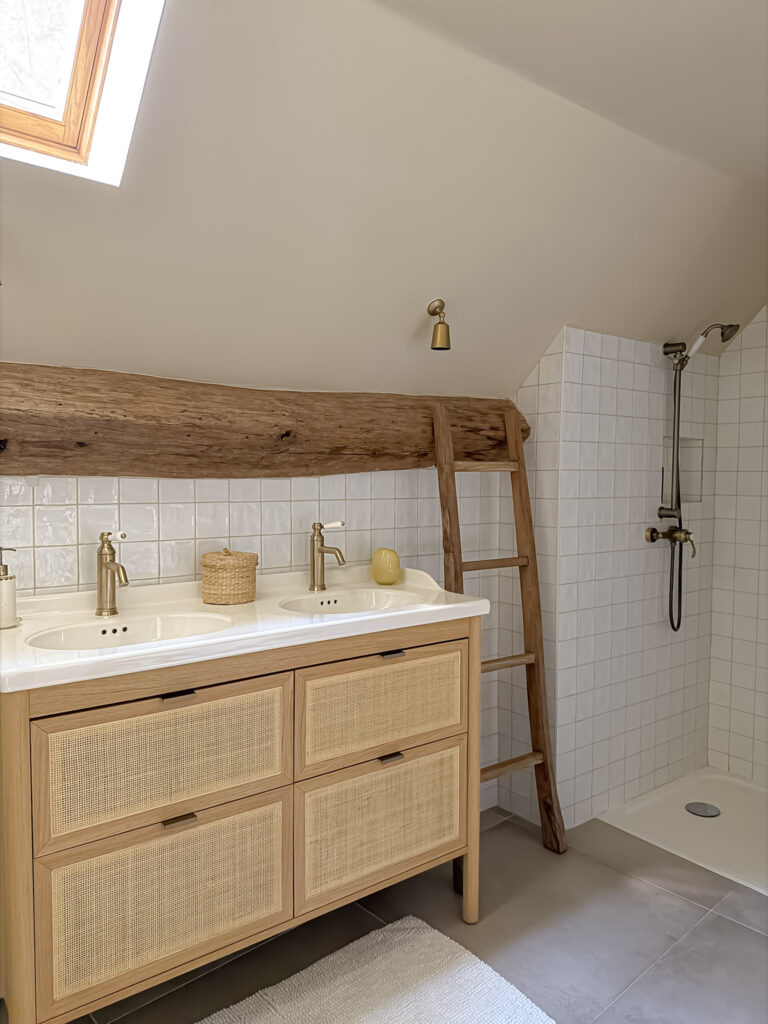
Upstairs are two spacious bedrooms, each with its own ensuite bathroom. The sloped ceilings and exposed timbers continue the feel of the rest of the house, while the bathrooms are more contemporary, with wood, brass and white tile. Lots of light pours in through the windows and skylights. One of the bedrooms has views of the river, while the other looks over the gardens. One of the more unusual details is the main floor bathroom incorporated into the round turret, where sections of the original stone remain visible.
Who This French Countryside Stay Is Best For
Moulin de Rochopt is best suited to travellers who want the place they stay to shape the experience of the trip.
It would work especially well for:
- Couples wanting a romantic few days outside Paris without travelling too far.
- Two couples who want to share a beautiful house while still having their own bedroom and bathroom.
- Friends looking for a slower countryside break with space to cook, sit outside and spend time together.
- Mother-daughter trips, especially for those who would enjoy history, nature, village shops and a quieter pace.
- Travellers wanting a slower few days after Paris, particularly after a busy city itinerary.
- People who care about architecture and history, since the building itself is one of the main reasons to stay.
- Nature lovers, with the Yerres, birdlife, walking paths and surrounding greenery right outside.
- Travellers who want a taste of small-village life, with everyday shops nearby and a much more local feel than central Paris.
- Travellers who prefer to get around by train rather than rent a car, since Moulin de Rochopt can be reached from Paris by train and still gives you a genuine countryside experience.
- People who prefer independent stays over hotels, and like having a kitchen, living room and outdoor space of their own.
- Travellers who want to visit Paris but don’t necessarily want to stay in the city, using Moulin de Rochopt as a peaceful base and taking the roughly 30-minute train into Paris when they want museums, restaurants or sightseeing.
It’s less suited to travellers looking for nightlife, lots of restaurants and cafés immediately outside the door, or a packed sightseeing schedule from early morning until late at night. For anyone who wants to be able to walk out the door directly into central Paris, they should stay in the city instead.
The appeal here is almost the opposite: more privacy, more nature, more space, and a much gentler pace while still keeping Paris close enough to enjoy when you want it.
How long should you stay?
I think two nights is ideal because it gives you enough time to settle in, enjoy one full day and experience the property without feeling rushed. That said, when it was time for me to leave, I wished I had stayed one more night. Three nights or more would be even better if you are using it as a base to explore Paris and the surrounding area or simply enjoy the mill without feeling that departure comes too quickly.
If you are deciding between adding another night in Paris or spending two nights somewhere completely different, this is where Moulin de Rochopt makes a strong case for itself. You are close enough to return to Paris easily, but the experience gives you something the city cannot: space, nature, village life and time inside a historic property where staying put is part of the appeal.
A Few Things to Know Before You Stay
Moulin de Rochopt feels wonderfully tucked away once you are there, but the arrival is more ordinary than the setting might suggest. If you come by train, the area around it looks like a suburb with newer apartment buildings and a large supermarket nearby. From the station, you will still need to take a local bus or walk 3 km to reach the mill.
The property itself also has a very natural feel. This is not a manicured estate with clipped hedges and a perfectly cut lawn; the garden and grounds are intentionally more relaxed, with a wilder countryside look that suits the setting.
Moulin de Rochopt feels tucked away, but it’s not isolated. Newer residential development has grown up around this historic part of the river, with most properties sitting behind gates for privacy. The road itself is quiet, with one neighbouring house beside the mill, while on the other side the original footbridge crosses the Yerres and leads directly to the riverside walking paths. Once inside the property, it feels peaceful and private, but you are still very much connected to the surrounding neighbourhood.
My Take on Staying at Moulin de Rochopt
What surprised me most was how quickly Moulin de Rochopt felt removed from Paris, despite being so close to it. I expected the history to interest me and the setting to be beautiful, but I did not expect to enjoy simply being there as much as I did.
For me especially, it’s very hard to unplug from work. It’s nearly impossible to separate travelling for pleasure and travelling for work, as I am constantly thinking of stories to write and photos to capture. But here at Moulin de Rochopt, it was almost instant that I put my camera down, turned my mind off and just immersed myself in this place. It’s the quiet luxury of travel: truly being in the present moment, and something I needed so badly.
My favourite parts were sitting on the window bench with the windows open, walking beside the Yerres, and watching the herons on the riverbed. I wrote in my journal, ate well, and drank good wine. The mill is absolutely beautiful, but it was the combination of the setting, the history and the feeling of having the place entirely to yourself that will stay with me.
I would recommend it to travellers and clients who want a few peaceful days without going far, who care about architecture and history, and who like the idea of staying somewhere with a strong sense of place. Two nights are enough to experience it properly, although when it was time for me to leave, I found myself wishing I had one more.
For me, that is probably the best measure of a good stay.