

4 days in Tuscany is just enough time to experience the region well—if you focus.
Not on everything. On the right things.
This itinerary is designed for a slower, more intentional way of travelling in Tuscany. You won’t rush through Florence or tick off every famous stop. Instead, you’ll base yourself in one area and explore a handful of towns deeply—places like Pienza, Montepulciano, Siena, and the Val d’Orcia countryside.
I’ve followed this exact route myself, more than once, adjusting it over time to reduce driving, avoid crowds, and create space for the moments that actually stay with you—long lunches, quiet streets in the morning, and those winding roads you didn’t plan for.
If you’re wondering how to spend four days in Tuscany without feeling rushed, this is the itinerary I’d recommend.
This post may contain affiliate links, meaning I get a commission if you decide to purchase something through the links, at no additional cost to you. Read my Affiliate Disclosure.
Is 4 Days in Tuscany Enough?
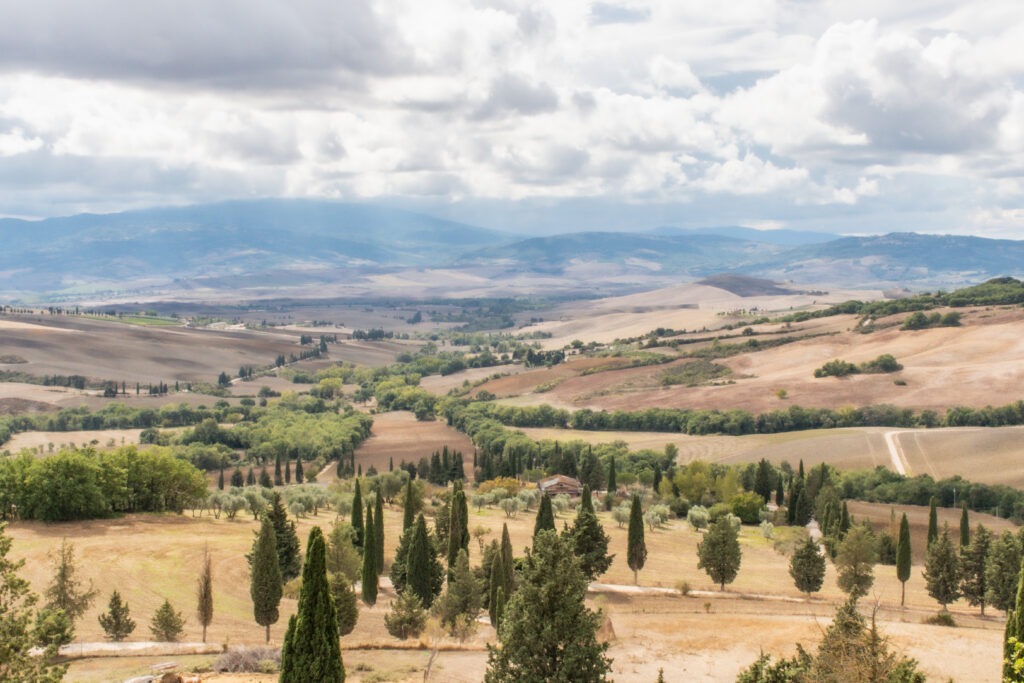
Yes—four days in Tuscany is enough, if you focus on fewer places and experience them more deeply.
What most people get wrong is trying to see too much. Tuscany isn’t a checklist destination. Distances may look short on a map, but the reality is slower—winding roads, hilltop towns, and the kind of scenery that makes you want to stop often.
With four days, the most rewarding approach is to:
- base yourself in one area (more on that later)
- explore nearby towns like Pienza, Montepulciano, Siena, and the Val d’Orcia
- leave space for long meals, scenic drives, and unplanned moments
This is also why I intentionally do not include Florence or Pisa in this itinerary.
Both are worth visiting—but not on a 4-day Tuscany trip like this. Florence deserves several days on its own, and Pisa is a detour that interrupts the natural flow of the countryside. Trying to include them usually results in more time in the car than actually experiencing Tuscany.
After years of travelling through this region—and now planning trips for clients—this is the approach I consistently recommend. And for first-time visitors, especially, the feedback is always the same:
Slowing down, choosing fewer places, and staying longer in each one is what makes Tuscany feel the way they imagined it would.
If you want a trip that feels unhurried, immersive, and memorable, four days is not just enough—it’s exactly right.
The Perfect 4-Day Tuscany Itinerary

This itinerary is designed to build gradually—not overwhelm you from the start.
You’ll begin in the Val d’Orcia, where Tuscany feels open, spacious, and immediately recognizable. Then, each day adds a little more depth—more history, more contrast—before slowing down again at the end.
It’s not about covering ground. It’s about letting the experience unfold in the right order.
Day 1: Val d’Orcia (Montepulciano + Pienza)

Why this works as your first day: it eases you into Tuscany without rushing.
You arrive, settle into your base, and step straight into the landscape you came for—hilltop towns, vineyard views, and that slower pace that defines the region.
Morning to Mid-Afternoon: Montepulciano
Start your day in Montepulciano—and aim to arrive early.
This is when the town is at its best:
- quieter streets
- shopkeepers opening their doors
- soft morning light over the valley
Spend your time:
- wandering uphill toward Piazza Grande
- stepping into small boutiques, art galleries, wine shops
- pausing at viewpoints along the way
Montepulciano has more to do than many Tuscan towns, which makes it the perfect place to begin. You can take your time here without feeling rushed.
Midday tip:
Stay for lunch. Choose somewhere with a view if you can; I like Caffè Poliziano for that exact reason. Then follow it with a relaxed, early afternoon wine tasting at any of them along Via del Teatro.
Afternoon to Evening: Transition to Pienza
By mid-to-late afternoon, make your way to Pienza (about 20 minutes away). This is a small shift geographically—but a noticeable shift in pace.
Pienza isn’t about activity. It’s about atmosphere.
And this is why timing matters. By late afternoon:
- many day-trippers have already left
- the streets feel quieter
- the light begins to soften over the Val d’Orcia
Pienza is best experienced in a few simple moments:
- Walk through the town slowly—it doesn’t take long
- Make your way to the belvedere behind the cathedral to watch the sun dip behind the mountains
- Pause for an aperitivo, Bar Il Casello is the perfect spot
- Stay for dinner
This is where you settle into the rhythm of Tuscany. No agenda. No rushing.
Just the ritual of the evening: the light changing, voices in the street, and that gentle passeggiare—wandering without purpose, but not without meaning.
Day 2: Cortona + Arezzo (From Quiet Mornings to Local Evenings)

Why this works as your second day: after easing into Tuscany yesterday, today introduces a bit more contrast—a smaller, scenic hill town in the morning, followed by a larger, more lived-in city in the afternoon and evening.
It’s a natural progression: start quiet, then expand.
Morning: Cortona (Arrive Early)
Begin your day in Cortona, and like yesterday—timing matters.
Arrive early, before the town fully wakes up, and the crowds arrive.
Cortona is smaller and more compact, which makes it ideal for a slow morning:
- wander the narrow streets without a plan
- step into a church or small shop as they open
- find a spot in the piazza and simply sit
This is one of the best places to pause and observe—locals greeting each other, the pace of the morning unfolding naturally.
You don’t need a checklist here. Cortona is about being, not doing.
Midday: Transition to Arezzo for Lunch through Evening
By late morning, make your way to Arezzo (about 35 minutes away).
This is where the day opens up.
Arezzo is larger, more local, and far less visited than Cortona—which makes it the perfect place to spend the rest of your day without feeling the pressure of crowds.
Arrive in time for lunch and settle in. I recommend you do that on the Piazza Grande, at a restaurant called Essenza Dario e Anna.
Arezzo has more depth—and more space to explore at your own pace.
Spend your afternoon:
- walking through its historic centre
- visiting the Basilica of San Francesco and its frescoes
- browsing local shops that feel untouched by tourism
Then stay into the evening. This is where Arezzo really distinguishes itself. There are more restaurant choices, more locals than visitors and a more grounded, everyday atmosphere.
Day 3: Siena + Monteriggioni (Iconic Tuscany, Then Exhale)

Why this works as your third day: this is your most iconic day—but also your most strategic.
Siena draws crowds for a reason. The key is not to avoid it—but to arrive before it fully wakes up, experience it at its best, and then leave before the pace shifts.
You’ll end the day somewhere completely different: smaller, quieter, and restorative.
Morning to Mid-Afternoon: Siena
Arrive in Siena for the day early.
Make your way straight to Piazza del Campo—before the tour groups, before the noise. This is when the space still feels expansive, almost cinematic.
Take your time here:
- walk the curve of the piazza
- sit for a moment and take it in
- wander the surrounding streets while they’re still quiet
Then continue to the Duomo di Siena. Even if you’ve seen many churches in Italy, this one has a way of stopping you.
Timing matters here more than anywhere else on this itinerary.
An early start changes the entire experience.
Stay in Siena for lunch—and do it well.
Book ahead at Osteria Le Logge, a place that feels both refined and deeply rooted. It’s the kind of meal that becomes part of the memory of the day, not just a stop within it.
After lunch, take a final wander or a gelato before leaving the city.
Late Afternoon: Monteriggioni
By mid-to-late afternoon, drive to Monteriggioni (about 30 minutes).
The contrast is immediate.
After Siena, Monteriggioni feels almost impossibly still:
- a small, walled village
- a simple loop you can walk in less than an hour
- wide views over the surrounding countryside
This is exactly why it works here.
Walk the walls, pause at the viewpoints, and let the day soften into evening. Stay for a quiet aperitivo or an early dinner if you choose—or simply take in the atmosphere before heading back to your base.
Day 4: Montalcino (An Experience to End On)

Why this works as your final day: your last day in Tuscany shouldn’t feel like another checklist.
It should feel like a shift.
After three days of towns, streets, and landmarks, this day moves differently. It’s less about what you see, and more about what you experience—the landscape, the wine, the stillness in between.
This is something I intentionally build into my own trips—and into my clients’ itineraries as well. The feedback is always the same: ending this way feels more reflective, more complete.
You’re not trying to fit anything in. You’re letting it all settle.
Morning: Montalcino (Unhurried Start)
Begin your day in Montalcino, but without urgency. No need to make it an early start.
This isn’t a place you need to “cover.”
It’s a place to ease into. There will be no crowds to try to beat.
Walk through the town:
- take in the views from the fortress
- wander without a plan
- pause for a coffee alongside the locals
Montalcino feels quieter, more grounded—and that’s exactly what you want today.
Midday: Wine Experience (Slow Lunch, Not a Stop)
Choose one winery experience and stay awhile.
Maybe you are in the mood for a seated tasting (try Caparzo), or a long, unhurried lunch (I recommend Osticcio) or a winery tour and tasting (go to Poggio Antico).
Whether it’s a structured tasting or a relaxed countryside setting, this becomes the anchor of your day.
There’s no need to visit multiple wineries.
One is enough—when you give it your full attention.
Afternoon to Evening: Drive Through Chianti (No Fixed Agenda)
In the afternoon, take the scenic route through the Chianti countryside. I love this area. It’s about winding roads, vineyard-lined hills and pulling over when something catches your eye.
Let the drive be the experience. Take your time. Stop when you want. Or don’t.
As the light begins to change, you’ll feel the pace naturally slow. I recommend stopping in San Quirico d’Orcia at a romantic restaurant called Fonte Alla Vena for your final place to reflect on where you’ve been and your time spent in Tuscany.
Where to Base Yourself in Tuscany (And Why It Matters)

Where you stay will shape your entire time in Tuscany.
Not just what you see—but how it feels.
Choose the wrong base, and you’ll spend more time driving than experiencing. Choose the right one, and everything flows: shorter distances, slower mornings, easier returns at the end of the day.
For this itinerary, I recommend choosing one base and exploring outward. The question isn’t where is best—it’s what kind of Tuscany experience you want.
Your Best Base Options (Choose One)
| Town | Best For |
|---|---|
| Montepulciano | First-time visitors who want classic Tuscany: vineyards, Val d’Orcia landscapes, and postcard views |
| Arezzo | Travelers who want a quieter, more local experience with fewer crowds and a lived-in feel |
| Cortona | A balanced option: scenic and charming, but slightly more polished and accessible |
Montepulciano — For the Tuscany You’ve Been Imagining
If this is your first time in Tuscany, Montepulciano is the most intuitive choice.
You’re surrounded by the Val d’Orcia—rolling hills, cypress-lined roads, wineries, and small villages—all within easy reach. It’s the Tuscany most people picture, and from here, it’s effortless to experience.
Driving times:
Pienza (~20 min) • Montalcino (~45 min) • Siena (~1 hr 15 min)
Ideal if you want maximum scenery with minimal effort.
Arezzo — For a Slower, More Local Tuscany
Arezzo feels more lived-in than visited.
It’s quieter, less polished, and gives you access to the same itinerary—but with a more local rhythm, especially in the evenings.
Choose to stay in Arezzo if you prefer:
- fewer tourists
- places that feel undiscovered
- a more grounded pace
Driving times:
Cortona (~35 min) • Siena (~1 hr) • Val d’Orcia (~1–1.5 hrs)
Ideal if you value atmosphere over proximity.
Cortona — A Balanced Middle Ground
Cortona offers a balance of beauty and ease.
It’s scenic and well-known, but still quieter than you’d expect—especially early and late in the day. It also sits well geographically, with access to both Tuscany and nearby Umbria.
Choose a holiday rental in Cortona if you want:
- a classic hill town with a softer pace
- something refined, but not busy
- a central, flexible base
Driving times:
Arezzo (~40 min) • Montepulciano (~45 min) • Siena (~1 hr 15 min)
Ideal if you want balance—scenery, access, and comfort.
A Few Final Thoughts on Travelling in Tuscany Slowly
There’s a version of Tuscany that can be seen.
And there’s a version that can be felt.
Most itineraries focus on the first—how many towns you can visit, how much you can fit in. But the Tuscany that stays with you isn’t built that way. It happens in the space you leave open. In the extra hour you didn’t plan. In choosing to stay, instead of move on.
If you follow this itinerary as it’s designed—fewer places, more depth—you’ll leave not feeling like you missed something, but like you’ve already started thinking about when you’ll return.
Because that’s what Tuscany does. It invites you back.
If you’d like help shaping your own version of this—one that reflects your pace, your preferences, and how you want your time to feel—I offer personalized Tuscany itineraries designed around slow, immersive travel.


