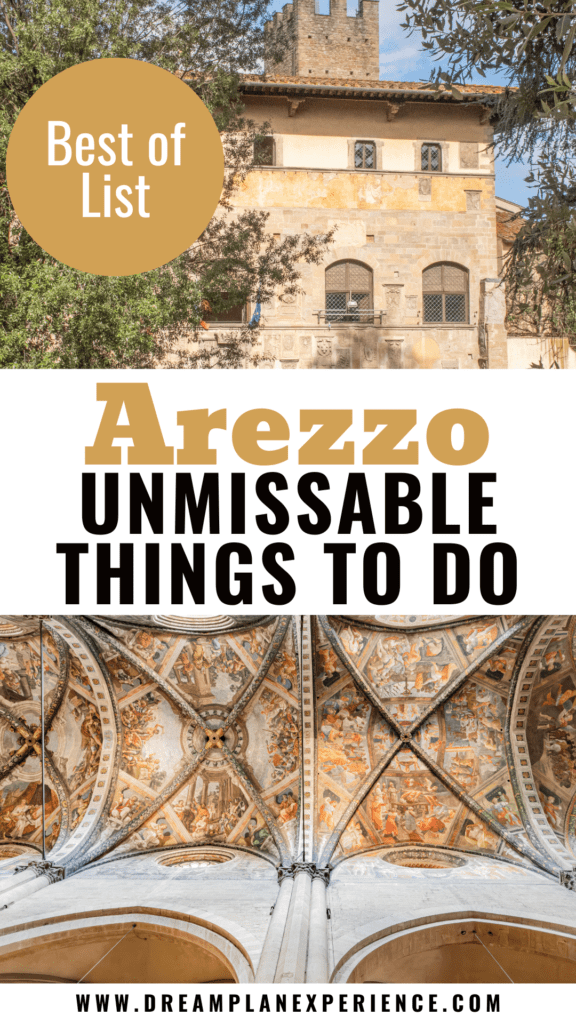
Arezzo is one of those Tuscan towns that quietly rewards you—if you know how to experience it.
If you’re searching for the best things to do in Arezzo, you’ll find the expected highlights: Piazza Grande, Renaissance frescoes, and medieval churches. But what makes this town different isn’t just what you see—it’s how it feels to move through it.
I’ve visited this town twice, once over a decade ago, and on a recent return visit, I spent two nights here, long enough to settle into its pace. Mornings were quiet, almost empty. By late afternoon, the streets softened into quiet evenings.
I’ll walk you through the best things to see in Arezzo—structured as a natural walking route through the city, with the small details most lists miss.
This post may contain affiliate links, meaning I get a commission if you decide to purchase something through the links, at no additional cost to you. Read my Affiliate Disclosure.
Why Visit Arezzo (And Who It’s Really For)

Arezzo isn’t the prettiest town in Tuscany—and that’s exactly why it’s worth visiting.
What surprised me most is how unchanged it feels. I first came here over a decade ago, and when I returned, it was almost exactly the same. That’s rare in Tuscany. Places like Siena, or Montepulciano, and Pienza have only grown busier, more shaped by tourism. Arezzo hasn’t.
It feels lived-in.
In the early morning, it’s quiet—almost empty. By mid-day, yes, day-trippers arrive. But even then, it never feels compressed the way Cortona or Pienza can, where narrow streets funnel people into tight spaces. Arezzo breathes. The streets are wider. It feels like a real town, not a curated one.
That said, Arezzo isn’t for everyone.
If you’re dreaming of a postcard-perfect hill town, go to Pienza or Cortona. If your trip revolves around wine tastings and vineyard views, Montepulciano will suit you better. And if it’s your first time in Tuscany with limited time, some places will feel more immediately “wow.”
But Arezzo is for the traveller who wants something else.

Arezzo is for the traveller who wants to experience a Tuscan town as it is lived in—where the beauty reveals itself slowly, and where some of Italy’s greatest frescoes are found inside quiet churches, not crowded museums.
A Quick Look: Best Things to Do in Arezzo

| Place | A quiet, grand space with stained glass and frescoes, set slightly above the city, with a peaceful atmosphere |
|---|---|
| Piazza Grande | The heart of Arezzo, known for its sloped square, medieval architecture, and local events like the antiques fair on the first Sunday of the month and Buratto del Saracino, the famous medieval jostling tournament |
| Basilica di San Francesco | Home to Piero della Francesca’s Legend of the True Cross—one of Italy’s most important fresco cycles |
| Arezzo Cathedral (Duomo) | A quiet, grand space with stained glass and frescoes, set slightly above the city with a peaceful atmosphere |
| Medici Fortress | Best panoramic views over the Tuscan countryside, especially in the late afternoon light |
| Casa Vasari | A rare look inside a Renaissance artist’s home, with richly painted interiors |
| Corso Italia | The main street for wandering, shopping, and observing everyday local life |
| Roman Amphitheatre | A quieter, off-the-path site that reveals Arezzo’s Roman past without the crowds |
How to Experience Arezzo in One Day (My Walking Route)

The best way to experience Arezzo isn’t by ticking off sights—it’s by moving through it slowly, on foot, letting the day unfold.
Start Your Morning in Piazza Grande

I started my morning in Piazza Grande, just steps from where I stayed in Arezzo. Early, it’s quiet in a way that feels almost suspended in time.
I stood in the centre and slowly twirled around, admiring all the building facades. I remember being impressed when I first saw it, and a decade later, I still am. My gaze steadies on the districts’ plaques affixed to the wall, identified by specific colours and emblems.
Off in the corner of this main square, you will find the Life is Beautiful map, the Oscar-winning movie directed by Roberto Benigni, where you can find the exact locations of the film throughout Arezzo.
From there, take Via dei Pileati—a peaceful stretch lined with stone walls, sculptures, and tall trees. It’s an unexpected transition, away from the square and into something softer.
Continue into Passeggio del Prato, where shaded paths lead you toward the Medici Fortress. The views aren’t as dramatic as Pienza or Cortona, but they don’t need to be.
Time your visit for the top of the hour—the church bells echo across the city from the nearby cathedral, a moment that stays with me.
Late Morning: The Cathedral and Nearby Stops

From here, step into Arezzo Cathedral. It’s calm, spacious, and often quiet despite many people visiting here.
Around this area, you’ll find several sites—Casa Vasari, Palazzo Pretorio, Petrarch’s House, San Domenico—but this is where slow travel matters. You don’t need to see everything. Choose what interests you the most.
I wandered past Casa Varsari and Pretorio Palace to admire its exteriors, paused in the courtyard of Petrarch’s House, which I remember being fond of on my first visit to Arezzo, and stepped briefly into San Domenico. That was enough.
Midday: Corso Italia and Getting Lost

Make your way down to Corso Italia, the city’s main artery. It’s wider, busier, more commercial—but this is where you begin to understand and see evidence of daily life.
Just off it, the streets narrow again.
Zigzag between Corso Italia and Via Andrea Cesalpino, dipping in and out of the smaller lanes. This is where the character of Arezzo reveals itself.
For a break, I sat at Borgo San Piero for tea and a croissant. The owner was warm and curious, the kind of exchange that reminds you you’re not just passing through.
Stop at Santa Maria della Pieve—it was nearly empty when I visited, a quiet moment of stillness. The back of the nave sits on Piazza Grande, and I think most people walk right by thinking it’s just another church.
Afternoon: Long Lunch and Wandering

Lunch is best found off the main streets.
I ended up at Antica Osteria l’Agania, with Trattoria Il Saraceno just next door—both tucked into side streets you’d miss if you stayed on Corso. This is the pattern in Arezzo: step away, and it gets better.
The afternoon is for wandering. No plan.
Follow the streets, pause for a gelato, lean against a wall, and watch the city move around you.
I spent time inside Arti\giá\nato, speaking with a local artisan, Domenica Festa, whose family has been making shoes for decades. These are the moments you don’t plan—and the ones you remember.
Optional: End at the Roman Amphitheatre
If you want to extend your walk, head toward the Roman Amphitheatre near the train station. That’s if you are curious about ancient Roman history, or want to compare it to other Roman amphitheatres like the Colosseum in Rome or Verona’s theatre.
That’s a full day in Arezzo. Not rushed. Not overfilled. Just enough to feel like you were there.
Tips for Experiencing Arezzo Well

Arezzo isn’t a place you rush. It reveals itself in how you move through it.
Don’t try to see everything. You don’t need to. The real experience of Arezzo happens in the space between the sights.
Step off Corso Italia often. It’s the main artery, but the quieter streets just beside it are where the city feels more personal, more local. That’s where you’ll find the places worth lingering.
Prioritize your mornings and late afternoons. Early, the city feels almost empty. By evening, it softens again. The middle of the day is different—busier, warmer, a little louder.

Let that be your pause.
Take your time over lunch. Sit longer than you planned. This is part of the ritual here, not a break from it.
Choose what interests you most, and let that guide your time. Some places you’ll walk past. Others you’ll stay longer than expected. That’s the balance.
If this isn’t your first visit, return to something familiar. See it at a different time of day. Notice what’s changed—and what hasn’t.
That’s where Arezzo becomes more than a place you visited.
My Final Take on What Makes Arezzo Different
Arezzo might seem a bit underwhelming at first.
It doesn’t compete for your attention the way other Tuscan towns do. But that’s the point.
Arezzo feels like everyday life in Italy. Not quieter—just more subtle. The kind of place where nothing is trying too hard, and because of that, you notice more.
It’s a town you settle into, even if only for a day, with these things to see.
If this is your kind of travel—slower, more intentional—you’ll understand it.
And if you want more of this kind of Europe, I share it quietly through my curated weekly newsletter.