

If you’re searching for how to take the Chunnel train from Paris to London, you’ll quickly notice something frustrating: most guides either repeat the same surface-level facts or contradict each other entirely.
That was exactly my experience when I was planning my own trip. I had taken plenty of trains around Europe for nearly thirty years and yet this one felt different and oddly under-explained.
I took the train from Paris to London and then returned the same way, and what surprised me most wasn’t the tunnel itself, but the process around it. Border controls, timing, station flow- none of it worked the way I expected based on what I’d read online.
This article exists because I couldn’t find a clear, first-hand walkthrough when I needed one. The train people call the chunnel from Paris to London is Eurostar. It runs from Gare du Nord to St Pancras in about 2 hours 17 minutes. What follows is a practical, step-by-step guide based on my real experience.
This post may contain affiliate links, meaning I get a commission if you decide to purchase something through the links, at no additional cost to you. Read my Affiliate Disclosure.
Chunnel vs Eurostar: What You’re Actually Booking
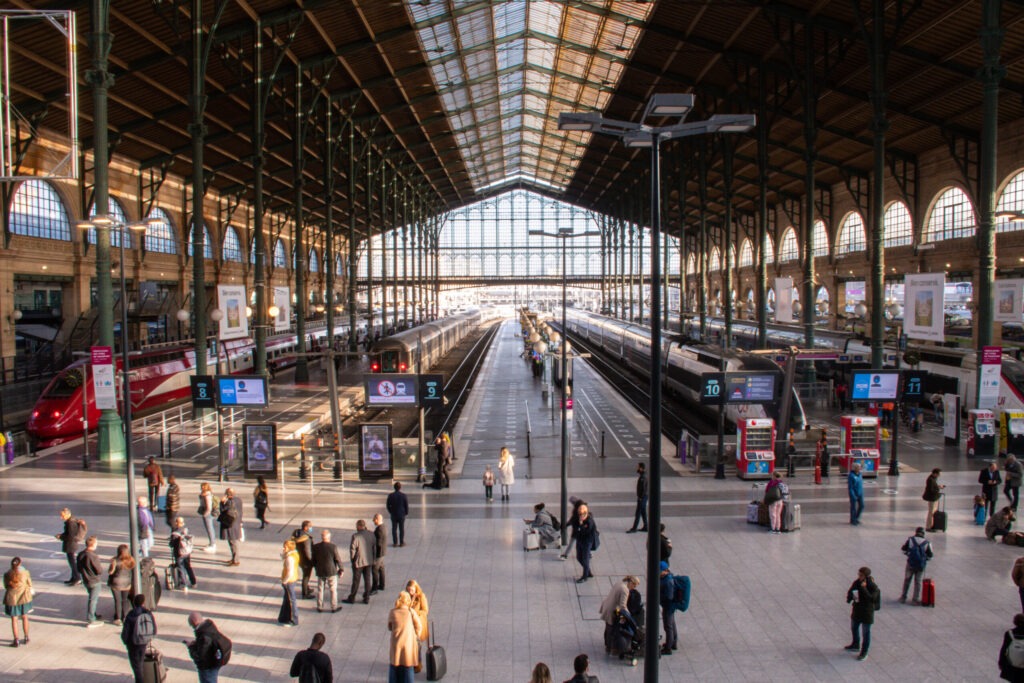
One thing that confused me when planning this trip was the term “Chunnel train.” It’s commonly used online, but there isn’t actually a train called the Chunnel.
The Channel Tunnel, often called the Chunnel, is the tunnel beneath the English Channel. Eurostar is the passenger train that travels through it between Paris and London.
So, when you’re looking for tickets, schedules or fares, search for Eurostar Paris to London rather than a Chunnel train. Eurostar is the direct passenger train between the two cities through the Channel Tunnel.
Travel Documents You Need for Eurostar From Paris to London
Travelling from Paris to London means crossing from France into the UK, so there are a few requirements to take care of before you board. The names can be confusing, but API, ETA and EES are three different things.
Advance Passenger Information (API)
Before travelling to or from the UK on Eurostar, you need to provide Advance Passenger Information (API). This includes details from your passport, such as your name, nationality, passport number and expiry date.
You can add it through your Eurostar booking or the Eurostar app. I would do this as soon as your trip is booked rather than leaving it until departure day. Your Eurostar ticket won’t be released until the required API has been completed.
UK Electronic Travel Authorization (ETA)
Depending on your nationality, you may also need an Electronic Travel Authorization (ETA) to enter the UK. Many travellers who can visit the UK without a visa, including Canadians and Americans, now need an ETA for a short visit.
This is something you need to arrange before travelling. If you normally require a UK visa, different rules apply, so check the requirements for your nationality rather than assuming an ETA is enough.
Entry/Exit System (EES)
The Entry/Exit System (EES) is different again. It is an EU border system for many non-EU nationals travelling into or out of the Schengen Area and is handled as part of border control.
When travelling from Paris to London, applicable passengers may have additional EES checks as they leave France, including registering biometric information such as a facial image or fingerprints. You don’t need to apply for EES before your trip. Any required steps are handled as part of the border process at the station.
If you are returning from London back to Paris as I did, you will be required to go through the EES border control procedures. And since it’s launch in spring 2026 this has not been a smooth process. Allow extra time.
This is another reason I wouldn’t treat the Paris to London Eurostar like an ordinary European train and arrive shortly before departure.
Travel and border requirements can change, so check Eurostar and the official UK entry requirements for your nationality before your trip.
Step-by-Step: How to Take the Chunnel Train From Paris to London
This is the part I wish I’d found when I was planning my own trip. The Chunnel train from London to Paris does not work like most European train journeys, and knowing the steps in advance makes the experience calm and predictable instead of stressful.
Step 1: Go to the Right Station — Gare du Nord

All Eurostar trains from Paris to London depart from Gare du Nord in the 10th arrondissement.
A few things I learned quickly:
- Eurostar has its own clearly marked area inside the station, separate from domestic and regional trains.
- Departures are in Hall 2, on the first-floor balcony overlooking the main concourse, reached by the escalators opposite platform 17 or lifts opposite platforms 9 and 10. All you need to do is follow the UK flag signs.
- I found it helpful to arrive earlier than I normally would for a European train, simply to orient myself without rushing, but you also need this for the extra check-in process explained below.
Once you spot the Eurostar signs, the process becomes easier.
Step 2: Ticket Gates, Passport Control and Security
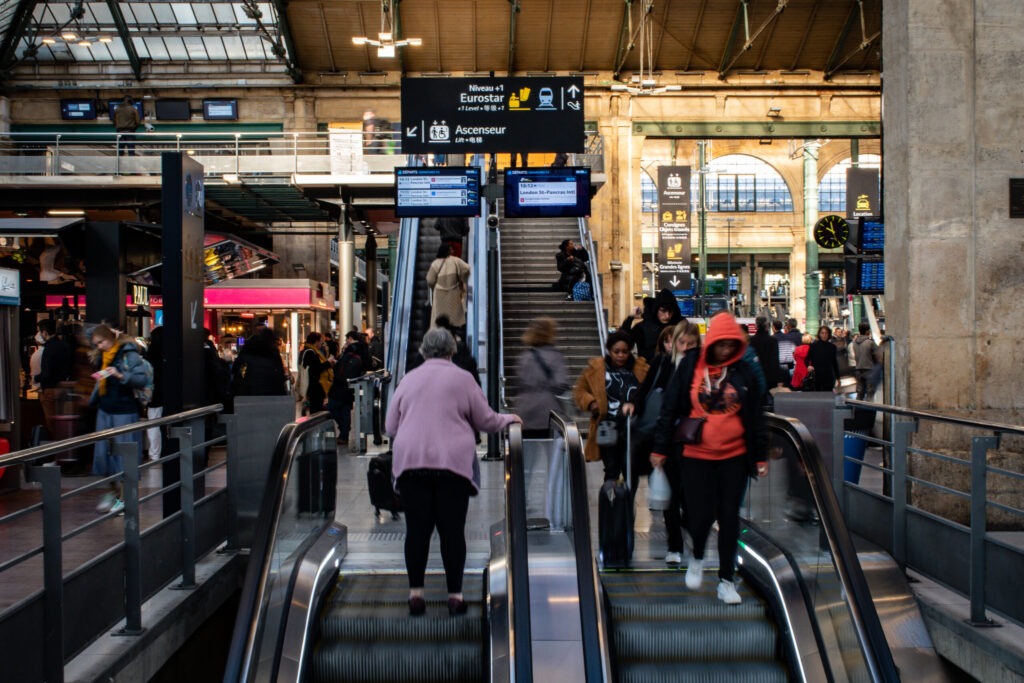
Unlike most Europe-to-Europe train trips, you must go through security screening by first clearing exit control for France, and then clearing the UK border control. That means passports are checked first by French authorities and then by UK Border Force before security.
All of this happens before boarding, which is because the United Kingdom is not a Schengen zone country
In practice, it felt closer to an airport process. Eurostar customs and security are organized by departure time, and the lines usually open around two hours before departure. I found the process a bit frantic at first, but as long as you’re in the queue for your scheduled train, you’ll make it through in time.
What helped me most was understanding that:
- You cannot just arrive five minutes before departure; you are expected to check in at least 45 minutes before the scheduled departure time.
- The process looks chaotic, but if you’re queued for your scheduled train, the system works, and you’ll get through on time.
- Flag Eurostar staff if you feel you might miss your connection; I did hear and see other travellers be reassured they will make it or pulled from the queue and put into a priority line.
- Once you’re through passport control, there’s no coming and going.
Step 3: Waiting to Board (More Structured Than I Expected)
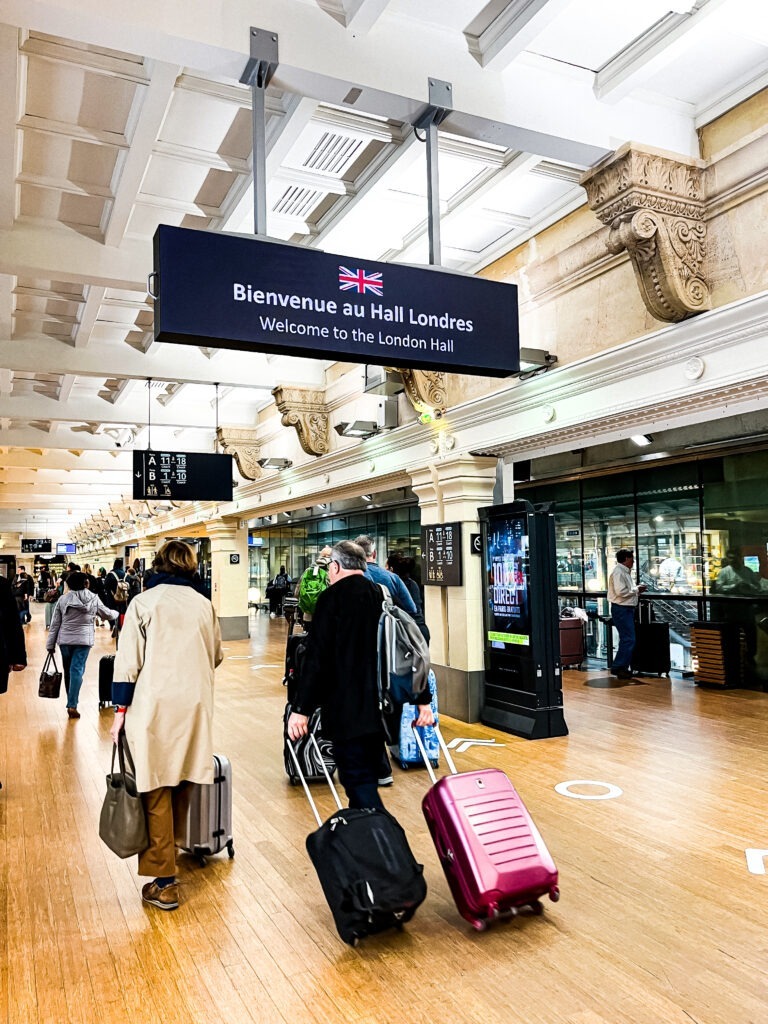
After clearing border control, you wait in a secure departure area until the gates open, usually 20 minutes before departure time.
What stood out to me:
- Seating is limited, but turnover is steady
- Boarding announcements are clear and easy to follow
- Just like what you’d expect to find at an airport, there are duty-free shops and restaurants
Step 4: Boarding the Train (Assigned Seats, No Scramble)

Boarding the Chunnel train is pretty straightforward.
- Seats are assigned, so there’s no rush
- You board by car number, then seat number
- Luggage goes:
- On racks at the end of the carriage
- Or above your seat for smaller bags
What surprised me most was how un-flying-like this felt. No fighting for bin space. No last-minute stress.
Step 5: The Channel Tunnel Crossing (Brief and Uneventful)
Once the train is moving:
- The journey is only 2 hours and 17 minutes (up to 2 hours and 37 minutes)
- Display monitors show the train’s location, estimated arrival time and speed
- The highest speed was very close to 300 km per hour
- The tunnel portion is short; it’s only about 50 km long and lasts about 22 minutes
- There’s no announcement when you enter or exit the tunnel portion; it’s just dark out your window. If you weren’t watching, you might miss it entirely
- The train’s speed drops to 160 km per hour
Step 6: Arriving in London at St Pancras International
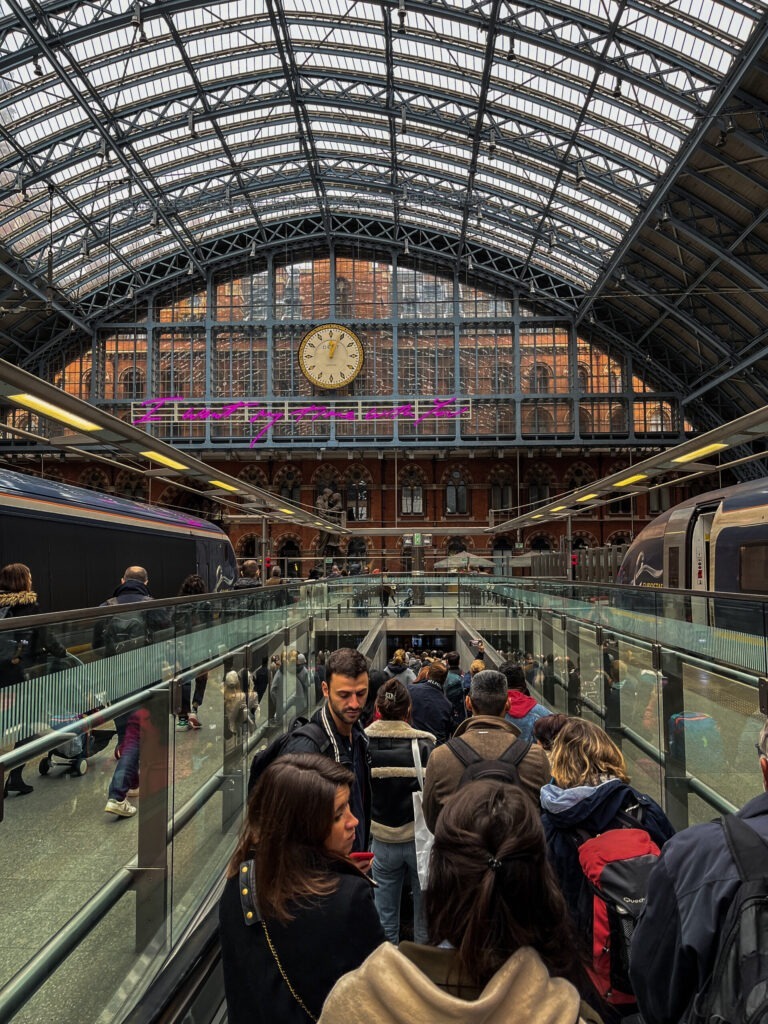
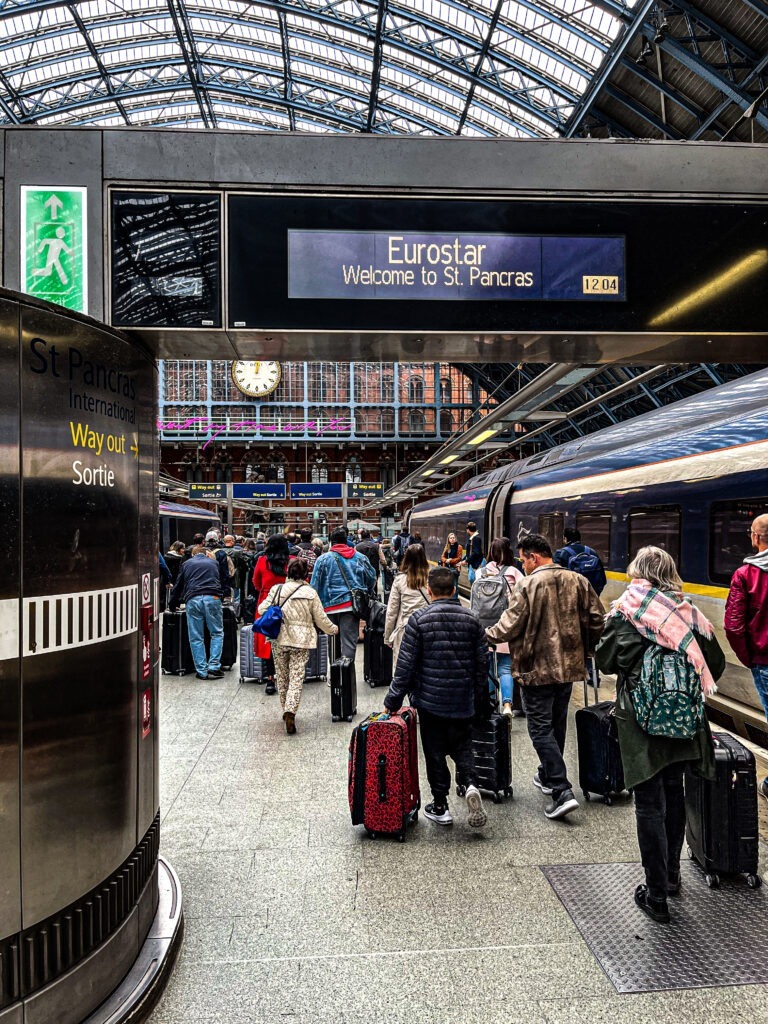
This is one of the best parts of the journey, as you arrive directly at St Pancras International, in central London and there’s no passport control on arrival because it’s already done. You step off the train, and you’re there. One thing to remember: Paris is one hour ahead of London, so the scheduled arrival time can make the train appear shorter than its actual elapsed journey.
From here:
- The Underground (or The Tube) is downstairs. There were long lines at the ticket kiosk stations, but the lines move fairly quickly. Thanks to the kind stranger who gifted me their 24-hour day pass
- What surprised me the most as I mentally compared Paris and London was that a metro ticket in London is almost triple the cost of Paris
- Taxis are easy to find to take you straight to your London hotel
St Pancras felt immediately alive; there was live music, people moving in every direction, and an energy that contrasted sharply with the quieter, more reserved feel of Paris, but I was excited to explore all of London’s greatest landmarks.
How Far in Advance Should You Book the Chunnel Train?
This was one of the questions I struggled to get a straight answer to when I was planning my trip. The advice online ranged from “book months ahead” to “just grab it a few days before”, which isn’t very helpful when you’re trying to plan your trip.
What I can confirm is that Eurostar prices are demand-based.
The earlier you book, the more choice you’ll have in both price and departure times. As trains begin to fill, prices rise and sometimes noticeably.
This rule applies to any train booking in Europe. The earlier you book, the more you save.
What I’ve learned:
- Even though Eurostar says tickets to or from London can generally be booked 10–11 months in advance, through release windows, my experience was that it was about 180 days that I could book my ticket. Black dates are available to book; grey dates are not.
- If you know your travel date, booking several weeks ahead is usually enough to secure a reasonable fare.
- There are multiple departures throughout the day (about 10), but frequency and departure times vary.
- Prices tend to climb for:
- Fridays and Sundays
- Summer months
- School holidays and long weekends
- Last-minute tickets do exist, but they’re often more expensive and leave little flexibility.
Tip: Don’t be surprised that Eurostar requires an account to book tickets. Creating one is quick and keeps all your travel details in one place.
Why the Train Is Faster Than Flying (Even When It Looks Slower)

At first glance, flying might seem quicker as the flight itself is only about 1 hour 15 minutes. But when I compared the full journey, the Eurostar actually won in convenience and overall travel time. Here’s why:
- No airport transfers: Gare du Nord and St Pancras are centrally located. You step off the train in the heart of London without an extra 45–60 minute ride from the airport.
- Streamlined check-in: I found Eurostar security and passport control much faster and less stressful than airport lines, even during busy periods.
- No luggage hassle: You can keep your bags with you, without waiting at a carousel.
In my experience, the train feels not just faster, but more civilized and predictable, perfect if you value calm, slow-travel planning over airport chaos.
Another bonus: train travel allows up to two pieces of luggage and no restrictions on liquids. A benefit that comes at a cost when flying.
Is the Paris to London Eurostar Worth It?
I would take the Eurostar from Paris to London again. I liked the novelty of travelling under the English Channel, although you barely notice it. But for me, I really do love train travel through Europe.
The bigger advantage is what it does to your itinerary. Travelling between two major cities can easily consume most of a day, but this route makes Paris and London surprisingly easy to combine in the same trip without making the travel day feel like a write-off.
And if you’re trying to work Paris, London or several European destinations into one trip, this is exactly the kind of decision I help my clients with. My personalized trip planning focuses on choosing the right route, deciding how much time to spend in each place and building an itinerary that doesn’t feel rushed.