

One day in Avignon is enough to see its famous landmarks and explore some of its streets, as long as you’re selective about what you visit.
I’ve been to Avignon twice, during two separate week-long trips to Provence. Returning gave me a better sense of what’s worth prioritizing, from the important must-sees like Palais des Papes and Pont Saint-Bénézet to just wandering some of its streets.
Based on both visits, I’ve put together a 1-day Avignon itinerary that balances the main sights with time to enjoy the city. I’ll share how to plan your day, what I recommend seeing and what you can skip when time is limited.
This post may contain affiliate links, meaning I get a commission if you decide to purchase something through the links, at no additional cost to you. Read my Affiliate Disclosure.
Morning in Avignon: Historic Landmarks and What to Prioritize

The area around the Palais des Papes has enough historic sites, churches, museums and viewpoints to fill an entire day. With only one morning, you’ll need to be selective.
I’d start with Avignon’s two most famous landmarks, Pont Saint-Bénézet and Palais des Papes, before choosing which nearby attractions interest you most.
The biggest decision is whether to tour the inside of the Palais des Papes. Allowing up to two hours for the palace means having less time for the cathedral, gardens and smaller historic sites nearby.
My advice is to choose one or two additional places rather than trying to see everything. They’re all within a short walk of each other, making it easy to adjust your morning based on your interests.
Pont Saint-Bénézet: Walk Across or Admire It from the River?

Better known as the Pont d’Avignon, this famous bridge stretches partway across the Rhône River. Built in the 12th century, it once connected Avignon with Villeneuve-lès-Avignon. Repeated flooding left only four of its original 22 arches standing.
Growing up in Canada, I learned the French song Sur le Pont d’Avignon in school, so seeing the actual bridge was a memorable moment for me.
I recommend starting here in the morning, when the light creates beautiful reflections on the Rhône. It’s also a good opportunity to photograph the bridge with Avignon’s medieval walls in the background.
Is it worth paying to walk onto the bridge? That depends on your interests. If you enjoy history, you can purchase a ticket to explore the remaining arches and learn more about its past.
Otherwise, I think the views from the riverfront are enough to appreciate this famous landmark. You can enjoy the scenery, take your photographs and save more time for the Palais des Papes.
How much time to allow: Around 15–20 minutes for exterior views, or longer if you choose to visit the bridge itself.
Palais des Papes: Is It Worth Going Inside?

From the bridge, make your way to the Palais des Papes, Avignon’s most famous landmark and one of the largest Gothic palaces in Europe.
During the 14th century, Avignon was the centre of the Catholic Church, and the palace served as the residence of the popes. Its fortress-like appearance, massive stone walls and imposing towers are reminders of the power and influence the papacy held here.
We chose to explore the palace independently rather than take a guided tour. Inside, you’ll find vast halls, chapels, courtyards and chambers. Many rooms are surprisingly bare, with little of their original decoration remaining, so don’t expect the interiors to look like they once did.
What impressed me most was the sheer scale of the place. My husband was particularly fascinated by the three-metre-thick walls, enormous doors and fortress-like construction. There’s a lot to take in.
Is it worth going inside? I would recommend it if you enjoy history and architecture. Allow around 1.5 to 2 hours to explore at a non-rushed pace. It’s one of Avignon’s most significant historical sites, and visiting the interior gives you a better understanding of its importance.
However, if medieval history isn’t a particular interest, you can still appreciate the palace’s impressive exterior from Place du Palais without purchasing a ticket.
My advice: This is the biggest time commitment of your morning. If you decide to tour the palace, choose just one or two of the nearby attractions that follow. If you skip the interior, you’ll have more time to explore the cathedral, museums and quieter corners surrounding it.
What Else to See Near the Palais des Papes

One of the advantages of visiting Avignon is how many historic sites are within a short walk of the Palais des Papes. But with only one morning, you’ll need to make some choices.
If you’ve spent two hours touring the palace, I’d recommend choosing one or two of the following places based on your interests rather than trying to see them all.
- Notre-Dame des Doms Cathedral: Right beside the palace, this 12th-century cathedral is worth a short visit if you enjoy historic churches. Look for the gilded statue of the Virgin Mary above the bell tower.
- Rocher des Doms: For some of the best views in Avignon, head up to this hilltop garden overlooking the Rhône River, Pont Saint-Bénézet and Villeneuve-lès-Avignon. It’s a good choice if you’d rather spend time outdoors. Parts of the garden have been undergoing restoration, so check access before visiting.
- Musée du Petit Palais: Located at the northern end of Place du Palais, this museum houses an impressive collection of medieval and Renaissance paintings, particularly Italian works. Admission to the permanent collection is free. I’d recommend it for art lovers, but it could easily take up the remainder of your morning.
- Chapelle des Pénitents Noirs: This small Baroque chapel on Rue Banasterie is another option if you enjoy religious architecture. Interior visiting hours are limited, typically to Friday and Saturday afternoons, so it’s more likely to be an exterior stop on a morning walk.
- Verger Urbain V: Tucked behind the Palais des Papes, this public garden was once part of the papal gardens. Today, it’s a quiet place with benches, greenery and views of the palace walls. A lovely option if you want a short break from sightseeing.
- Place de l’Amirande: Walk along Rue Peyrolerie to reach this small square, where you’ll find the elegant La Mirande hotel facing the historic Saint-Laurent tower. It’s worth passing through for the architecture and doesn’t require much additional time.
- Place de l’Horloge: Avignon’s main square is surrounded by cafés, the 19th-century opera house and the historic town hall with its clock tower. It’s a natural place to pass through as you make your way toward the Old Town.
My recommendation: If you’re visiting the Palais des Papes, I’d choose Notre-Dame des Doms and Rocher des Doms as two nearby stops, then continue through Place de l’Amirande toward the Old Town. If medieval art is a particular interest, consider the Musée du Petit Palais instead.
And if you’ve decided to skip the palace interior altogether, you’ll have more time to visit several of these places before lunch.
Lunch in Avignon: A Relaxed Meal at Place des Corps Saints
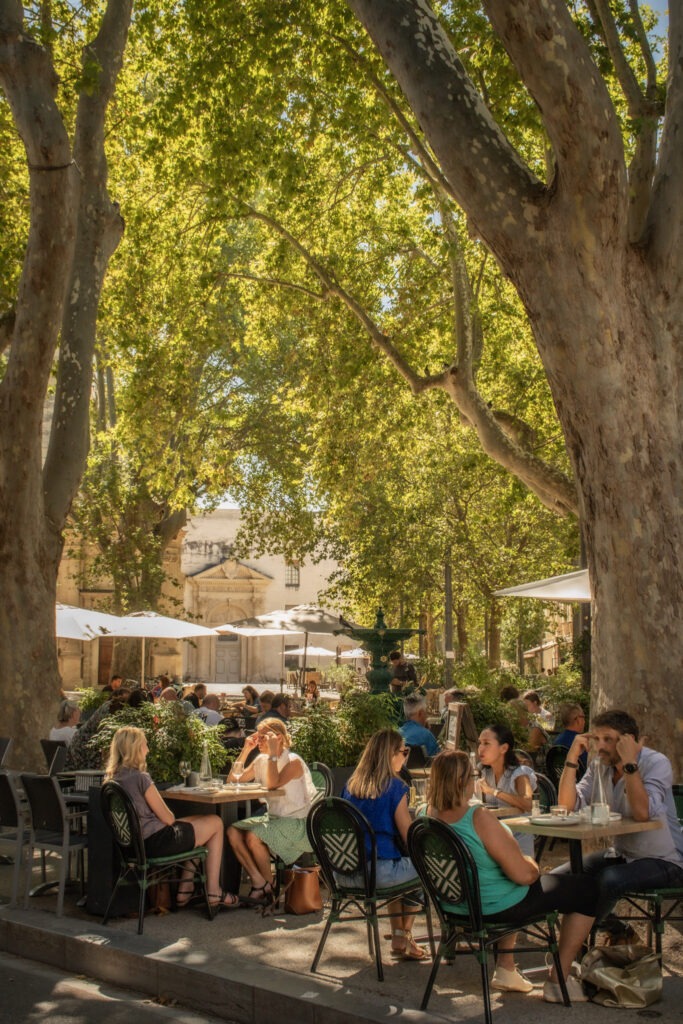
Most guides to Avignon will recommend lunch at Les Halles, the city’s covered market. It’s a good option if you want to browse local produce or grab something quick to eat. But I have a better recommendation if you’d prefer to sit down and enjoy a leisurely lunch. You are in Provence after all, and that’s the best way to soak up the atmosphere.
Head to Place des Corps Saints, a lovely square where restaurant terraces spread out around the central fountain. It’s the kind of place where you’ll want to linger rather than rush through a meal.
On one of my visits, I had hoped to dine at L’Atelier de Bélinda, but it was fully booked. Instead, we ate at Le St Pierre, right beside it, with tables set out in the same square around the fountain.
Would I recommend it? I honestly couldn’t tell you what I ate or even whether the food was particularly good. But I do remember the setting. Sitting in the middle of the square, listening to the fountain, looking out at the old buildings with their classic shutters, and the soft Provençal light filtering through the large chestnut trees overhead. That’s what stayed with me, and it’s why I’d recommend lunch here.
For me, this is a much nicer way to break up a day of sightseeing. Enjoy a proper lunch, take in the atmosphere and give yourself some time before heading off to explore more of the Old Town.
My tip: If you have your heart set on L’Atelier de Bélinda, reserve a table in advance. Otherwise, there are other restaurants around the square to choose from. I’d allow at least an hour and a half for lunch, preferably a little longer.
Afternoon in Avignon: Wander Through the Old Town
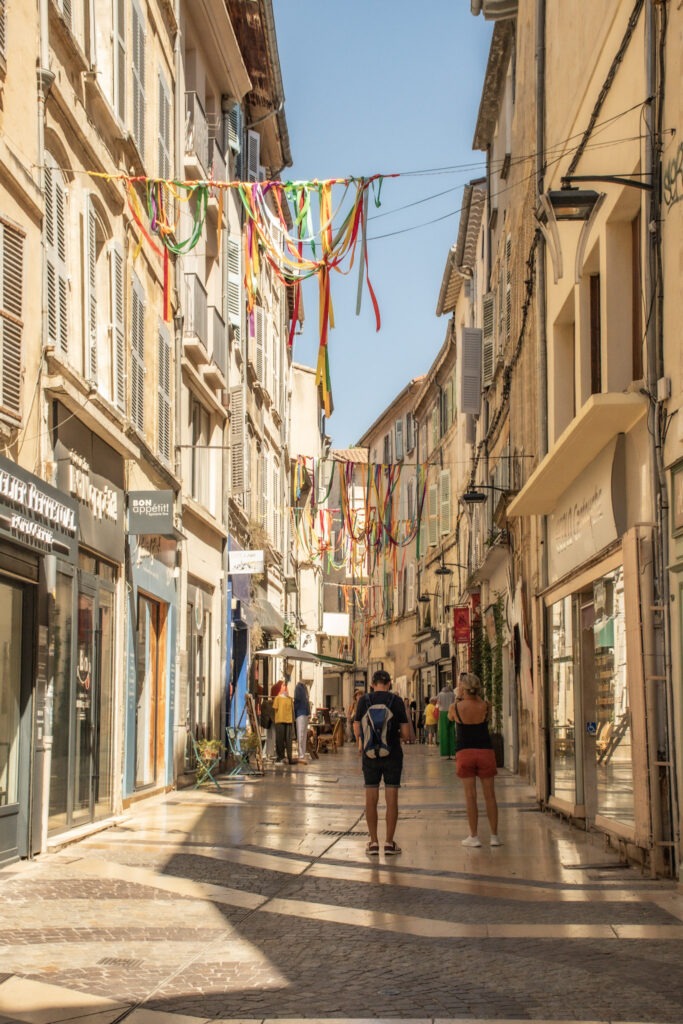
After lunch, I’d leave the afternoon open for exploring Avignon’s Old Town. This is where I’d slow down, wander the smaller streets, browse shops and see what catches my attention.
One of the things I love about Avignon is its architecture. The pale stone buildings, colourful shutters, hidden courtyards and small squares make it a lovely city to explore on foot.
Rather than follow a strict route, I recommend choosing a few streets or places that interest you. You can easily spend the entire afternoon wandering, but I’ve included a couple of worthwhile stops if you’d prefer something more structured.
My Favourite Streets to Explore in Avignon
From Place des Corps Saints, you can wander toward Rue des Trois Faucons, Rue des Fourbisseurs and Rue de la Bonneterie. These are good streets to explore if you enjoy independent shops, local artisans and smaller boutiques.
Rue des Fourbisseurs is particularly worth visiting for its artisan shops and galleries. Historically, this was a street where craftsmen polished weapons and worked with leather. Today, you’ll find local makers selling ceramics, jewellery and other handmade goods.
Rue de la Bonneterie is another interesting shopping street, known for its independent designers and creative boutiques. Both streets are good alternatives to Avignon’s larger shopping thoroughfares.
I wouldn’t worry about walking the entire length of every street. Take whichever side streets appeal to you, stop somewhere for a coffee or browse a shop that catches your eye.
Of all the streets I discovered in Avignon, Rue des Teinturiers remains one of my favourites. This tree-lined street follows a narrow canal fed by the Sorgue River. Historic stone buildings line one side, while old waterwheels sit along the water. It reminded me of what you’ll find in L’Isle-sur-la-Sorgue, just on a bigger scale.
The waterwheels were used in the textile industry, when the canal powered mills used in silk production and fabric printing. Four of the original wheels remain today, whereas far greater numbers can be found in L’Isle-sur-la-Sorgue.
Along the way, look for the Chapelle des Pénitents Gris, a small historic chapel with a beautifully decorated interior. Access can be limited, but it’s worth noticing as you walk past.
My recommendation: If you enjoy photography, historic streets or quieter corners of a city, I’d prioritize Rue des Teinturiers over spending more time in the main shopping areas. Allow around 20–30 minutes for a leisurely walk, or longer if you stop at a café.
Other Places to Visit if You Have Time

If you’d rather visit a museum or spend time in a garden, there are a couple of other places worth considering.
Musée Calvet: Located on Rue Joseph Vernet, this fine arts museum occupies an elegant 18th-century mansion. Its collections include paintings, sculptures and decorative arts, and admission to the permanent collection is free. I especially like visiting museums housed in historic buildings, as there’s often as much to appreciate about the architecture as the exhibits.
I’d choose this if art is a particular interest, but if you’ve already visited the Musée du Petit Palais in the morning, you probably won’t need another museum unless you have time to spare.
Rue Joseph Vernet is also worth exploring if you enjoy shopping, with a selection of fashion boutiques and independent stores.
Square Agricol Perdiguier: Near Rue de la République, this small public garden is an easy place to stop if you’re heading back toward Avignon Centre train station. It has shaded benches, Mediterranean plants and the remains of a Gothic cloister.
It’s not somewhere I’d go out of my way to visit, but it’s a pretty spot that won’t take you long to walk through, or if you want to take a break, especially after an afternoon of walking.
My advice: Don’t feel you need to fit all of these places into your afternoon. If you’ve spent most of your morning exploring the Palais des Papes and nearby landmarks, I’d choose Rue des Teinturiers and leave the rest of the afternoon for wandering. If museums or shopping interest you more, spend your time there instead.
Making the Most of Your One Day in Avignon
Having visited Avignon twice, one thing I’ve come to appreciate is that while the historic centre is compact and easy to walk, there’s more here than you can comfortably fit into one day. The landmarks may be close together, but it’s the time you spend exploring them, stopping for lunch or discovering an unexpected corner that makes the difference.
My advice is to leave a little room in your plans. Some of my favourite travel memories come from places I hadn’t intended to visit.
If you’re planning a trip through Provence and finding it difficult to decide where to go, how much time to spend in each place or how to connect it all, my custom Europe trip planning services can help you create an itinerary that suits your interests and preferred pace.


