

Is Pienza worth visiting?
I’m often asked this by travellers planning a Tuscany itinerary and wondering which hill towns truly deserve their time.
I’ve visited Pienza twice now. And each time, I understood its appeal more clearly.
Pienza is not a place of grand monuments or endless attractions. It’s a town designed to be felt.
Built during the Renaissance as an ideal city, it sits quietly above the Val d’Orcia. The views are expansive. The streets are charming. The atmosphere will make you smile.
For the right traveller, Pienza is absolutely worth visiting.
I’m here to help you decide.
This post may contain affiliate links, meaning I get a commission if you decide to purchase something through the links, at no additional cost to you. Read my Affiliate Disclosure.
Where Pienza Is — And Why Its Location Matters

Pienza sits high in the Val d’Orcia, in southern Tuscany, between Montepulciano and Montalcino. That position is everything.
From here, the landscape opens outward. Rolling hills. Cypress-lined roads. Long sightlines that slow you down without asking. Pienza doesn’t press in on itself the way many hilltop towns do. It looks out.
Its location also makes it easy to reach without feeling overrun. Most travellers pass through on a loop, often following wine routes. That creates an instant, worthy Tuscan itinerary.
If your itinerary is already full of larger towns—Siena, Montepulciano, Florence—Pienza offers contrast. It’s smaller in scale, but big in charm. A reset moment between bigger and busier stops.
For me, Pienza works best as a pause point for a couple of hours. A place to stop between your day. A place to look, stroll, enjoy a meal and recalibrate before moving on.

A Town Designed on Purpose — Pienza’s Renaissance Story

Pienza exists because one man had a vision.
Born nearby, Pope Pius II returned in the 15th century and decided to rebuild his hometown according to Renaissance ideals. This wasn’t an expansion. It was a reinvention. The goal was harmony. Proportion. Human scale.

The town was redesigned with intention. Streets aligned. Squares balanced. Buildings are placed to create order rather than spectacle. Nothing here is accidental, and nothing competes for attention.
You feel this as you walk. Pienza is easy on the senses. It doesn’t overwhelm you. It guides you gently, inviting you to leisurely stroll. That sense of calm is not incidental. It was planned.
Pienza earned its UNESCO status for this Renaissance urban planning, as it is considered one of the earliest and clearest expressions of how architecture, public space, and landscape can exist in balance.
Is Pienza Worth Visiting for the Experience, Not Just the Sights?

Pienza is just one of those towns that you feel it. Indescribable once you’re there. These are the reasons why I think it’s worth visiting.
The Atmosphere — How Pienza Actually Feels When You’re There

Pienza just feels good.
The romantic streets with names like Via dell’amore (street of love) and Via del Bacio (kiss street) are lovely to stroll. The pace is unforced. Even when people are present, the town never feels hurried or loud. Sound carries softly here. Footsteps. Voices. Wind moving through open space.
I notice this every time I arrive. My shoulders drop. My walking slows. Pienza doesn’t ask you to do much. It asks you to notice.
This is not a town built for main attractions. It’s built for enjoying Tuscan life.
The Views — Why They’re Among the Best in Tuscany

Pienza looks outward, not inward.
From the edges of town, the Val d’Orcia unfolds in every direction. Long curves of land. Light that changes constantly. No visual clutter. Just space.
What makes these views special is their accessibility. You don’t have to hike or search. You arrive at a simple stone wall or quiet path, and the landscape is already there.
I return to the same viewpoints each visit. Not to take photos, but to soak up the landscape. It’s exactly how you imagine it to be—gently rolling hills, patchwork farmland, and winding cypress-lined roads that create a postcard-perfect setting.
The region is full of vineyards, olive groves, wheat fields, and medieval hilltop towns perched strategically to offer stunning views.
Each season you visit, the view looks a little bit different. On my first visit in the spring, the landscape was vibrant and green. With autumn, it turns muted earth tones, which was my second visit. I’ve declared there is no wrong time to visit Pienza.
Why Slow Travellers Love Pienza
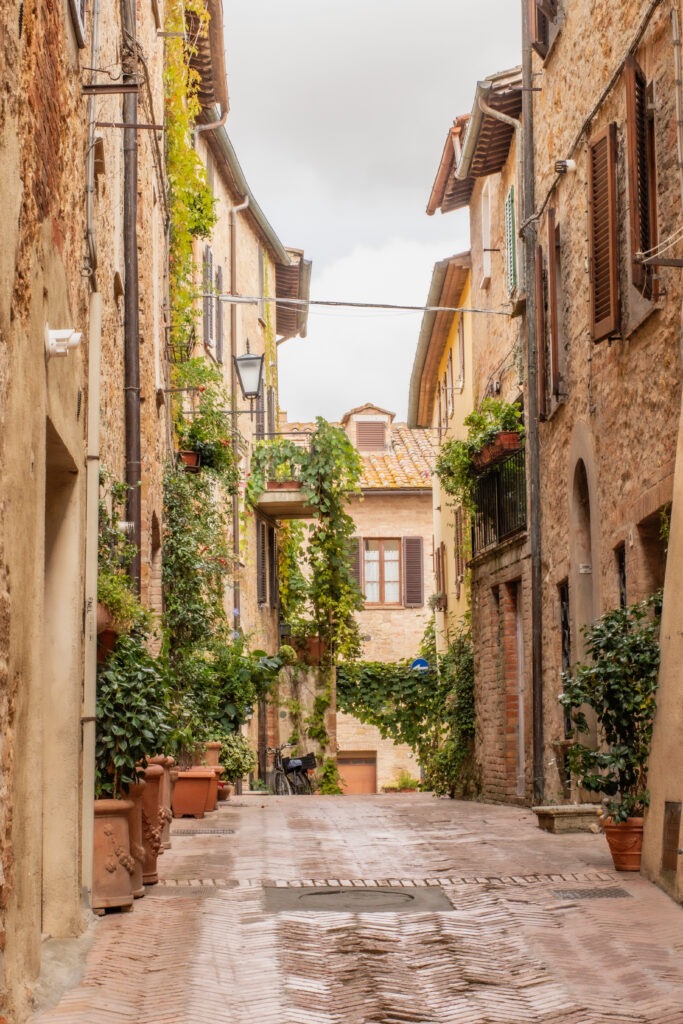
Pienza rewards restraint.
You don’t need a plan. You don’t need to optimize your time. The town reveals itself through small moments—an open window, a bench in the sun, a street that leads nowhere in particular.
For slow travellers, this is the appeal.
Pienza offers completeness without urgency. You can see it in a few hours, yet still feel satisfied staying longer.
No visit to Pienza is complete without tasting the famed Pecorino cheese, and you’ll find plenty of places to sample the creamy, tangy cheese. I highly recommend visiting a local cheese shop, such as La Bottega del Pecorino.

Don’t miss the famous Fiera del Cacio, also known as the Pecorino Cheese Festival, which takes place on the first Sunday in September every year.
How Pienza Compares to Other Tuscan Hill Towns

Pienza is often grouped with Tuscany’s hill towns, but it behaves differently.
| Town | How It Feels Compared to Pienza |
|---|---|
| Montepulciano | Vertical. Dramatic. Steeper streets and heavier architecture. It asks more of you physically and visually. Denser. More to see and do. Pienza is lighter. Less — in the best way. |
| Arezzo | Lived-in. Layered. Working streets shaped by daily life. Grounded and unscripted. Pienza feels more refined. More contained. Intentionally composed. |
| Cortona | Cinematic. Tight lanes. Big emotional pull. Often busy and compressed. Pienza offers similar beauty with more air around it. |
| Radda in Chianti | Inward-looking. Smaller footprint. Residential and restrained. Turns toward itself. Pienza opens outward to the landscape. |
| Siena | Grand. Historic. Intense. Commands attention with scale and significance. Pienza doesn’t compete. It invites quiet appreciation. |
If Tuscany’s bigger towns energize you, Pienza may feel understated. If they exhaust you, Pienza will be adored.
Reasons Pienza Might Not Be Your Favourite Tuscan Town

Pienza has changed.
When I first visited over a decade ago, it felt undiscovered. Quiet streets. Long pauses between people. A sense of having arrived somewhere still under the radar.
That is no longer the case.
The secret is out. Pienza now draws steady crowds, especially from late morning to mid-afternoon. Shops clearly cater to visitors. Cheese counters are busy. Viewpoints are shared.
If you dislike crowds, this matters. If you’re hoping for an untouched hill town, you may leave disappointed.
Pienza is also small. There’s limited nightlife. Limited variety. If you want layers, grit, or surprise, you may find it too polished.
Timing helps. Early mornings and evenings still offer calm. Visit midday, and you’ll realize Pienza is no longer a hidden gem. It’s a known one.
My Final Take — Who Pienza Is Truly For
Pienza is for travellers who notice.
Those who value proportion over drama. Atmosphere over activity. It’s for people who enjoy sitting longer than planned and walking without a destination.
I’ve returned because Pienza is one of my favourites. It doesn’t change much. It’s one of those places that I will return to again.
It’s a place to experience—slowly.
Planning an Italy trip and want it to feel balanced, not exhausting? I help travellers design itineraries that leave room to experience a place properly. You can also join my newsletter for travel reflections, planning tips, and destination insights.


