

When people search for things to do in Pienza, they’re often expecting a long list. I’ll be honest — that’s not what this town offers. And that’s exactly why I value it.
After decades of travelling through Italy and returning to Tuscany again and again, I’ve learned to recognize places that are designed to be consumed… and places that are meant to be experienced. Pienza falls into the second category. It’s small. Walkable in minutes. But what it lacks in volume, it makes up for in proportion, views, and atmosphere. So much so, I’ve returned here twice.
You don’t come to Pienza to rush between attractions. You come to wander slowly, taste pecorino at a local shop, stand along the walls overlooking the Val d’Orcia, and feel the history of a Renaissance town.
Here’s how I recommend spending your time.
This post may contain affiliate links, meaning I get a commission if you decide to purchase something through the links, at no additional cost to you. Read my Affiliate Disclosure.
First, Understand What Pienza Is (And Isn’t)

Before you decide which of the things to do in Pienza matter most, it helps to understand what this town actually is.
Pienza is small. You can cross the historic center in under ten minutes. It was designed in the 15th century as a Renaissance “ideal city,” built with symmetry and proportion in mind. Today, it sits within the Val d’Orcia UNESCO World Heritage landscape, and that context matters. Pienza was never meant to overwhelm. It was meant to feel balanced.
It is not a packed sightseeing town. There are no endless museums. No long attraction lists. No frantic energy.
And yet, it is absolutely worth visiting. Pienza is my favourite town in Tuscany. I first visited more than ten years ago, when it still felt quietly undiscovered. I returned recently and saw the difference. It’s more popular now. More photographed.
It doesn’t deter me.
Because what makes Pienza special is the feeling I get when I wander these streets. That’s what draws me back.
For the Architecture Lover
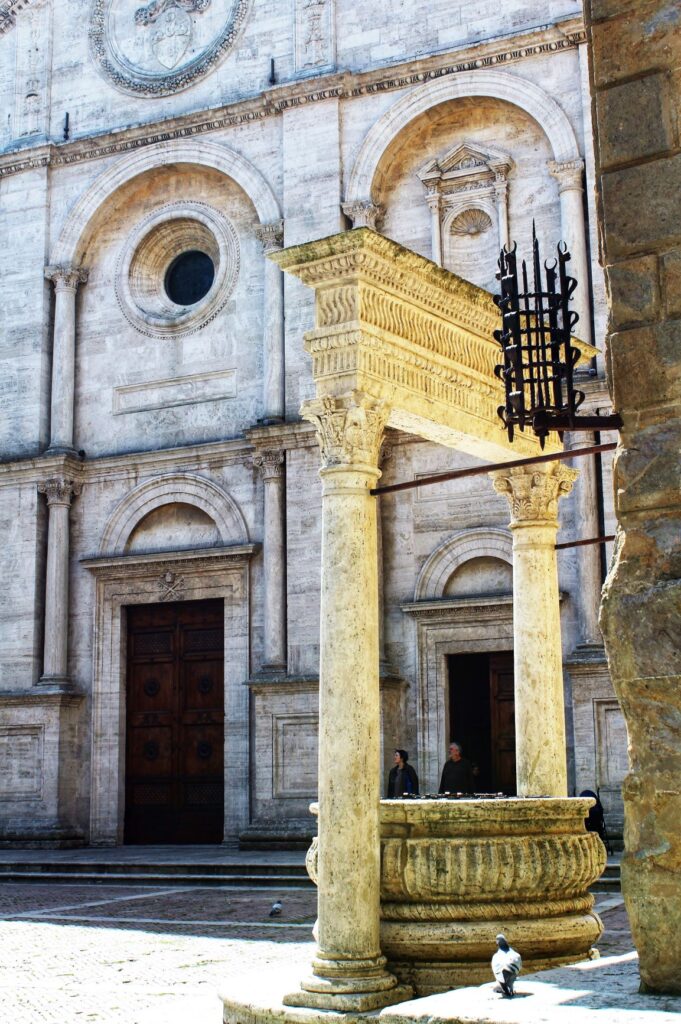
If you love proportion, symmetry, and thoughtful design, Pienza delivers in a way few Tuscan towns do. I don’t just walk through Piazza Pio II — I pause there. The entire square feels intentional. Balanced. Composed.
Designed in the 15th century under Pope Pius II, this square reflects his vision of an ideal city. Stand in the center and notice how everything aligns—the Duomo, the palazzi, even the well in front of Palazzo Piccolomini. This is the reason it was named one of Italy’s UNESCO World Heritage Sites.
Like any piazza in Italy, this is where locals gather. Conversations drift. Children kick around a football. What’s noticeably absent is the usual ring of al fresco dining dominating the main square. The tables are tucked away on side streets instead. I actually prefer it this way. It feels quieter. More personal. The loudest sound when I was there was the flutter of pigeons echoing off the stone.
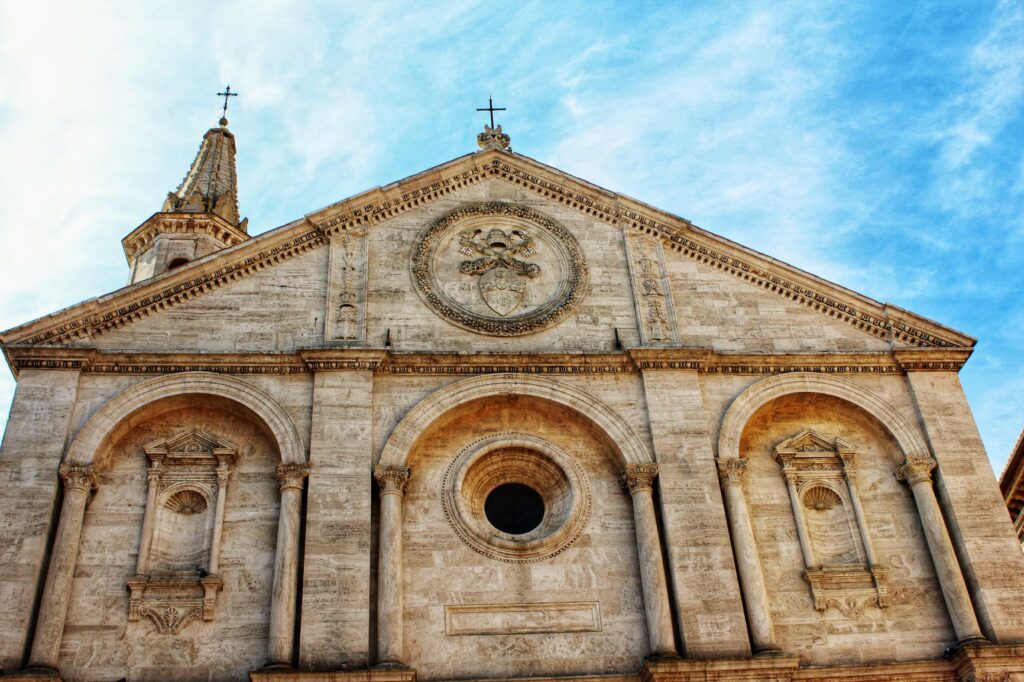
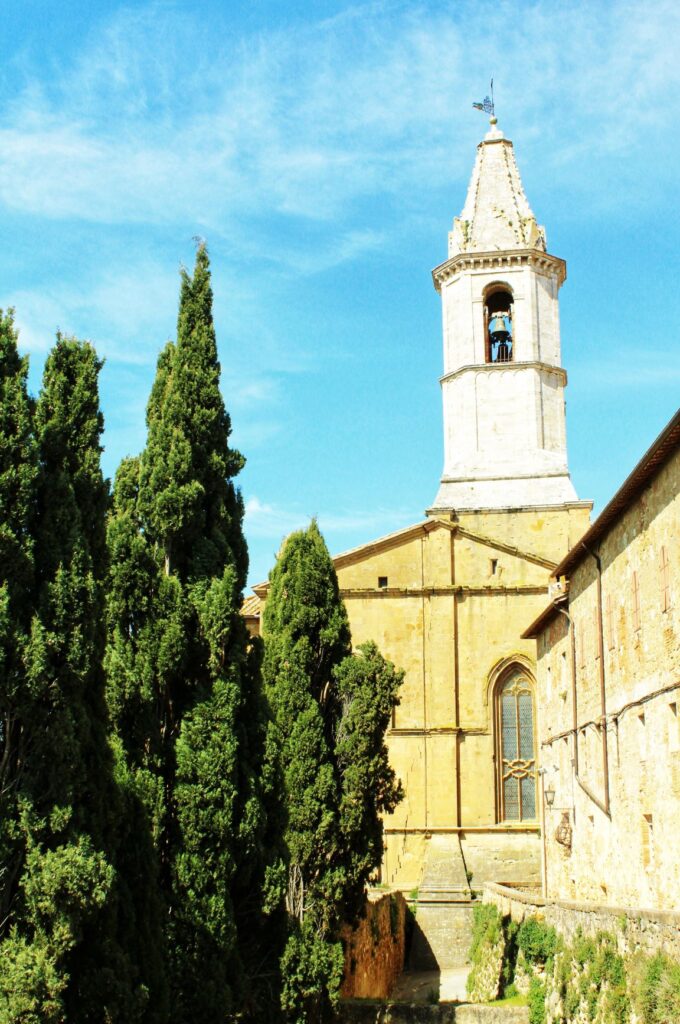
Inside the Pienza Cathedral, I admired the 15th-century paintings, but what fascinated me most was the structure. The cathedral sits on shifting Val d’Orcia soil, and if you walk behind it, you’ll notice the slight lean. Even the pointed bell tower tells a story — inspired by styles Pope Pius II admired during his time in Germany. This wasn’t random architecture. It was a vision translated into stone.
The highlight for me was the inner courtyard of Palazzo Piccolomini, once the summer residence of Pope Pius II. Its hanging garden — considered one of the first Renaissance roof gardens — opens toward the valley in perfect alignment. Standing there, I could see how architecture and landscape were meant to work together.
Right next door, Palazzo Borgia adds contrast. Once home to powerful cardinals, it now houses religious art and historical artifacts. The two palaces side by side quietly reveal layers of power, influence, and ambition.

In Pienza, architecture isn’t just something to look at. It’s something to notice. To understand. To feel
For the View Seeker
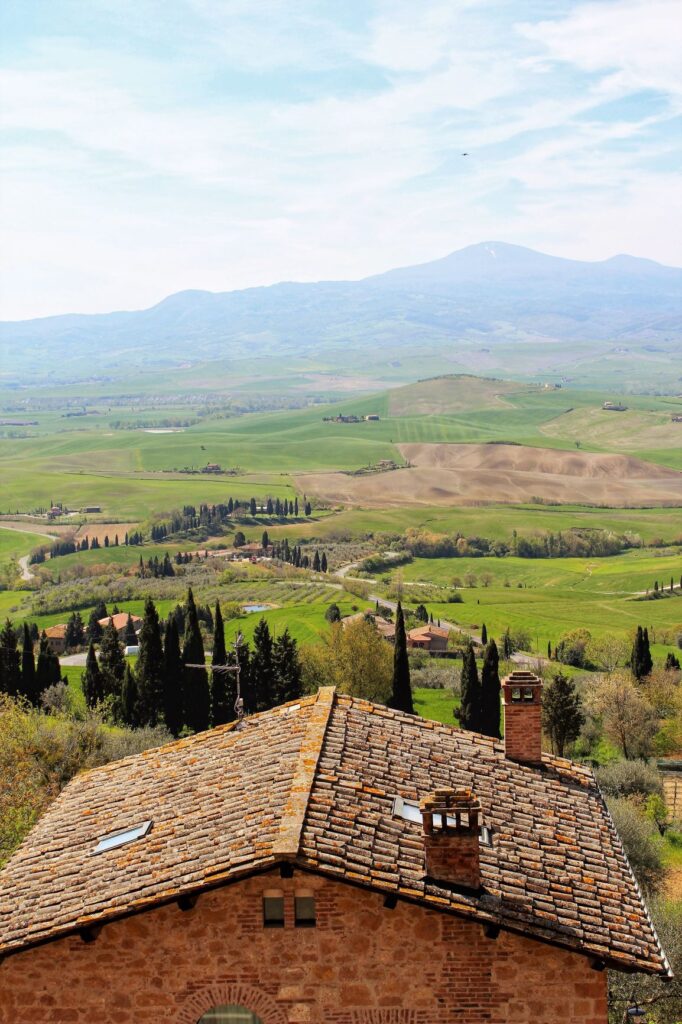
If you come to Pienza for one reason, let it be this: the views.
The town doesn’t just sit in the Val d’Orcia — it opens itself to it. Walk along the panoramic walls that hug the historic centre, and you’ll understand immediately why this landscape is protected as a UNESCO site. The hills roll in soft layers. Cypress trees punctuate the horizon. Farmhouses sit quietly in the distance.
The best stretches, in my experience, are along two streets at opposite ends—Via del Casello and Via Gozzante. This is where I slowed down the most. I leaned against the stone wall and just looked. No rush. No agenda. Just space.
I recommend coming early in the morning or at golden hour. In the morning, the air feels still, and the light is gentle. In the evening, the hills turn warm and dimensional. Both feel entirely different — and equally worth your time.
If architecture gives Pienza its structure, the landscape gives it breath. For me, these overlooks are one of the strongest reasons to visit and one of the best things you can do in Pienza.
For the Wanderer

If you enjoy towns best without a schedule, Pienza rewards you.
Start on Corso Rossellino, the main street that runs through the historic center. Every other lane seems to branch from here. It’s your anchor point. Walk it once to orient yourself — then let go of direction.
The slower you move, the more you’ll notice. Flower-covered balconies. Worn stone doorways. Artisan workshops tucked behind wooden doors. I found myself drifting down streets like Via Dogali, Via del Giglio, and Via della Volpe simply because they looked inviting.
Then there are the romantic lanes. Via dell’Amore (Street of Love) and Via del Bacio (Street of the Kiss) are as charming as their names suggest. They’re narrow. Quiet. Framed by stone. They open unexpectedly toward the valley. No map is needed. Just follow what draws you in.
I also make time for the artisan shops. Ceramiche Bai Linda on Via Gozzante showcases local ceramics. Bottega Artigiana del Cuoio offers handcrafted leather goods. On my first visit, I bought a leather bracelet from a local leather and jewellery maker. I still have it today. It’s small, but it carries the memory of that day.
This is how I experience Pienza. Not as a checklist. As a series of turns.
For the Food-Focused Traveller

In Pienza, food isn’t a side note. It’s the anchor.
The town is known for Pecorino di Pienza, and you’ll smell it before you see it. Wheels of cheese line shop windows in different stages of aging — some wrapped in walnut leaves, others matured in caves. On my first visit, I stepped into Marusco e Maria and asked to taste a few varieties. The younger cheeses were soft and creamy. The older ones were sharp, nutty, and complex. A drizzle of honey over a slice brought it all together.

On my second visit, the owner at La Taverna del Pecorino invited me into the cave beneath the shop. Rows of wheels aged in straw, walnut leaves, even ashes. He explained how the flavour deepens over time, and how the sheep’s milk from this region gives the cheese its distinct character. It wasn’t just tasting. It was understanding.
Pair your cheese with a glass of local wine — a crisp Tuscan white or a structured red from nearby Montepulciano. The combination is sublime.
For a slow lunch overlooking the valley, I recommend La Bandita Cafe, Trattoria La Buca delle Fate, or Idyllium for its terrace seating. Sit longer than you planned. Order another glass. Let the landscape become part of the meal.
If you visit in early September, you may catch the Palio del Cacio Fuso — a local festival where teams roll wheels of pecorino through the square. It’s spirited. Playful. Entirely centred around cheese.
In Pienza, tasting isn’t just something to do. It’s how you connect to the town.
Things to Do in Pienza In Comparison to Nearby Towns

If you’re looking for a town that allows you to move at your own pace, Pienza stands apart. Many Tuscan towns are beautiful, but they demand energy — steep streets, crowds, cinematic vistas, or monumental scale. Pienza, by contrast, gives you space.
Here’s a quick comparison to put it in perspective:
| Town | How It Feels Compared to Pienza |
|---|---|
| Montepulciano | Vertical streets, dramatic architecture. More to climb and explore. Pienza is gentler and easier to wander. |
| Montalcino | Famous for wine, hilly, busier during harvest. Pienza is more contained and peaceful. |
| Cortona | Cinematic vistas, compressed streets, often crowded. Pienza offers similar beauty with more breathing room. |
| Siena | Historic, grand, intense, bustling. Pienza feels quiet, intimate, and scaled for strolling. |
| Arezzo | Lived-in and layered, working streets, local energy. Pienza is refined, quieter, and contemplative. |
For me, this is one of the strongest reasons to spend time in Pienza. There is no checking off the main sights, it’s more about tasting the local pecorino, wandering the streets, and admiring a view — something that’s rare in Tuscany’s more famous hill towns.
So… Is Pienza Worth It for You?
Here’s the truth: Pienza isn’t about doing everything. It’s about being present. If you love dense towns filled with endless stairs, crowded piazzas, and nonstop attractions, Pienza may feel understated.
But if you appreciate moments that let you truly notice your surroundings, Pienza will steal your heart. It’s the kind of town where you can wander without a plan, sip local wine, pause to watch the hills glow in golden hour, and feel like the pace of life slows just for you.
I return here because it rewards patience and curiosity. It’s small, yes, but full of personality and charm. Every street, every corner, every view has been carefully composed — and it leaves space for you to make it your own.
If you want more slow-travel stories, curated tips, and insights you won’t find anywhere else, join my newsletter community. Travel deeper, one town at a time.


