

The first time I walked up to the Prague Castle District, I didn’t rush. I remember the quiet crunch of cobblestones beneath my feet, the rooftops of Malá Strana falling away behind me, and that moment of pause before entering through the gates. I had always imagined a single castle. But what unfolded was far more—an entire historic complex that felt like its own little city.
The Castle District in Prague, also known as Hradčany, isn’t just home to Prague Castle. It’s a centuries-old neighbourhood filled with palaces, gardens, convents, viewpoints, and quiet lanes that invite you to linger. It’s where Prague’s royal, religious, and political history converge—layered and visible, if you take the time.
I’ll help you understand what this area of Prague truly is, how to plan your visit, and how to experience it at a slower pace. Beyond the famous landmarks, I’ll share what makes this district a place I’d return to again.
This post may contain affiliate links, meaning I get a commission if you decide to purchase something through the links, at no additional cost to you. Read my Affiliate Disclosure.
What Is the Prague Castle District?

When most people hear “Prague Castle,” they picture one grand building perched high above the city. But the reality is much more expansive. This district is not just a single castle—it’s an entire hillside neighbourhood with layers of history woven into its streets, courtyards, and rooftops.
Inside the Prague Castle complex itself, a UNESCO World Heritage Site, you’ll find some of the city’s most important landmarks:
- St. Vitus Cathedral, the towering Gothic masterpiece that holds royal tombs and sacred relics
- The Old Royal Palace, once the seat of Bohemian kings
- Golden Lane, a row of tiny colourful houses that once housed castle guards, goldsmiths, and even Franz Kafka for a time
- A series of courtyards, each with its own mood and era
- The Royal Gardens and South Gardens, perfect for a stroll with sweeping views of the city
It’s one of the city’s oldest quarters, filled with noble residences, religious sites, embassies, and charming streets that seem to wind back through time.
Walk around and you’ll pass the Loreto pilgrimage site, the Strahov Monastery with its baroque library, and views that stretch across the Vltava River. This part of Prague feels quieter than the busy Old Town, even though it holds such weighty significance.
You could visit the castle complex itself in a few hours, but to truly experience the Castle District, I recommend devoting at least half a day, if not more. The cafés, side streets, and peaceful gardens just outside the main attractions are often my favourite parts.
How the Castle District Compares to the Other Four Historic Districts in Prague

Prague is famously built around five historic towns, each with a distinct identity:
- Malá Strana (Lesser Town): Just below the Castle District, this is where I often begin my walk up. It’s filled with baroque churches, narrow lanes, and embassies. It feels intimate and ornate.
- Staré Město (Old Town): This is the beating heart of Prague with its astronomical clock, town square, and Gothic spires. It’s where most visitors start, and rightly so—but it’s also the most crowded.
- Josefov (Jewish Quarter): Tucked inside Old Town, this district holds centuries of Jewish history. It’s compact and sombre, with beautifully preserved synagogues and the haunting Old Jewish Cemetery.
- Nové Město (New Town): Don’t be fooled by the name—it was founded in the 14th century. It surrounds Old Town and includes Wenceslas Square, art nouveau buildings, and a more local feel.
Compared to these, the Castle District feels quieter (except for at the castle itself), more residential, and steeped in royal history. It doesn’t pulse with the energy of Old Town or the buzz of New Town. Instead, it offers height and perspective, and a great place to go for elevated city views of Prague.
How to Get to the Castle District in Prague
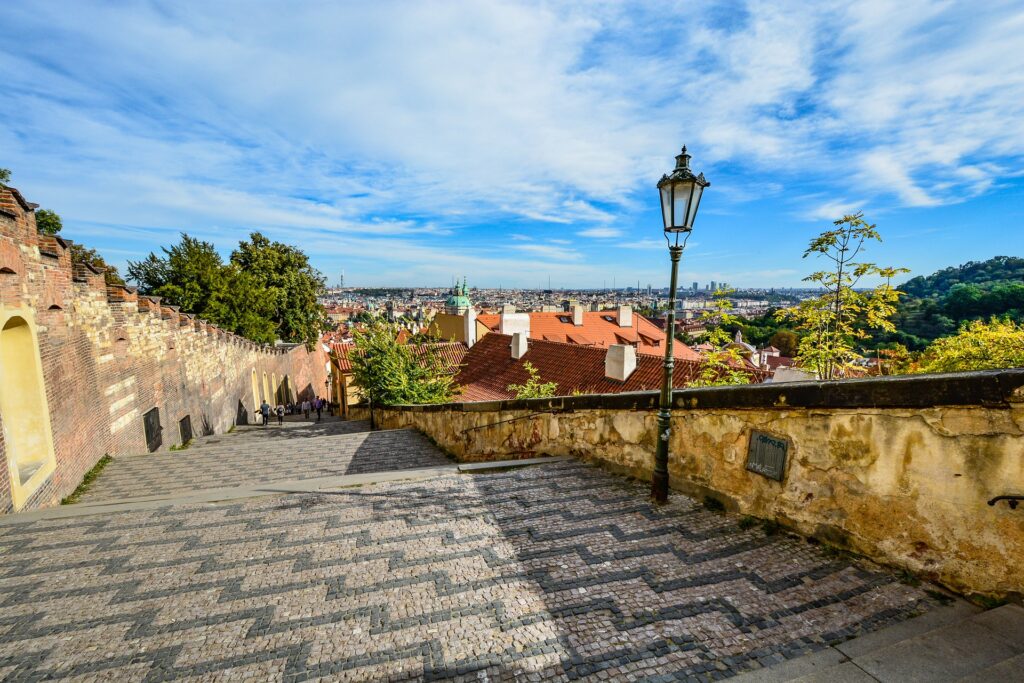
While you have a few different transportation options, I always choose to walk—it sets the tone for a slower pace, allowing you to stop and admire the views along the way.
Here’s what you need to know:
My favourite walking route:
- Start at Charles Bridge, crossing to the Malá Strana (Lesser Town) side
- Wander through Mostecká Street, then turn left onto Nerudova Street
- Follow Nerudova uphill—yes, it’s a bit of a climb, but it’s lovely and lined with historic buildings, artist studios, and old noble house emblems
- As you near the top, the castle gates appear, and the view over the red-tiled rooftops of Prague is quietly breathtaking
Why I love this route: it builds anticipation. And by the time you reach the castle, it feels like you’ve earned it.
Other Ways to Reach the District
If you prefer to save your energy, there are a few convenient options:
- Tram 22:
- Hop on and ride to Pražský hrad or Pohořelec stops
- From Pohořelec, it’s a gentle downhill walk through the district
- ✅ Affordable and efficient
- ❌ Still requires a bit of walking
- Taxi or Ride Apps:
- Drop-off points are nearby, though cars can’t enter the castle grounds
- ✅ Great for early mornings or mobility issues
- ❌ Less atmospheric than arriving on foot
- Funicular Railway (from Újezd to Petřín Hill):
- Ride the funicular and walk over from Petřín Lookout Tower through lovely gardens
- ✅ Scenic and unique
- ❌ Longer, and less direct
If it’s your first time and you’re able, I’d still suggest walking—even just one way.
When to Visit the Castle District

Best Times of Day
If you’re after a quieter experience, go early—before 9:00 AM. This is when you’ll have the courtyards nearly to yourself, and the light filtering through the trees is gentle and golden.
Another lovely option is late afternoon, especially around golden hour (an hour before sunset). The crowds begin to thin, and you can enjoy the gardens and views in a more relaxed way.
The Castle District is one of the most visited places in Prague, so timing makes a real difference.
Tips to avoid the crowds:
- Visit weekday mornings, especially Tuesday to Thursday
- Skip the mid-day hours between 11:00 AM – 3:00 PM
- Enter through less obvious gates, like the entrance from Pohořelec or Nový Svět, instead of the main entrance by the First Courtyard
I usually arrive early, explore for a couple of hours, then find a quiet café in Hradčany to relax and write a few notes.
What to See Inside the Castle District
Here are the key places I explored, and what stood out most from each.
St. Vitus Cathedral
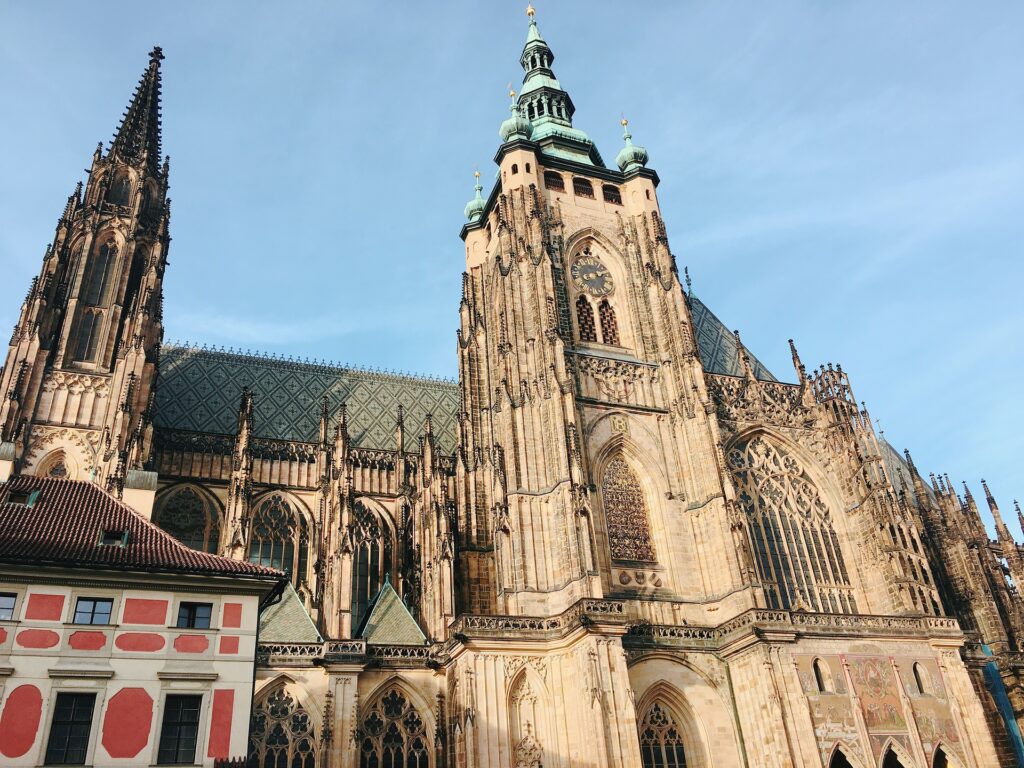
I’ll never forget the feeling of stepping into St. Vitus Cathedral for the first time. The Gothic spires seen from almost anywhere in the city are impressive, but they don’t quite prepare you for the hush and height inside.
The soaring ceilings, the play of colored light through stained glass, the echo of footsteps—there was a stillness that made time feel irrelevant. I sat in one of the side pews for a few minutes, just watching the light move slowly across the stone floor.
Things to notice inside and out:
- The rose window above the entrance
- The richly colored Alfons Mucha-designed stained glass (a modern touch in a medieval space)
- The ornate St. Wenceslas Chapel, glowing with semi-precious stones
- The tombs of Bohemian kings, including Charles IV
- Outside: walk the full perimeter of the cathedral—some of the most interesting carvings are hidden around the back
Whether or not you’re religious, the cathedral asks you to pause. And I think that’s the point.
Old Royal Palace

The Old Royal Palace felt like walking through a quiet chapter of a story you’ve heard only in fragments. This was once the heart of royal and political life in Bohemia, and though it’s more subdued than the cathedral, the spaces carry a different kind of gravity.
What stood out to me:
- The Vladislav Hall, with its soaring vaulted ceiling and curious horse ramp (yes, horses were ridden inside here during ceremonies)
- The Defenestration Room—where nobles were thrown from a window in a moment of rebellion that changed history
- The view from the balcony over the Second Courtyard gives you a sense of how power and pageantry once looked
You don’t need to be a history expert to enjoy this place. It’s the scale and weight of the rooms that leave a mark.
Golden Lane
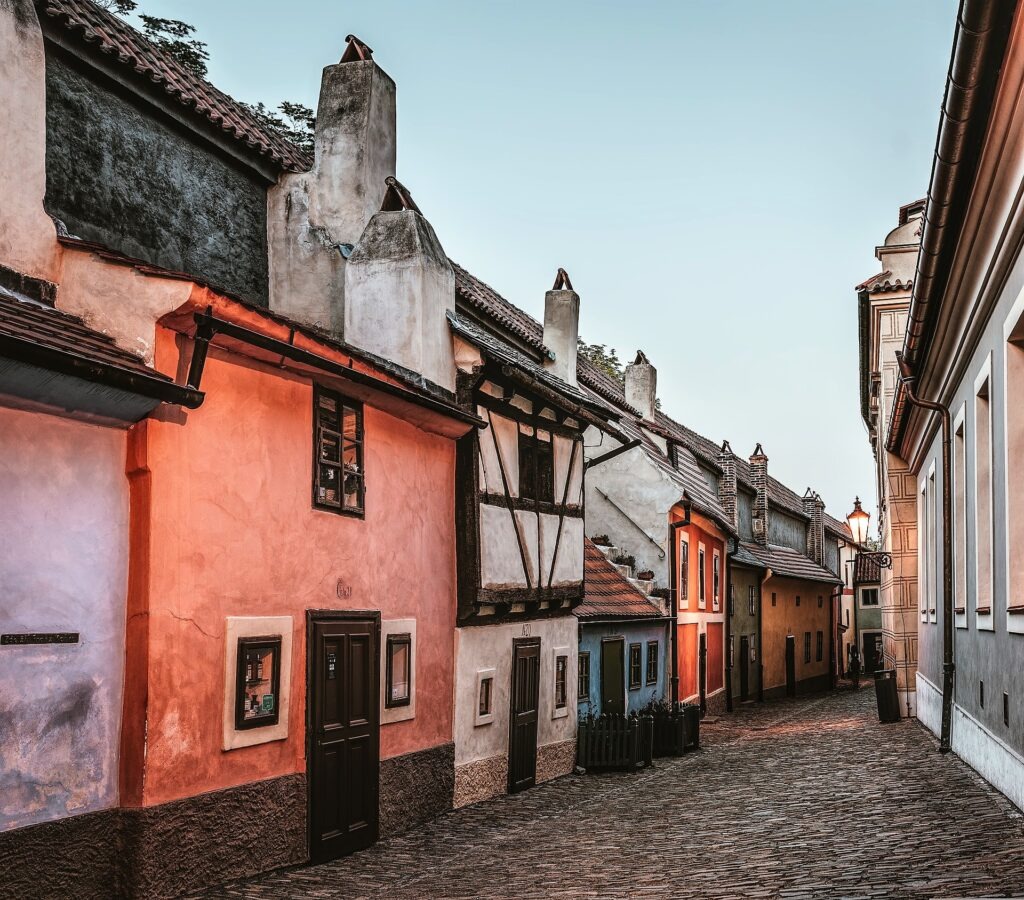
At first glance, Golden Lane looked like something out of a fairytale—tiny, brightly colored houses squeezed side by side like dolls’ homes. But once I stepped inside, I realized there was more substance than I expected.
The lane was once home to castle guards, goldsmiths, and even writers like Franz Kafka, who lived here briefly. Today, the houses are set up as small exhibitions—some showing how people lived, others filled with medieval armour or artisan tools.
What surprised me:
The mix of charm and realism. These weren’t just pretty façades—they told quiet stories of everyday life behind palace walls.
Is it worth the separate ticket?
Yes—if you’re interested in the social history of the castle, or if you’re visiting during less crowded times. If it’s packed, it can feel rushed and less meaningful. I recommend going early in the day if you want to enjoy the quiet.
Other Notable Spots
While most visitors focus on the main attractions, I found real gems in these lesser-known corners:
- Daliborka Tower
- A former prison at the end of Golden Lane. Dark, narrow, and haunting in its own way
- Lobkowicz Palace (requires a separate ticket)
- Privately owned, this palace houses a lovely collection of paintings and musical manuscripts (Beethoven included). The audio guide is excellent.
- South Gardens
- Terraced gardens that offer some of the best views over Prague. I brought a coffee here one morning and just sat in silence.
- Royal Garden
- Located on the north side of the complex, it’s quieter and less frequented, especially in the mornings. A great place to walk slowly and gather your thoughts
Do You Need a Ticket? What to Know Before You Go
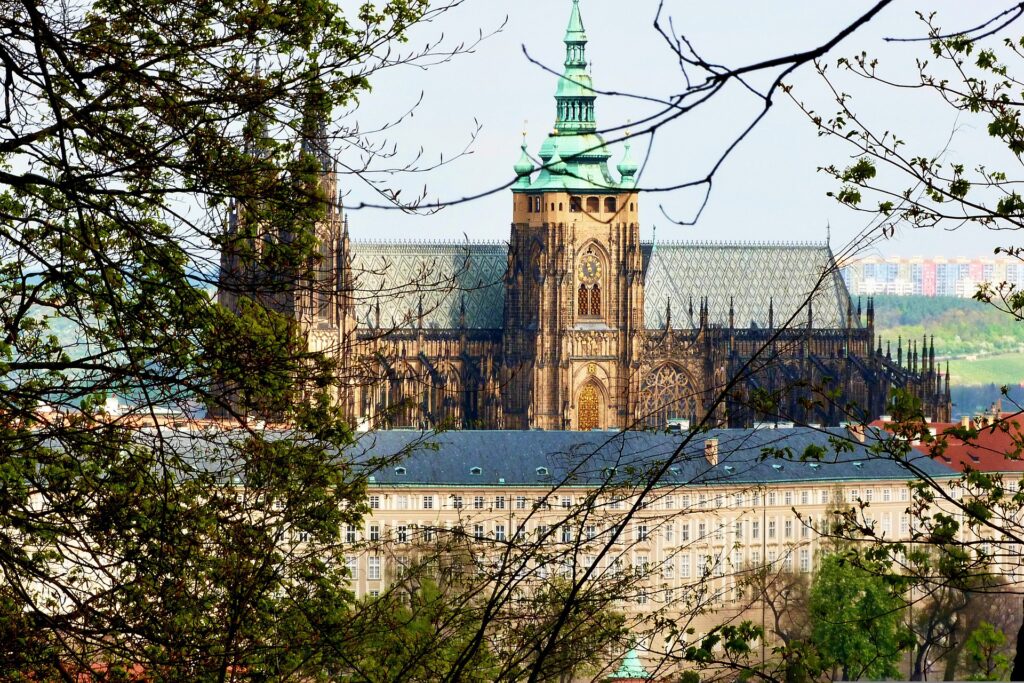
It might be a bit confusing to figure out what you actually need a ticket for. Some parts felt open and free, others had turnstiles and signs. So let me make it easier for you.
What’s Free and What’s Ticketed
The good news? You can wander much of the Castle District and castle courtyards without paying a thing. The outer areas—including the courtyards, gardens (when open), and many views—are completely free to the public.
But if you want to enter the main historical buildings, you’ll need a ticket. These include:
- St. Vitus Cathedral (the full interior, including the St. Wenceslas Chapel)
- Old Royal Palace
- Golden Lane and Daliborka Tower
- Basilica of St. George
Ticket Options
Tickets are sold as circuits—a bundled group of sites within the castle complex.
Most visitors choose:
🟡 Circuit B – The most popular option
Includes:
- St. Vitus Cathedral
- Old Royal Palace
- Golden Lane with Daliborka Tower
- Basilica of St. George
💡 This is the one I usually recommend—it covers the essentials without overwhelming you.
🟢 Circuit A – Includes everything in Circuit B, plus exhibition spaces like the Story of Prague Castle and the Picture Gallery
🔵 Special Exhibitions – Extra tickets are required for places like Lobkowicz Palace, seasonal garden tours, and select exhibitions
🎟️ Where to buy tickets:
- On-site at ticket offices in the Second Courtyard (recommended only if travelling in the low season)
- Online in advance (recommended if visiting in peak season)
- Through guided tours that include skip-the-line entry
I highly recommend either of these two options: skip-the-line Castle ticket OR Castle tour with a local guide
Do You Need a Guided Tour?
Personally, I’ve done the Castle District both on my own and with a guide. If it’s your first visit and you enjoy historical context, a small group or audio guide can be really helpful in bringing the palace and cathedral to life.
But if you prefer to wander slowly, notice details, and follow your own pace—as I often do—a self-guided visit can be just as meaningful. You won’t need more than a few hours unless you’re diving deep into exhibitions.
Opening Hours and Entry Notes
🕒 Prague Castle Complex:
- April–October: 9:00 AM to 5:00 PM (buildings)
- November–March: 9:00 AM to 4:00 PM
The grounds and courtyards open as early as 6:00 AM, which is ideal for quiet morning walks.
🛂 Security Checks:
There are bag checks at all entrances, so allow extra time during busy seasons. They’re efficient, but there can be a wait.
Summary: A Few Tips from Personal Experience
- Visit early or late in the day to avoid queues
- Skip the midday rush, especially during summer
- Wear comfortable shoes—there’s a lot of cobblestone
- Plan for at least 2–3 hours if doing Circuit B at a relaxed pace
What to See Beyond the Castle Complex

One of the best parts of exploring this district is what lies just beyond the castle gates. Once I stepped away from the crowds near St. Vitus and wandered a little farther, I discovered quiet corners, lesser-known sites, and charming streets that felt like they belonged to a different century.
If you have a few extra hours—or even better, an entire afternoon—here’s what I recommend seeing just beyond the main complex:
Hradčanské náměstí (Hradčany Square)

Right outside the main castle gates, this square is an elegant introduction to the Castle District beyond the complex.
- Surrounded by noble palaces like the Archbishop’s Palace and Schwarzenberg Palace
- Offers sweeping views over the rooftops of Malá Strana
Loreta

Just a short walk from the square, Loreta is a serene baroque pilgrimage site that often goes overlooked.
- Known for its bell tower and carillon, which plays a sweet, tinkling melody on the hour
- Inside is the Holy Hut replica and a small treasury with an ornate diamond monstrance
Even if you don’t go inside, sitting in the courtyard or hearing the bells from a nearby bench is a lovely experience.
Nový Svět (New World Street)
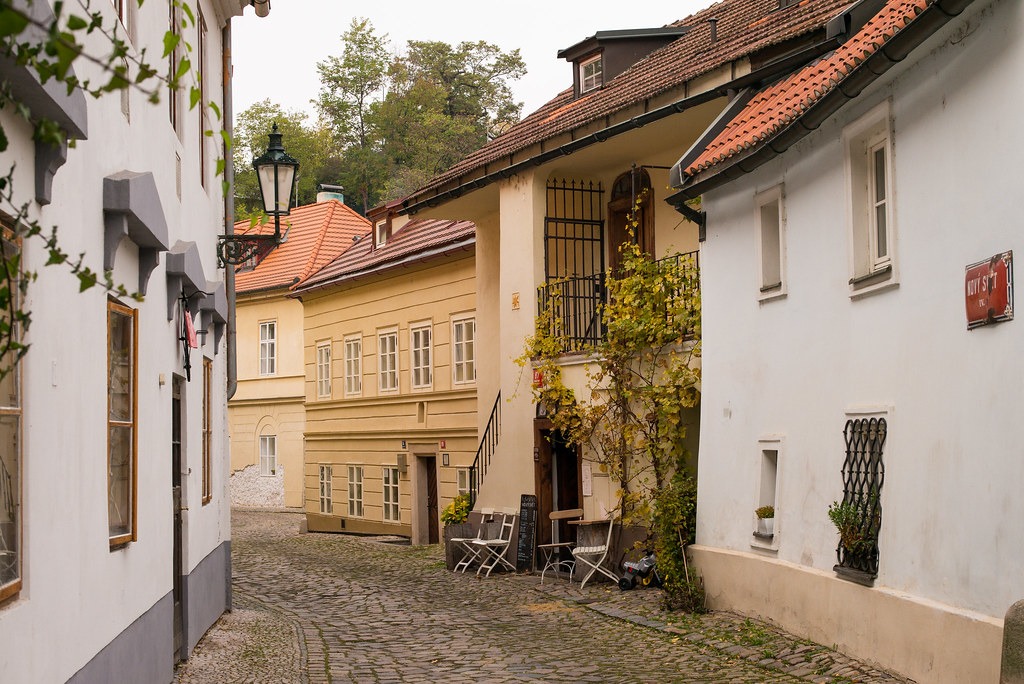
One of my favourite discoveries in Prague.
- A tiny, hidden residential street tucked behind Loreta
- Lined with low, pastel-colored cottages and flowering window boxes
- Often empty, even in peak season—it feels like time stopped here
I love walking this street slowly, maybe with a coffee in hand (from the cute coffee shop called Karvarna Novy Svet), and imagining who might have lived here centuries ago. It’s easy to miss, and that’s what makes it so special.
Strahov Monastery

At the top of the hill, the Strahov Monastery offers a different perspective—both visually and spiritually.
- Home to a famous baroque library with ornate ceilings and rows of antique books
- A small gallery featuring Central European religious art
- Peaceful grounds and a panoramic view over the city from behind the complex
Where to Eat or Rest Nearby
After wandering, I always like to take a long pause with a good meal or drink. Here are two places I’ve returned to more than once:
- Peklo Restaurant (Uvoz 169)
- A unique spot built into a former monastery wine cellar just below Strahov
- Has a shaded garden terrace for summer lunches or early dinners
- Quiet, rustic, and with a relaxed pace, perfect for slow travellers
- Klášterní Pivovar Strahov (Strahov Monastic Brewery)
- The brewery run by the monks, right beside the monastery
- Serves hearty Czech food and its own St. Norbert beers
- Indoor and outdoor seating available—great atmosphere in the late afternoon
Both spots feel tucked away from the tourist trail, and both offer that rare combination: local flavour and quiet surroundings.
Exploring these places beyond the Castle Complex reminded me why I love slow travel so much—it’s not just about ticking off monuments, but about walking without a plan, stepping into side streets, and giving your curiosity room to wander.
Final Thoughts
Every time I return to the to this area of Prague, I find a new reason to linger just a little longer.
Looking for more ideas? Read about my Prague river cruise experience. Or discover how to extend your trip with two unforgettable side trips to:


