

Trastevere in Rome is often described as charming, bohemian, and romantic. And while all of that can be true, it’s also incomplete.
This is a neighbourhood that rewards timing and a willingness to let go of expectations. It can feel intimate and local in the morning, then loud and overexposed by nightfall. Both versions exist at once—and how you experience Trastevere depends almost entirely on how you move through it.
I’ve returned to this part of Rome many times, over decades of travelling to Italy. I’ve seen those differences. What I’ve learned is that Trastevere isn’t something to conquer or “see.” It’s an area of Rome that’s worth unplanned exploration, curiosity, and a slow-footed pace.
I’m not sharing this as a list of must-dos. Rather, it’s a guide to understanding what Trastevere actually offers—and how to decide whether it’s right for your Rome.
This post may contain affiliate links, meaning I get a commission if you decide to purchase something through the links, at no additional cost to you. Read my Affiliate Disclosure.
Why Trastevere Feels So Different From the Rest of Rome
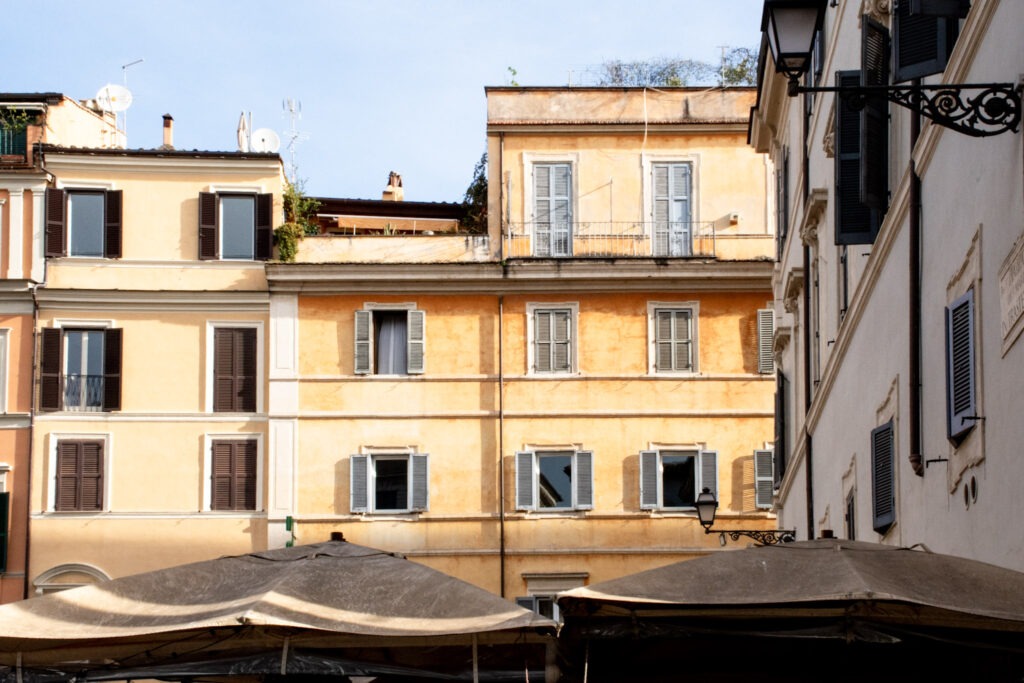
Trastevere doesn’t unfold the way monumental Rome does. There are no grand sightlines or “wow” reveals. Instead, the neighbourhood tightens around you. Medieval streets twist and narrow. The scale drops. Your pace slows, whether you intend it to or not.
What stands out first is texture. Worn, warm-toned stucco buildings—ochre, rust, faded peach—softened by age rather than restored to perfection. Laundry lines stretch between windows. Vines creep up facades. Window boxes spill with flowers and herbs. It feels lived in, not staged. Beautiful and gritty at the same time.
Churches are unassuming here. You stumble upon them. Trattorias tuck into corners or down alleyways with handwritten menus and only a couple of tables and chairs outside.
Sounds replace landmarks: voices bouncing off stone, clinking glasses, cutlery scraping plates, scooters squeezing through streets never meant for them.
From My Personal Experience:

My first visit to Rome’s Trastevere was before social media, before maps told you where to go. I got lost on instinct. It was a Saturday. I wandered until hunger stopped me, ate lunch in a restaurant with a view of the nearby Santa Maria as a trio of string musicians played.
I watched as locals greeted friends. Children kicked a football near the fountain. It’s the Rome I imagined in my head. Romanticized right in front of me like a movie scene.
The Two Trasteveres: Daytime Calm vs Nighttime Chaos

Trastevere lives two very different lives, and most people only meet one of them.
In the morning, it wakes slowly. Before 9 a.m., the streets are almost empty. No café chairs dragged out yet. No street sweepers either, which means you see the quiet evidence of the night before—stacked bottles, chalk menus half-erased, yesterday’s energy littered on the cobblestones.
Light filters in gently, catching the uneven stone and warming the façades. This is when Trastevere feels intimate, almost private.

By evening, the mood shifts. Voices rise. Tables multiply. The streets are crowded with people. Trastevere becomes loud, social, kinetic.
On weekdays, the crowd leans heavily tourist. On weekends—especially Sundays—it changes again. Families gather after church. Tables are pushed together. Lunch stretches for hours. It’s noisy, joyful, and unapologetically communal. I love to watch that energy, even when it overwhelms.
From My Personal Experience:
Personally, I’m selective now. I prefer a quiet aperitivo around six, somewhere intimate, followed by a late dinner elsewhere. Trastevere at night skews younger, drawn by relaxed bars and lower prices. When I go, I choose carefully. I do have some favourite places to eat in Trastevere.
Walking Trastevere Roma Without a Plan (And Why That’s the Point)

Don’t come here with a checklist. You won’t need one. I come with a few loose anchors and let the rest unfold in between.
Santa Maria in Trastevere is usually one of them. The basilica’s mosaics glow softly inside, and the square outside, with its fountain, feels like a shared living room. People linger. Kids circle the fountain. No one seems in a hurry. I especially love the colour of the buildings that line the open square—pale blues, pinks and creams.
Several streets away, Piazza Santa Cecilia is much calmer, more inward-looking. Almost like a secret discovery. The church is unassuming, but it carries weight. Most visitors miss the reason to visit here. Make your way to the book shop and leave a €2.50 donation to bear witness to the crypts and the stunningly small underground chapel lined with mosaics.

Antica Farmacia S. Maria della Scala is another pause point. I first discovered this on my first trip, one of Europe’s oldest pharmacies, now a museum. Check the timing of your visit, as it has been closed with a reopening expected later in 2026.
On Sundays, Trastevere stretches further. Porta Portese turns into a sprawling outdoor flea market where locals actually shop. It takes patience—and a bit of digging—but I’ve found real deals here, including Italian leather sandals I still wear years later.
My Personal Favourite:

The moments that always slow me down aren’t monuments at all. They’re the backstreets east of Viale Trastevere—Vicolo Moroni, Via del Moro, Via della Pelliccia, Via della Lungaretta—where the neighbourhood feels unfiltered.
You don’t walk these streets to “see” Trastevere. You walk them to feel it.

How Trastevere Fits Into a Well-Paced Rome Trip

I treat visiting Rome’s Trastevere as a recurring stop, short bursts of time, during each of my trips. A few hours is often enough: arrive with intention, for me, it’s usually to try a new restaurant, stroll around for a bit, visit a few old favourite places or streets and notice what’s changed since my last visit and leave.
It pairs naturally with nearby areas. I like to combine it with a walk up to Gianicolo for views, or take a stroll through the lovely Villa Sciarra park or the rose botanical garden. I cross over after enjoying Testaccio for a food-forward afternoon. And, it also flows easily with the Jewish Quarter.
Is Trastevere Worth Visiting—and Who It’s Not

Trastevere isn’t a universal fit for every traveller. Some love it deeply, while others just like it. Not a flaw. It’s a filter.
It works beautifully for slow travellers who enjoy contrast. For return visitors who’ve already done the Historic Centre and want to cross the Tiber to see another side of the city. For people who don’t mind a bit of friction—uneven streets, noise, grit alongside beauty—and who measure a place by feeling and not a checklist.

It doesn’t work well for early sleepers, light sleepers, or anyone craving quiet evenings. It’s a tough choice for travellers short on time who want to focus only on Rome’s highlights and must-sees. And it often disappoints those who only want to see the “pretty version” of Rome. This area is neither polished nor elegant. It’s lived-in charm.
This is also where I offer a gentle warning about staying here.
Many people think they want to stay in Trastevere—romantic photos, ivy-covered buildings, candlelit dinners. But the reality is late nights, heavy foot traffic, street noise, and mornings that begin with the evidence of the night before.
Where you stay within Trastevere matters enormously—and in some pockets, it simply doesn’t work.

My personal truth: I love visiting Trastevere. I love eating in the restaurants in Trastevere. I return every trip. But I’ve chosen not to stay here. For me, it’s best experienced in doses—wandered, lingered in, dining, then left behind.
My Final Thoughts About Trastevere in Rome
This area of Rome is no longer a hidden gem like when I first visited it over a decade ago. Nevertheless, it’s one of my rituals to return here, at least once on each return trip.
This is all about “atmosphere” and less about things to see and do in Trastevere.
If you want more insights like this—ways to move thoughtfully through Rome and beyond—join my newsletter for curated tips, reflections, and slow-travel inspiration.


