

London doesn’t suffer from a lack of landmarks.
It suffers from too many — and not enough time.
For first-time visitors, especially, the temptation is to see everything, and quickly. Buckingham Palace before lunch. Tower Bridge by afternoon. The London Eye squeezed in somewhere between. It’s an exhausting way to see the city.
And honestly? It barely scratches the surface of what London actually is.
This guide to London landmarks is different.
Instead of a rushed checklist, I’ll help you understand what makes a place a landmark, why it matters, and who it might appeal to — so you can choose the landmarks that fit your travel style.
Slow travel isn’t about seeing less.
It’s about seeing what matters to you.
This post may contain affiliate links, meaning I get a commission if you decide to purchase something through the links, at no additional cost to you. Read my Affiliate Disclosure.
What Makes a Place a London Landmark?

Not every popular attraction is a landmark — and not every landmark requires a ticket.
A landmark is a place that does at least one of the following:
- Holds historical, political, or cultural significance
- Is instantly recognizable and symbolic of London
- Has shaped the city’s identity over centuries
- Lives on in collective memory, literature, or daily life
Some landmarks are grand and formal.
Others are woven quietly into everyday London.
What they share is meaning. They are a part of London’s culture. It’s what makes London distinctly different than Paris or Rome.
The downside —they draw crowds and become heavily visited tourist attractions. They are popular for a reason, and yes, are worth visiting. I recommend that you don’t go to London just to see its landmarks. The city is more than its landmarks, like its neighbourhoods, with my favourite being Notting Hill.
London Landmarks by Interest: Choose What Speaks to You
Instead of seeing landmarks in isolation, I find it far more rewarding to group them by interest. This makes planning easier — and helps you avoid landmark fatigue.
Royal & Political Landmarks: Power, Pageantry, and Tradition

These are the landmarks most people picture first — and for good reason.
The symbolic heart of the British monarchy is Buckingham Palace. Even if you never step inside, standing at the gates gives you a sense of scale and ceremony. I like to walk The Mall, the red surfaced road from Trafalgar Square that leads to the Palace. I recommend early mornings before the crowds or on a Sunday when the road is closed to traffic.
Kensington Palace is more personal, more intimate. This palace tells stories of royal lives lived slightly offstage. It pairs beautifully with a slow walk through Kensington Gardens. The highlight here is the Sunken Garden, featuring the statue of Diana, Princess of Wales. My favourite way to enjoy Kensington Palace was the Royal High Tea at the Pavilion, where I had a direct view of the Palace and gardens.

The Palace of Westminster & Big Ben is London’s most iconic silhouette. Seeing Big Ben in person was enough for me. No tour, just seeing the scale of the architecture from the River Thames was exciting in and of itself.
Westminster Abbey has layer upon layer of history. Coronations, weddings, burials — this isn’t just a church, it’s a record of the nation itself. If you enjoy places that ask you to slow down and reflect, this one stays with you. The downside is that the visiting hours can be changed at a moment’s notice. Unfortunately, due to a special service, this was closed to the public during my visit to London.
The Horse Guards Parade, often overlooked, but absolutely is an important landmark of London. This open ceremonial space connects royal tradition with everyday London life — especially if you catch the Changing of the Guard without the chaos of Buckingham Palace.
My Travel Take on these Royal & Political Landmarks
- Best for: First-time visitors, history lovers, those curious about monarchy
- Slow travel tip: Visit early morning or near sunset for atmosphere without crowds
- Elevate your experience: Join a small group guided tour to hear the tales of British monarchs and politicians while enjoying skip-the-line privileges
Historic Landmarks That Shaped London

These landmarks explain how London became London.
The Tower of London, dark, fascinating, and deeply human. This fortress has been a palace, a prison, and a place of execution. I find it most powerful when approached slowly, walking along the Thames and letting its weight settle in.
One of London’s most reassuring presences is St. Paul’s Cathedral. The dome dominates the skyline, but inside it feels unexpectedly calm. I always linger longer than planned here. Plan your visit here.
My Travel Take on these Historical Landmarks
- Best for: history enthusiasts, architecture lovers
- Slow travel tip: Pair these together over one unhurried day
Bridges & River Landmarks: London on Foot

London reveals itself best while walking — especially along the Thames.
The Tower Bridge, yes, it’s photogenic — but it’s also functional. Watching it open for passing boats reminds you that London is still a working city, not a museum. I like to walk across it for the views, but also to feel the energy of the city.
For classic views, you’ll want to spend some time crossing Westminster Bridge in both directions. Early morning is magic, when the river feels still, and the city hasn’t quite woken up. But the mid-day energy is slightly infectious, too.
The Millennium Bridge is modern, minimalist, and perfectly aligned with St Paul’s Cathedral. It’s one of my favourite approaches to the city.
My Travel Take on these Bridges
- Best for: walkers, photographers, slow wanderers
- Slow travel tip: Don’t rush. Let the river set your pace. Walk it at different times of day to see how it changes.
- Itinerary tip: Include all three bridges as you walk along the Thames, starting or ending with Tower Bridge.
Cultural & Performance Landmarks

These landmarks aren’t frozen in time — they’re still being used, nightly.
The Royal Albert Hall is grand, circular, and alive with sound. Even if you don’t attend a performance, seeing it in person explains why it’s endured.
A living link to London’s literary past is Shakespeare’s Globe Theatre. The reconstructed Globe sits beautifully along the river, bridging history and modern storytelling.
Covent Garden, once a market, now a stage. Street performers, musicians, and the constant hum of movement make this a cultural landmark rather than a static one.
My Travel Take on these Cultural Landmarks
- Best for: theatre lovers, creatives, curious wanderers
- Slow travel tip: If the arts are your passion, this will be the city to take in a live performance for a lasting memory
- Itinerary tip for Covent Garden: Eat, drink and shop across nine connecting streets to this historic square. For the market atmosphere, return on Mondays when the arcade features an antiques market, and between Tuesday and Sunday, an artisan market.
Modern London Icons: Architecture & Skyline

London’s landmarks aren’t only historic — some reflect the city’s modern structure. I was surprised by the sheer number of modern buildings over the historic ones.
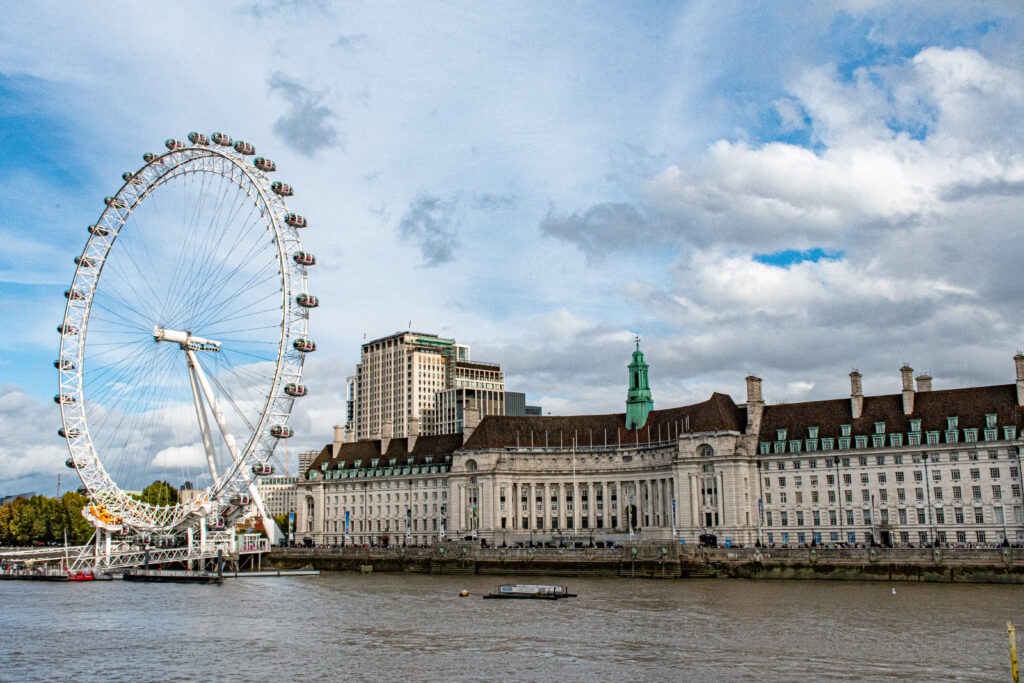
The London Eye. Touristy? Yes. But undeniably iconic. Whether you ride it or simply admire it from afar, it defines the modern skyline.
The Shard is a sharp, dramatic, and impossible to ignore. Viewing it from the river is enough, or enjoy a drink at the Shangri-La Hotel bar.
Then there’s The Gherkin. Playful and instantly recognizable. A reminder that London embraces bold design alongside tradition. View it from the river, or make a reservation at the restaurant.
My Travel Take on these Architectural Icons
- Best for: architecture fans, skyline lovers
- Slow travel tip: Decide whether you want the view from or of these landmarks
Public Spaces That Locals Actually Use

Some landmarks are felt rather than photographed.
Hyde Park is the needed green breathing space in the middle of the busy city. Walk it, sit with it, or simply pass through — it’s London at its most human. I like to walk through it at dusk, as the city winds down.
Trafalgar Square is grand, noisy, and unapologetically public. Whether you love it or not, it’s undeniably London.
My Travel Take on these Public Spaces
- Best for: people-watchers, slow afternoons
- Slow travel tip: Pause. Sit. Observe.
Instantly Recognizable Symbols

You don’t linger long — but you recognize them immediately.
Piccadilly Circus is bright, chaotic, and endlessly referenced. A moment here is enough to understand its cultural role.
Not a place, but a symbol. These Red Phone boxes represent London as clearly as any palace or bridge. The good thing is you don’t have to look very hard to find them. They are peppered all over the city.
My Travel Take on these Iconic Symbols
- Best for: first-time visitors, photographers
- Slow travel tip: Treat these as punctuation marks, not destinations
How to See London Landmarks Without Rushing
Here’s what I’ve learned:
- Choose 3–5 landmarks per day, max
- Group landmarks by walkable clusters
- Walk whenever possible — London rewards it
- Visit early morning or early evening for the atmosphere
Landmarks aren’t meant to be conquered via a checklist. They’re meant to be experienced.
Despite their often touristy reputation, they are worth visiting — if you choose intentionally. You don’t need to visit every single one; visit only those that appeal to you the most, and make the most sense from a geographical perspective.
My Final Take: Making the Most of Landmarks in London

Visiting these landmarks can add up quickly — many require an entrance ticket. My tip: choose the ones that genuinely interest you, rather than trying to see them all. This way, you get a richer experience without overspending or feeling rushed.
Plan your days around a mix of historic, cultural, and modern landmarks that match your style. Walk between clusters when possible, take breaks in parks or squares, and savour each experience.
If you want practical tips, curated travel news, and slow travel stories from Europe, join my newsletter. I share advice for travellers who prefer slow, meaningful exploration over checklists.

