

I visited Tübingen as a day trip from Frankfurt during my two-and-a-half-week stay using the Eurorail pass to visit a new charming German town every day.
The question I had before going—is Tübingen worth visiting?—was quickly answered the moment I stepped off the train. It was a destination I chose on a whim. Thinking I was going to spend the full day in Stuttgart, I quickly decided it wasn’t for me, and that’s how the nearby Tubingen got on my radar.
What I found was a university town full of colour and life, with crooked half-timbered houses leaning toward cobbled lanes and the Neckar River gliding through its center. It felt both historic and youthful at once.
Tübingen isn’t a city of big attractions. Instead, it invites you to slow down, wander, and notice the details—a painted town hall, a quiet square, a boat drifting down the river.
I’ll share my honest take on what to expect, the highlights, and whether Tübingen deserves a spot on your itinerary.
This post may contain affiliate links, meaning I get a commission if you decide to purchase something through the links, at no additional cost to you. Read my Affiliate Disclosure.
What Makes Tübingen Worth Visiting
The Idyllic Old Town
Above all else, Tübingen is simply beautiful. My camera was in overdrive from the moment I arrived. The town doesn’t just have a few pretty corners—it feels like the entire place was designed for wandering with a camera in hand. And there’s a reason for that.
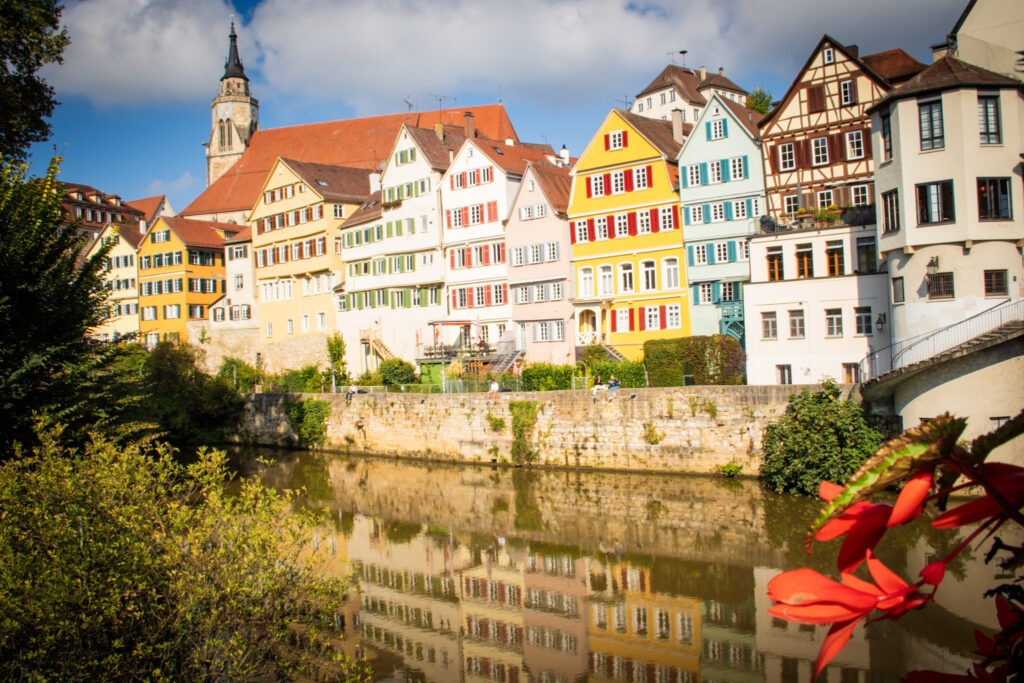
Because Tübingen wasn’t destroyed during World War II, its architecture is original. You can feel the difference immediately. Here, nothing feels re-created. The streets are narrow and winding. The lines are crooked. The colours are faded in the right places. The rooftops sit at uneven angles. It’s the kind of authenticity you can’t manufacture.
Around every turn, something new pulled my attention—a carved doorway, a cascade of flowers in a window, or a view of the Neckar that looked like a painting. Small, intimate squares appear without warning, often framed by fountains like the Georgsbrunnen or the ornate Neptunbrunnen.
Tübingen feels delightful in the truest sense of the word. Light, charming, and almost unreal at times. A destination pulled straight from a fairytale, yet lived in and loved by the people who call it home.

The Neckar River and the Famous Punt Boats
The Neckar is the soul of Tübingen. Wooden punt boats, known as Stocherkähne, glide slowly across the water, a scene unlike anywhere else in Germany that I’ve seen.
From the Neckarbrücke, just a short walk from the train station, I had my favourite view: the river reflecting the row of colourful houses, with flowers spilling over the bridge railings.
Schloss Hohentübingen
High above the town sits Schloss Hohentübingen. The climb is worth it for the views alone—rooftops, church spires, and the river winding below.
Inside, the castle holds a university museum with treasures ranging from ancient artifacts to scientific curiosities. But even if museums aren’t your focus, the setting itself—solid stone walls and quiet courtyards—feels deeply rooted in history.

The Market Square and Rathaus
At the heart of Tübingen lies the Market Square. Its centrepiece is the Rathaus, a Renaissance town hall with a painted façade so detailed and vibrant it hardly seems real.
This market square is home to the weekly market (I visited on a Monday, and there was a charming one), the authentic Christmas market, and other community events. I even learned that Tübingen has a strong chocolate culture and hosts the annual chocolART festival, Germany’s largest chocolate festival, in early December.
Tübingen’s Place in Germany
Tübingen is in southwestern Germany, in the state of Baden-Württemberg. It’s close to Stuttgart, making it an easy day trip, yet it feels worlds away from a big city.
The Black Forest lies to the west, and the Swabian Jura hills stretch nearby. Its location makes Tübingen a convenient base to explore southern Germany.
On a previous trip to Germany (this being my 7th), I stayed in the southern resort town of Konstanz, and from Tübingen it’s only 90 mins by car.
Practical Considerations – Is Tubingen for You?

Pros of Visiting Tübingen
For me, the biggest draw of Tübingen is its atmosphere.
It’s compact and walkable, which means you can slow down without feeling rushed. The half-timbered houses, the river views, and the castle all create a setting that feels both authentic and untouched.
I loved that it wasn’t crowded with tourists. The town still belongs to its residents, which gave me a glimpse of daily German life beyond the usual “must-see” cities with grand attractions.
Another advantage is how easy it is to reach from Stuttgart, it’s less than an hour.
Cons of Visiting Tübingen
Tübingen is small. If you’re looking for big sights, famous museums, or a packed itinerary, you may feel underwhelmed.
It’s not a city of grand monuments but of small details. Its pace is slower, more about cafés and riverside strolls than “checking off” attractions. For some travellers, that may not be enough.
It’s also 3 hours by train from Frankfurt, which is a lot for a day trip. But I still think it was worth my time visiting here.
Who Will Love Tübingen

For Slow Travellers
Tübingen rewards those who don’t need a checklist. The joy is in wandering—turning a corner and discovering a crooked house leaning into the street, or pausing at a fountain in a quiet square.
I spent time simply watching the play of light on the Neckar River and felt that it was as valuable as any museum visit. It’s the kind of place where small details carry weight, exactly what we slow travellers seek out.
For History Lovers
The town’s medieval heart is remarkably intact because Tübingen was spared destruction in World War II. That means what you see—the winding streets, the half-timbered houses, the stone arches—isn’t a reconstruction as you find in cities like Frankfurt, but original history.
The castle, Schloss Hohentübingen, dates back to the 11th century. Within its walls, archeologists uncovered the “Venus of Hohle Fels” carving and prehistoric flutes from nearby caves, some of the oldest known musical instruments in the world.
For Culture Seekers
As a university town, Tübingen has always drawn writers, thinkers, and artists. The university itself is one of Germany’s oldest, founded in 1477. Famous philosophers studied here, including Hegel and Hölderlin.
The poet Hölderlin even lived in a tower by the river that now bears his name—the Hölderlinturm—still one of the town’s most recognizable landmarks. You can visit, sit by the water, and imagine the ideas that once shaped modern thought.
Add to this a vibrant café culture, bookstores tucked into side streets, and student events that spill into public squares.
Getting There

I visited Tübingen as a day trip from Frankfurt, with Stuttgart as my first destination, using my Eurorail pass. The journey took just 2 hours and 15 minutes by train, with one easy connection in Stuttgart. From Stuttgart itself, Tübingen is even closer—around 50 minutes on a regional train.
If you’re coming from Munich, expect about 3.5 to 4 hours, usually with a change in Stuttgart as well. From Berlin, the trip is longer—roughly 6 to 7 hours by train—so it makes more sense to combine Tübingen with a stop in Stuttgart or the Black Forest region.
The train station in Tübingen is only a short walk from the Neckarbrücke, but many people hopped on the city bus instead of walking to the Old Town.
Final Thoughts
Tübingen was such a delightful surprise. Its beauty—though it has plenty of that—it really is about the small size for me, making it an easy town to digest in a few hours. Sometimes, as travellers, that is exactly what we need. I left with the sense that Tübingen doesn’t try to impress you. It simply is what it is—quietly compelling. And that’s what stayed with me long after I left.
If you’re drawn to places just like this, Tübingen is worth your time.
If you enjoy reflections like this—and want more slow-travel guides, behind-the-scenes notes from my trips, and curated Europe inspiration—I’d love for you to join my newsletter. It’s where I share my best stories first.

