

Set in the rolling hills of the Taunus region, the small town of Idstein feels like the kind of place you hope to discover when travelling through Germany.
I first found this town during my month spent living in Frankfurt, setting out on quiet day trips by train in search of smaller towns that still felt local. After nearly forty years of returning to Germany — including two periods living here — I’ve learned that some of the most memorable places are not always the most famous ones.
Idstein, Germany, was exactly that kind of discovery.
Its old town is a cluster of colourful half-timbered houses gathered around a lively square, where cafés spill onto cobblestones and the pace of the day unfolds slowly. It isn’t a place filled with must-see attractions. Instead, Idstein invites you to wander — to look up at crooked timber frames, follow narrow streets, and settle into the quiet rhythm of a small German town.
This post may contain affiliate links, meaning I get a commission if you decide to purchase something through the links, at no additional cost to you. Read my Affiliate Disclosure.
My First Impressions of Idstein’s Old Town

Some towns reveal their charm slowly. In Idstein, it appears almost immediately.
The moment you step into the old town, the streets narrow and the architecture begins to lean and bend in that unmistakable way of historic German timber-frame construction. Crooked Fachwerkhäuser tilt gently toward the lanes, their beams painted in soft pastels — pale blue, dusty rose, buttery yellow — as if the buildings themselves had settled comfortably into the hillside over centuries.
The lanes curve gently between rows of half-timbered houses, their wooden beams forming intricate patterns across the facades. Some houses lean slightly toward one another, while others open onto tiny courtyards or tucked-away corners that feel almost unchanged by time.

I found myself frequently pausing to look up — at carved beams, painted shutters, and flower boxes spilling colour from upper windows. The streets are narrow enough that every turn reveals another perspective of the town’s architecture.
Not far away, cities like Wiesbaden and Mainz offer grand boulevards, museums, and riverside promenades. Idstein feels different — smaller, quieter, and more intimate.
Unlike heavily visited German towns such as Rothenburg ob der Tauber, Nuremberg, Heidelberg, or Würzburg, Idstein still carries the quiet feeling of a place where people simply live their lives.
That is part of its appeal.
Exploring the Old Town in Idstein

Once you step into the historic center of Idstein, the town quickly reveals itself as wonderfully walkable. There’s no need for a plan or a map. The old town is compact enough that the best approach is simply to wander, letting the streets lead you naturally from one corner to the next.
During my visit, I found that Idstein unfolds in small moments — a lively square, a medieval tower rising above the rooftops, a quiet street that suddenly opens onto another view of timber-framed houses. It’s a town that rewards curiosity.
König-Adolf-Platz: The Heart of Idstein

Nearly every path through the old town seems to lead to König-Adolf-Platz, the central square and social heart of Idstein.
This is where the town’s most striking half-timbered houses gather together, their colourful facades leaning gently toward the square as if they’ve been quietly observing daily life here for centuries. Painted beams frame pastel walls, and the buildings tilt ever so slightly, giving the square a charmingly imperfect symmetry.
What makes this square especially memorable is that you can see it from above. Near the Löwenbrunnen, a set of old stone steps climbs beside the square toward the upper level near the orange Rathaus. From here, the perspective changes entirely. Instead of craning your neck upward to admire the buildings, you see the intricate timber framing almost at eye level — every beam, carving, and painted detail suddenly easier to appreciate.
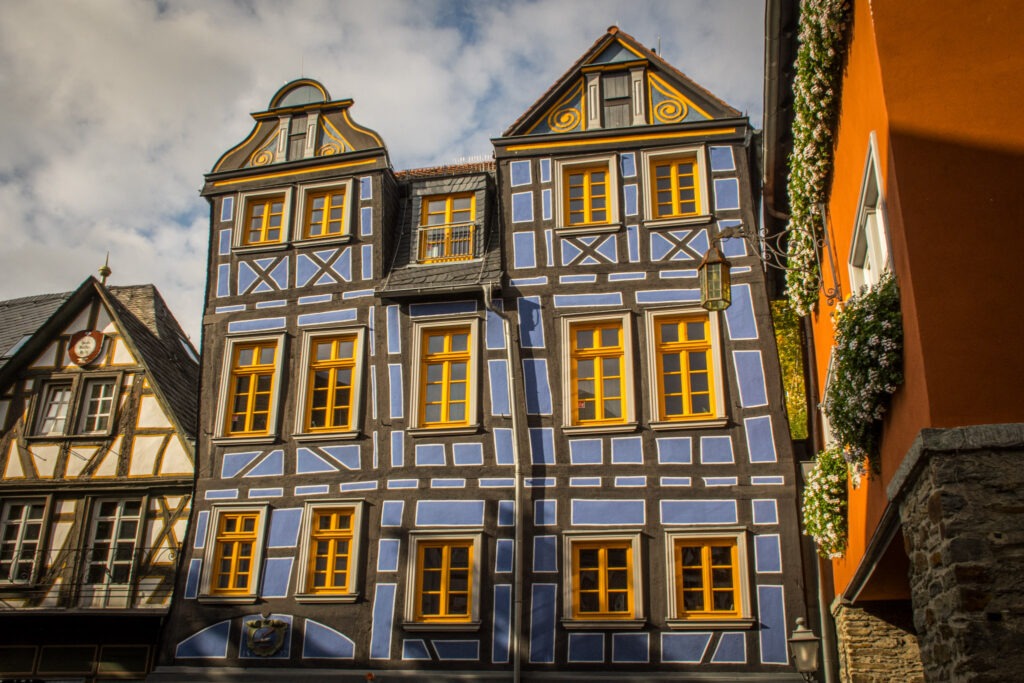
One building that immediately caught my attention was the wonderfully crooked Schiefes Haus, sometimes referred to locally by the sign of the knife-maker’s guild that once occupied it. The house leans so dramatically that it almost feels like something from a fairy tale — as though the builder had intentionally exaggerated the angles just for effect. In reality, the uneven lines reflect centuries of construction techniques and settling timber, giving the building its unmistakable character.

Another architectural standout is the remarkable Killingerhaus, one of the most elaborate half-timbered buildings I’ve seen anywhere in Germany. Built in 1615 by a wealthy local merchant, its facade is richly decorated with carved wooden beams, ornamental panels, and intricate patterns that demonstrate both craftsmanship and status. Today, the building houses Idstein’s city museum and also serves as the town’s tourist information office — a fitting role for one of the most visually striking buildings in the square.
Standing in König-Adolf-Platz, surrounded by these crooked, colourful houses, it’s easy to understand why this square remains the lively center of the town. It’s the place where Idstein’s architecture, history, and everyday life come together in one small, unforgettable space.
The Leaning Witches’ Tower

Rising above the rooftops of the old town is one of Idstein’s most recognizable landmarks: the Hexenturm, often translated as the Witches’ Tower. Dating back to the 12th century, the stone tower once formed part of the town’s defensive fortifications and today stands with a noticeable lean that immediately draws the eye.
But the walk to the tower is just as interesting as the landmark itself.

From the old town, I followed a small stone bridge known as the Alte Brücke, which gently leads you toward the edge of the historic center. Crossing the bridge, you pass through the Kanzleitor, a historic gate that once marked the transition between the medieval town and the administrative buildings of the ruling counts.
Stepping through the Kanzleitor feels almost like entering another layer of Idstein’s history. Just beyond it, the Witches’ Tower rises dramatically from the hillside, its thick stone walls leaning slightly after centuries of weather and settlement.
Despite its picturesque appearance, the tower’s name reflects a darker chapter in the town’s past. During the witch trials of the 17th century in this region of Hesse, the tower was used as a place of imprisonment before trials were carried out.
Yet the area surrounding the tower today feels remarkably peaceful.

Beside it lies the Residenzschloss Idstein, a former residence of the Counts and later Princes of Nassau. Much of the castle complex dates from the 17th century, when Idstein served as a small but important administrative seat for the Nassau rulers. The buildings were later adapted for educational use and today house a school.
Adjacent to the palace is the quiet Schlossgarten Idstein, a green space that feels almost hidden compared to the lively market square. When I wandered through this area, there were only a handful of people strolling along the stone gravel pathways.
Wandering the Streets of Idstein

Beyond the main square and the tower, some of my favourite moments in Idstein came from simply wandering its quieter residential streets.
One street I especially enjoyed walking on was Obergasse. If you follow it all the way uphill, it gradually opens to views looking back over the rooftops of the old town, where the Hexenturm rises above the cluster of half-timbered buildings below. At the top of the hill sits Hotel Höerhoff, an elegant historic property with a well-regarded restaurant. If I were to spend a night in Idstein, this is exactly where I would stay — close enough to walk into the old town, yet quiet and slightly elevated above it.

About halfway back down Obergasse, a small side street called Kaffeegasse branches off. From here, I wandered slowly through several parallel streets — Felix-Lahnstein-Straße, Borngasse, and Weiherwiese — walking the full length of each one. These streets are lined with rows of colourful timber-framed houses where daily life quietly unfolds.
It was here that I noticed the small details that make towns like Idstein so memorable: flower boxes spilling over windowsills, worn stone steps at doorways polished by centuries of use, and occasional old barn doors and stables that hint at how these houses once functioned long before cars and modern conveniences.

At one point, I discovered a narrow passageway between buildings that felt almost secret, as though I had accidentally wandered onto private property. The romantic path gently led through to Kreuzgasse, eventually bringing me back toward the Marktbrunnen near the center of town.
What I loved most about this part of Idstein was how residential it felt. While many visitors stay close to the main square, these neighbouring streets reveal a quieter side of the town — the places where locals live among centuries-old architecture that continues to shape everyday life.
FAQ About Idstein, Germany
Where is Idstein, Germany?
Idstein is a small historic town in the state of Hesse in western Germany. It sits in the Taunus region about 40 km (25 miles) northwest of Frankfurt, making it an easy and scenic day trip from the city.
Is Idstein worth visiting?
Yes — especially if you enjoy smaller towns with preserved historic centers. Idstein’s colourful half-timbered houses, medieval landmarks, and relaxed atmosphere make it one of the most charming towns near Frankfurt, without the crowds found in more famous destinations.
How do you get to Idstein from Frankfurt?
The easiest way to reach Idstein is by regional train from Frankfurt. The journey takes about 40–50 minutes, and the station is a short walk from the old town. Driving is also possible and takes roughly the same amount of time.
How much time do you need in Idstein?
Most visitors can explore Idstein comfortably in half a day. That said, the town rewards a slower pace. Plan time to wander the old town streets, enjoy a café in König-Adolf-Platz, and walk toward the Hexenturm and castle gardens.
What is Idstein known for?
Idstein is known for its beautifully preserved old town filled with colourful half-timbered houses. The town’s most recognizable landmark is the leaning Hexenturm (Witches’ Tower), along with the lively König-Adolf-Platz and historic buildings like the Killingerhaus.
Idstein Is A Town Worth Visiting
After many years of travelling through Germany, I’ve learned that the places I often return to aren’t always the ones that appear on every itinerary.
They’re the smaller towns — the ones where you can wander without a plan and let the character of the place reveal itself slowly.
When I’m helping clients plan time around Frankfurt, I’m often looking for towns that offer exactly that kind of experience. Places that are easy to reach, beautiful to walk through, and still feel rooted in local life. Idstein is one I’ll happily recommend.
If you enjoy discovering towns like this — the quieter corners of Europe that reward a slower pace — you might enjoy my newsletter as well. It’s where I share reflections, travel discoveries, and small places that linger long after the trip ends.


