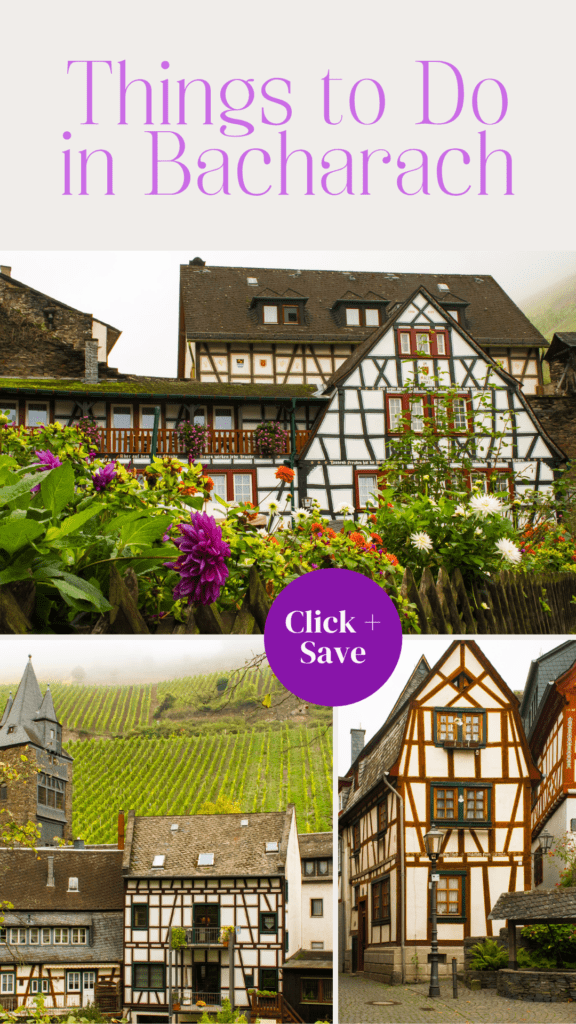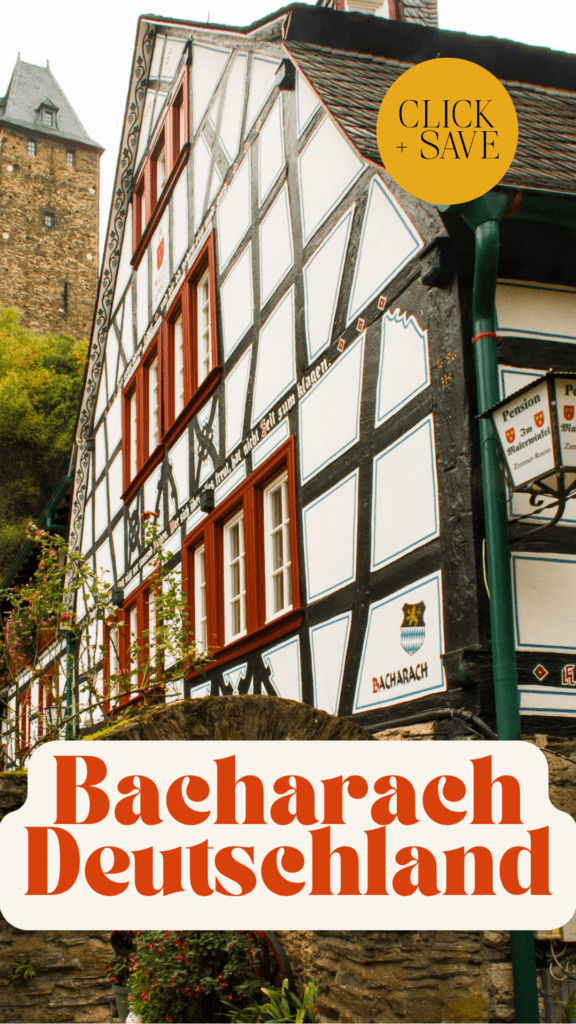

There are places along the Rhine that you can take in at a glance.
Bacharach wasn’t one of them—at least not in the way I expected.
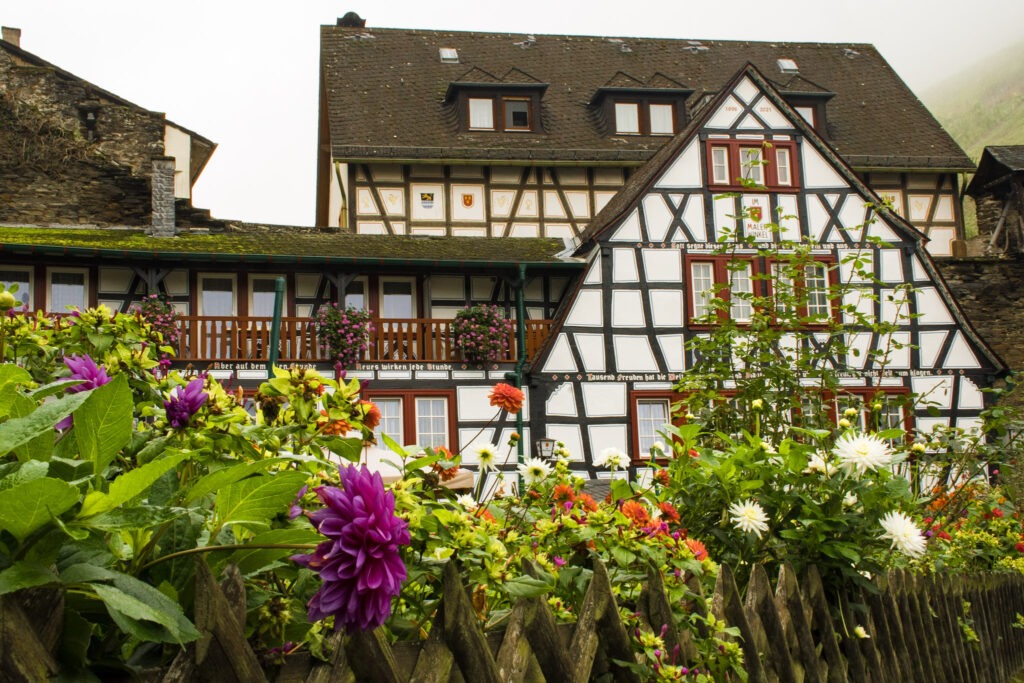
I arrived early, entering through the stone gate tower from the river and within a few steps, the streets shifted into timber-framed houses, close together, quietly holding their place.
It was gray. Damp. Light rain in the air.
And still, everything stood out.
Almost immediately, I thought—this is exactly what I was looking for.
A small, sleepy town. Nearly empty. No effort required to see it clearly.
I had come here during a month spent moving through the Rhine and Moselle, searching for places like this. And while there are certainly things to do in Bacharach, what stayed with me wasn’t a list—it was how quickly I liked this town.
This post may contain affiliate links, meaning I get a commission if you decide to purchase something through the links, at no additional cost to you. Read my Affiliate Disclosure.
Why Bacharach Was Exactly What I Was Looking For
Bacharach sits along the Upper Middle Rhine, between visiting Koblenz and Mainz, on one of the most scenic stretches of the river. Trains run directly along this route, making it easy to reach and simple to include in a Rhine itinerary.
It’s also not a hidden place. Bacharach appears regularly in Rhine itineraries—very much part of what I think of as the Rick Steves effect. And typically, that level of visibility brings crowds.
Arriving early, in gray, drizzly weather in October, I found the town nearly empty. And that shifted everything. Without the volume of visitors, Bacharach felt quiet.
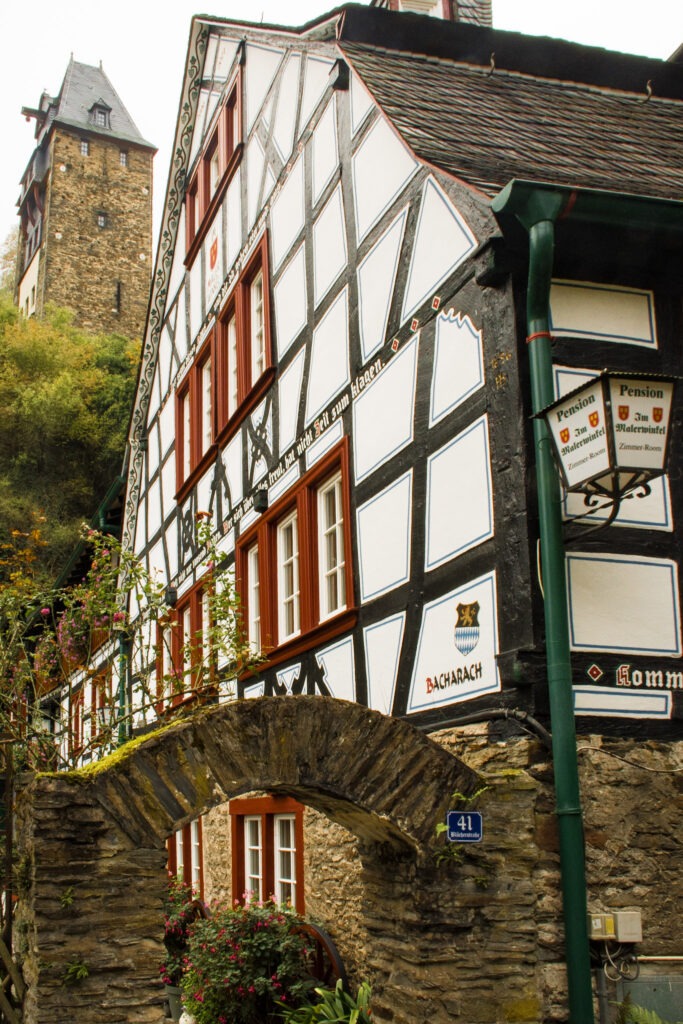
It’s smaller and more contained, with a level of visual cohesion that makes the town feel whole. Timber-framed houses, narrow lanes, the remains of the town walls, and Stahleck Castle above—it all sits within a compact space that’s easy to move through without feeling directed from one “sight” to the next.
I had spent weeks moving through the Rhine and Moselle, visiting every town you can imagine. And compared to the towns closest to Bacharach, it stood out.
- Koblenz feels like a small city—busier, more spread out, less defined by a single atmosphere, with lots to see, do and places to eat.
- Boppard has a broader, more developed riverfront with a steady flow of visitors.
- Sankt Goar and Oberwesel are quieter, but tend to feel like places you pass through rather than settle into.
- Rüdesheim is lively and well known, but noticeably commercial, with a constant energy that doesn’t let up.
Bacharach offered a different kind of experience. That contrast is what makes it worth choosing.
Things to Do in Bacharach
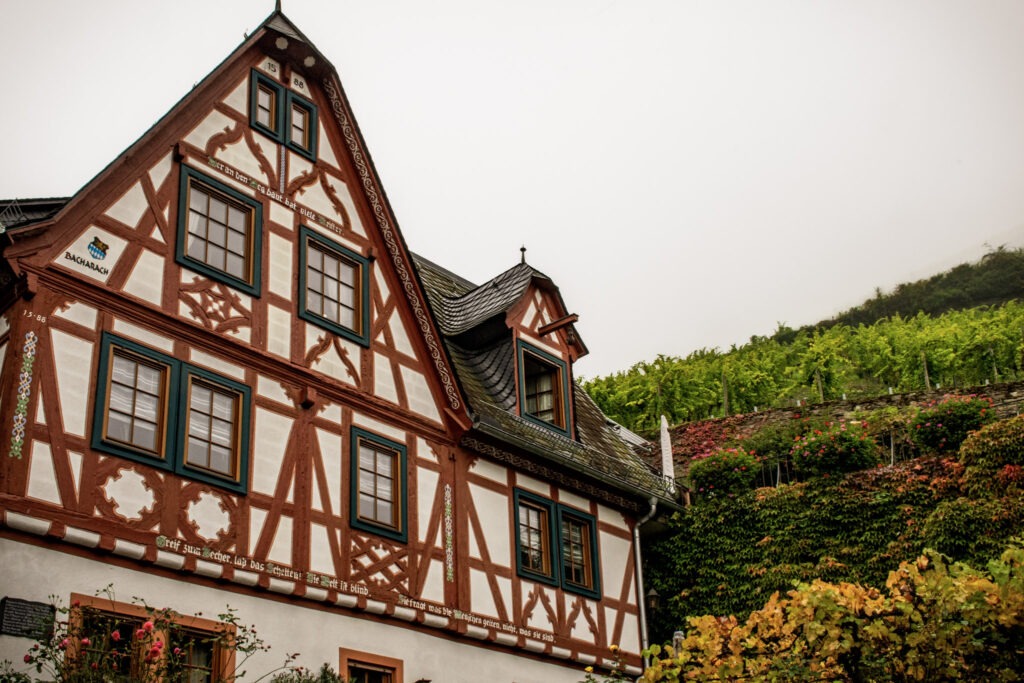
You enter through the Marktturm, a medieval gate tower that once formed part of the town’s defensive walls. It dates back to the 14th century, built to protect Bacharach during its time as an important Rhine trading post. Passing through it, you’re not just entering a town—you’re crossing into a space that has held its shape for centuries.
Bacharach’s Altstadt
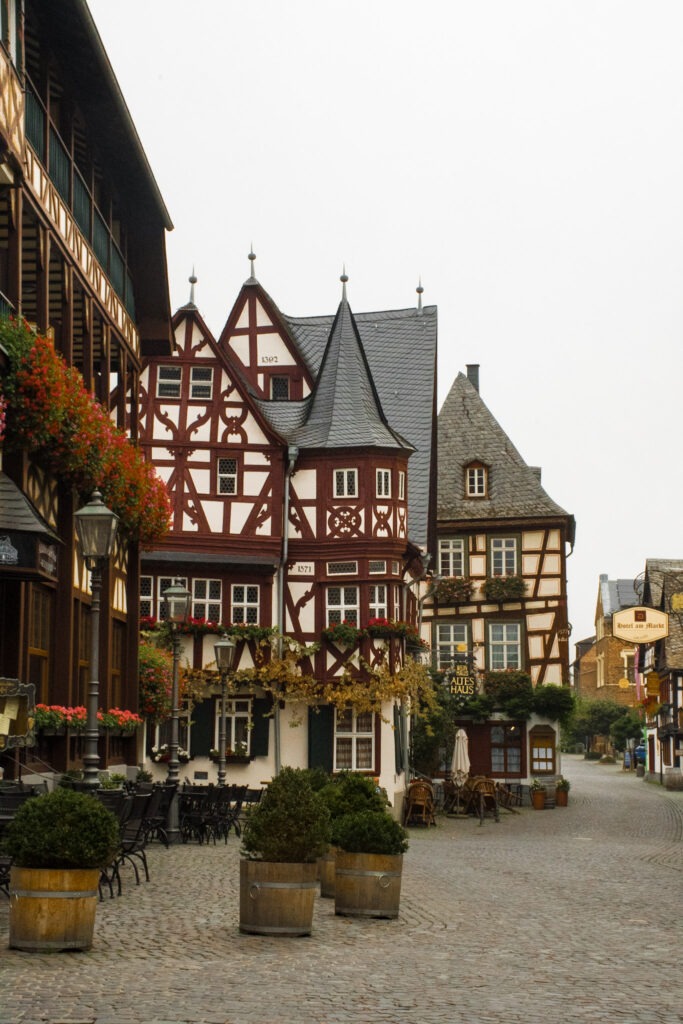
From there, the layout becomes clear quickly.
Two main streets run parallel to the Rhine, forming the spine of the town. Between them, narrow lanes cut across, creating a compact grid that’s easy to walk without thinking about direction. Most of the buildings are timber-framed, many with slightly uneven lines and deep-set windows, and almost all are in use—shops, small cafés, and restaurants tucked into the ground floors, with living spaces above.
Every town has a Rathaus—the town hall. Historically, this would have been the administrative center of Bacharach, where local decisions and trade matters were handled. Architecturally, it blends in with the surrounding buildings, and compared to everything else in town, it’s surprisingly the least interesting and a bit of a disappointment.
It’s worth stepping inside St. Peter’s Church, the town’s main church.
From here, the town begins to rise.
Above Bacharach: Castles, Towers, and Vineyard Views
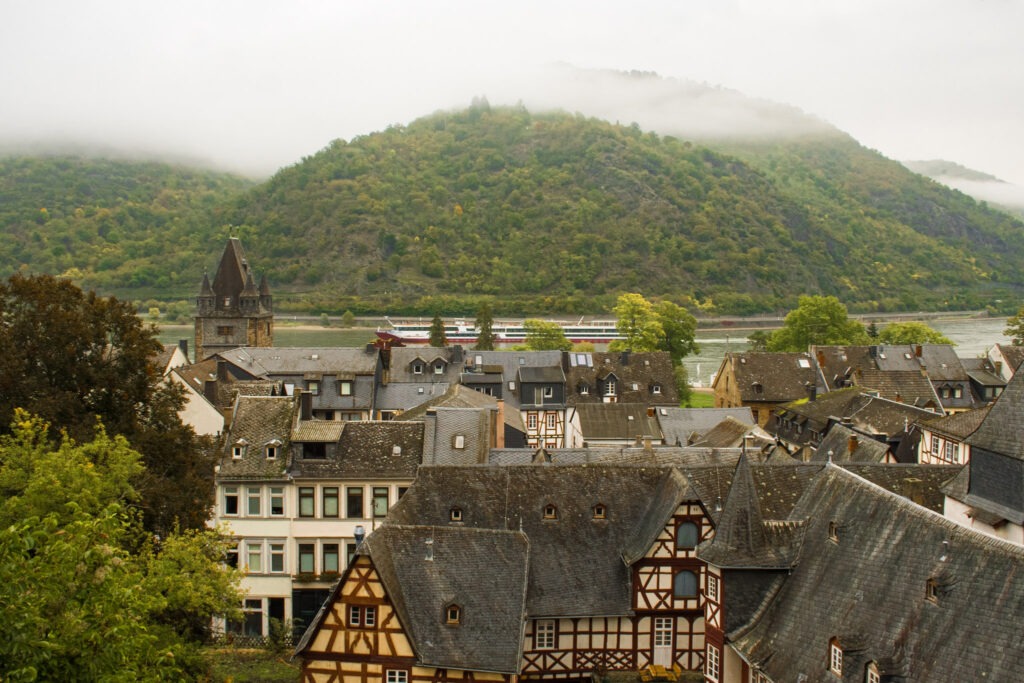
Just beyond the main streets, the incline becomes noticeable, and the landscape shifts from enclosed streets to a steep hillside.
You’ll come across the Wernerkapelle. It’s hard to miss—not because it’s intact, but because it isn’t.
What remains are the red sandstone arches of a Gothic chapel, open to the sky. Construction began in the 13th century, originally built as a pilgrimage site tied to the story of Werner of Oberwesel. That history is complicated, rooted in a medieval legend that led to the persecution of Jewish communities in the region.
There’s no interior to step into; you can only move around it.
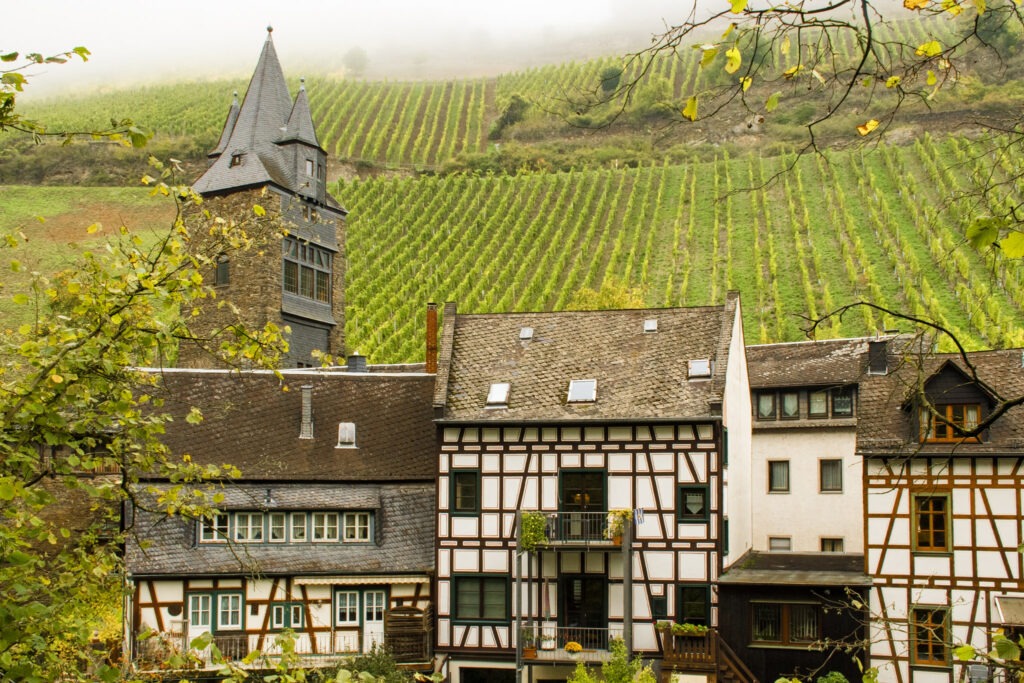
Further above Bacharach, you’ll see a series of stone towers scattered along the slopes and vineyards—remnants of the town’s medieval fortifications.
Some of these include the Postenturm, Liebesturm, and Spitzer Turm—all part of the original defensive wall system that once protected the town and monitored movement along the Rhine. Today, they are positioned along walking paths that lead upward through the vineyards.
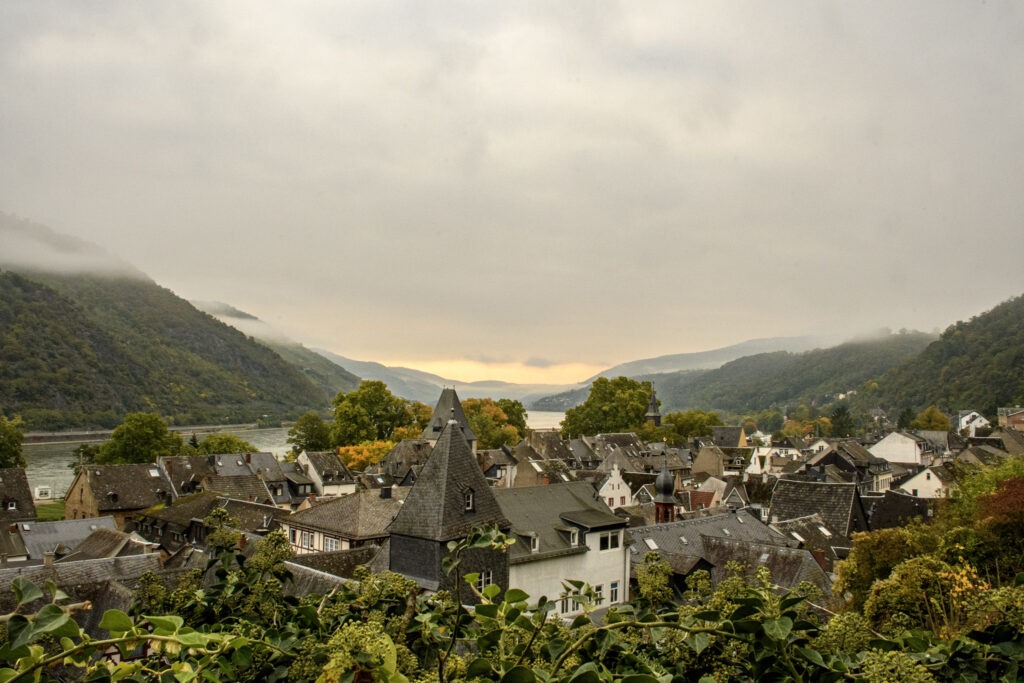
As you climb, the views begin to open.
There are several designated viewpoints—Aussichtspunkt, Rheinblick, and Heinrich-Heine-Blick, to name a few—each offering slightly different angles over the river and surrounding valley. You don’t need to reach all of them. Even stopping partway changes your perspective of the town below.
Continue upward, and you’ll reach Stahleck Castle.
Set high above Bacharach, the castle dates back to the 12th century and now operates as a youth hostel. The elevation is what matters here.
No matter which observation deck you decide on, the walk up is steady but manageable, following paved paths that gradually climb through the hillside. If the weather isn’t ideal, or if you prefer to keep things easier, there’s a lower option that still captures the atmosphere of Bacharach.
Malerwinkel is a small, scenic spot that is the easiest to reach and the starting point for many of these hiking spots. A narrow stream runs through it, framed by an old city gate and stonework that feels almost untouched.
FAQ About Bacharach, Germany
Is Bacharach worth visiting?
Yes—especially if you’re looking for a quieter, more cohesive Rhine town. It’s smaller, less commercial than places like Rüdesheim, and easy to experience without rushing. Timing matters—arrive early or stay later in the day to avoid crowds.
How much time do you need in Bacharach?
A half day is enough to walk the town and climb to the castle. A full day allows for a slower pace, including the hillside paths and viewpoints. It’s best not treated as a quick stop.
When is the best time to visit Bacharach?
Early morning or late afternoon. Midday can bring more visitors, especially in peak season. Shoulder seasons (spring and early fall) offer the best balance of fewer crowds and good weather.
Is Bacharach a good base for the Rhine Valley?
It can be—but only if you’re planning to slow down. Bacharach works best as a base when paired with one or two nearby towns, rather than using it to cover the entire Rhine. Its size and pace are better suited to a more focused, unhurried itinerary.
How do you include Bacharach in a Rhine itinerary?
Bacharach sits on the train line between Koblenz and Mainz. From Koblenz, pair it with Boppard or St. Goar, then continue south. From Mainz or Frankfurt, make Bacharach your main stop, with Oberwesel or St. Goar nearby. It fits easily into a half-day without rushing.
What Makes Bacharach Worth Visiting
What stayed with me wasn’t anything I set out to see.
It was how easily Bacharach held my attention once I arrived. No need to seek anything out. Just a quiet continuity of exploring the Rhine rather than what most itineraries suggest.
I’ve returned to Germany for decades now, and I notice this more each time—the difference between places you pass through, and places that ask you to slow down without saying so.
Bacharach does that quietly.
And if you arrive at the right time, you’ll feel it almost immediately.
If you’re planning your own time along the Rhine, I share more of this approach in my newsletter—or you can explore my trip planning services and The Unrushed Itinerary Method to build a slower, more intentional itinerary.