

You’ve likely seen the photos—whitewashed houses stacked above the sea, a medieval castle watching over the coast. The kind of place that looks too perfect to reach on a simple day trip.
And that’s the hesitation, isn’t it? How do you get from Valencia to Peñíscola without spending half the day wrestling with buses, trains, or the stress of driving in a foreign country? You want the reward of discovery, not the weight of logistics.
There is a way. One that frees you from timetables and road signs, yet still lets you linger where the old stones meet the sea. A way to experience Peñíscola as more than a quick stop, but as a story you step into.
This post may contain affiliate links, meaning I get a commission if you decide to purchase something through the links, at no additional cost to you. Read my Affiliate Disclosure.
What Makes Peñíscola Special

A Town Frozen in Time
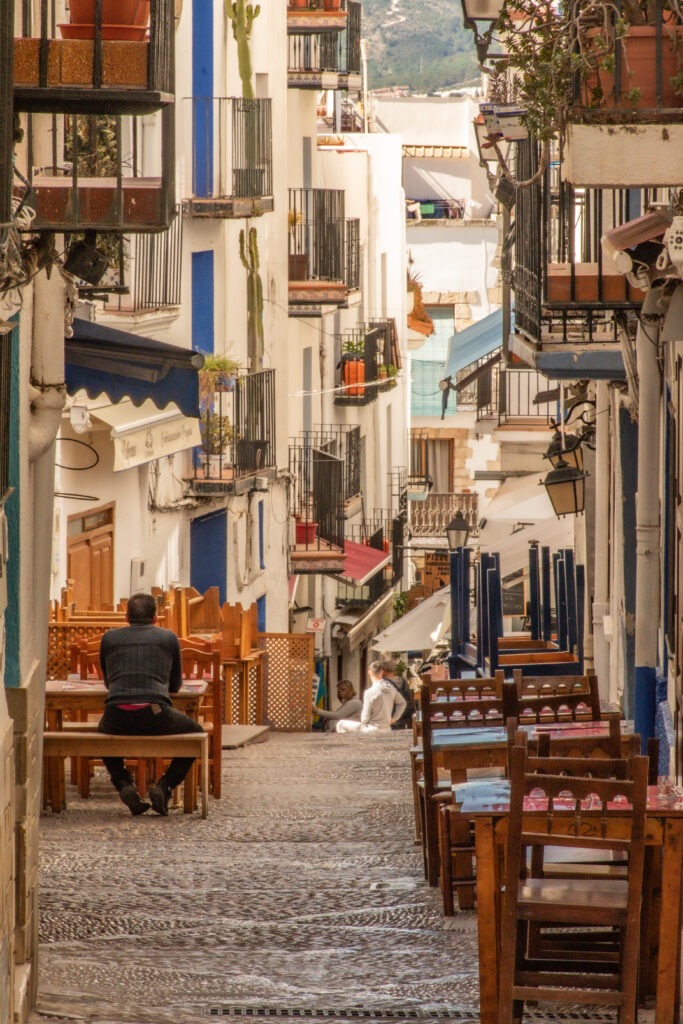
Peñíscola is often called the City in the Sea, and for good reason. The walled old town rises from the waves, crowned by the medieval castle of Papa Luna. Within the walls, you wander narrow cobbled streets where whitewashed houses tumble toward the shoreline, their balconies bright with flowers. At every turn, the sea is your backdrop—sometimes a flash of turquoise between rooftops, sometimes the full sweep of the horizon.
Cultural & Historical Significance
Imagine a castle standing atop a rocky promontory, the Mediterranean shimmering on all sides, while golden sands stretch out below. Whitewashed houses cascade down from its heights, giving the impression of a living postcard. It’s no surprise that Game of Thrones filmed here, using the fortress and streets as the setting for Meereen.
But long before television crews arrived, this was a place of power. Built by the Knights Templar, the castle became the refuge of Benedict XIII—known as Papa Luna—whose legacy still lingers in its stones.

I wasn’t the only one drawn to the scene. As I paused to take it in, a painter nearby lifted his brush, capturing the same perfect view on canvas. In that moment, Peñíscola felt less like a stop on a map and more like a story unfolding.
It’s this rare combination of history, beauty, and atmosphere that makes this a day trip from Valencia worth every step.
How to Get from Valencia to Peñíscola

Reaching Peñíscola from Valencia isn’t as simple as it looks on the map. There’s no direct train, only routes that leave you partway there and require searching for a bus connection. The buses themselves are limited, with schedules that rarely line up to make the trip smooth—and for non-Spanish speakers, navigating the options can feel unnecessarily complicated.
Driving seems like the obvious alternative, until you factor in traffic, parking on narrow streets, and the mental load of navigating unfamiliar roads. It’s time lost, and energy spent, when all you really want is to step into the old town and breathe it in.
The Small-Group Tour Solution
This is where a small-group tour changes everything. Instead of juggling timetables or maps, you’re picked up in Valencia and delivered straight to the city by the sea in about 90 minutes. No stress, no missed connections. Just the freedom to look out the window as the Mediterranean coast unfolds.
And when you arrive, it isn’t only about what you see—it’s about what you learn. A local guide adds layers of history and culture, sharing the stories that bring the castle and streets to life. The pace is unhurried, designed so you can experience rather than rush.
It’s a rare kind of travel: effortless, yet deeply rewarding.
Small-Group Tour vs. Going Alone
| Small Group vs Alone | Pros | Cons |
|---|---|---|
| Small-group Tour | – Stress-free logistics – Insider knowledge from a local guide – Opportunity to meet like-minded travellers | – Less flexibility with timing – Limited free time compared to going solo |
| Going Alone | – Complete freedom to linger or move on – Option to rent a car and explore nearby villages | – Stress of navigating transport – Missing local stories that enrich the experience |
If group tours bring to mind crowded buses and cookie-cutter itineraries, Peñíscola will surprise you. Small groups feel more like a circle of fellow travellers than a crowd, with guides who have time to answer questions and tailor their insights. And while driving may seem like the easier option, it rarely is. Between parking struggles, traffic, and missed turns, the cost is often measured in energy and time—two things better spent walking cobbled streets or lingering over a seaside meal.
My Experience Visiting Peniscola for the Day

The decision was simple. I wanted ease—the kind of day where the details are handled for me. I wanted culture—not just sights, but stories that deepen what I see. And I wanted connection—with a guide who knows the town, and with moments that would stay with me long after I returned to Valencia.
My Experience on the Tour
The day began smoothly, with a pick-up in Valencia and a relaxed drive along the coast. Our guide set the tone quickly. She paused often, giving us time to absorb her stories and to take photographs without feeling hurried.

We made a brief stop at the Museu de la Mar, a tiny Maritime Museum tucked along the sea wall. It isn’t filled with treasures, but it is rich in atmosphere—a cannon pointing out to sea, a reminder of the town’s strategic past.
The highlight was meant to be the Castillo de Peñíscola, the imposing fortress of Papa Luna. Yet when we arrived, the gates were unexpectedly closed for renovations. A disappointment, yes, but our guide turned it into something else. With quick thinking, she led us around the castle’s exterior, painting vivid pictures of the interiors we couldn’t enter. Her improvisation made the history come alive in ways a static exhibit never could.

She then guided us through El Parc d’Artilleria, included with the castle ticket. Once a military outpost, today it’s a garden laced with cannons, bunkers, and sweeping sea views. The contrast of flowers against stone fortifications gave the place a haunting beauty.


Afterwards, we had three hours of free time. For me, this was the gift. I wandered to the Casa de las Conchas, its façade glittering with thousands of shells. I chose a little restaurant down a quiet street—Taberna La Copla—where the owner assured me he could serve paella for one, a rare kindness in Spain where it’s usually shared. Sitting there, finally tasting this iconic dish in its home region, felt like a small victory.


The afternoon unfolded slowly. I wandered intentionally without direction, getting lost in the maze of cobbled streets, discovering new corners each time. A terrace called Boca offered cocktails and a view; I stayed for both. Later, I found myself at the Bufadero Marino, a natural blowhole where the sea crashed against the rocks, spraying mist into the air.


By the time we regrouped for the return to Valencia, I felt the day had given me more than I expected. The tour didn’t just take me to Peñíscola—it gave me the freedom and perspective to experience it fully.
Final Thoughts
A day trip from Valencia to Peñíscola is a gift of simplicity. Instead of timetables, parking, or logistics, you’re free to step into a world where history and sea meet. With a local guide, the castle, old town, and maritime past reveal themselves effortlessly.
The greatest luxury of all? Your only job is to enjoy the moment—to savour paella by the sea, to wander cobbled alleys, and to watch the horizon as time slows down.
If Peñíscola has sparked your curiosity, you may want to linger a little longer in Valencia itself. Continue exploring with my guides to the city—whether it’s where to eat, what to see, or how to slow down and make the most of your stay.
- How many days to spend in Valencia
- Find out the best time to visit Valencia for the weather and festivals
- The best attractions in Valencia
- Best things to see and do in Valencia
- What to do in Valencia for 3 days


