

If there’s one place in Berlin where history and creativity collide, it’s the Berlin East Side Gallery.
Stretching 1.3 kilometres along the Spree, this former section of the Berlin Wall has transformed into the world’s longest open-air gallery — a living monument to hope, unity, and the power of expression.
Every mural carries a story: of division and reunification, of protest and change, of personal memories layered over national history.
During my visits while living in Berlin, I never rushed this walk. I pause, circle back, notice something new each time — a brushstroke I missed, a phrase I didn’t fully absorb, a message that hits differently depending on where I am in my life.
I’ll walk you through some of the most meaningful works, the ones that stopped me in my tracks. These are the murals worth slowing down for.
This post may contain affiliate links, meaning I get a commission if you decide to purchase something through the links, at no additional cost to you. Read my Affiliate Disclosure.
What is the Berlin East Side Gallery?

The Berlin East Side Gallery is the longest remaining section of the Berlin Wall still standing today, a 1.3-kilometre open-air gallery stretching along the Spree River in Friedrichshain. After the fall of the Wall in 1989, artists from around the world were invited to transform this once-impenetrable border into a sweeping canvas of expression, remembrance, and hope.
Instead of being demolished like most of the Wall, this section became a living monument, colourful, raw, emotional, and constantly evolving. It’s one of the most visited places in Berlin.
Visitors come not just to take photos, but to walk along history itself, tracing the line where East once met West and absorbing the messages painted across concrete that once symbolized division.
Many of the murals have been restored or repainted over time due to the weather. What you’re seeing is a maintained version of the original vision, not untouched history. That tension between preservation and change is part of the experience, something that Berlin is famous for.
How the Berlin Wall Became an Open-Air Museum

When the Berlin Wall fell on November 9, 1989, the city erupted in celebration. But Berliners also faced a question: What should be done with the Wall that divided them? Most of it was torn down, yet a single stretch along Mühlenstraße remained.
In 1990, this surviving section was transformed instead of being erased.
Artists from 21 countries gathered to paint murals reflecting freedom, unity, political tension, and the emotional aftermath of reunification. Their work turned cold concrete into a global message, not just about Germany’s past, but about the resilience of people everywhere.
Today, the East Side Gallery stands as a memorial, a free museum and artwork, a reminder of what was, and a celebration of what changed.
Most first-time visitors will have this Berlin wall art site added to their must-see itinerary.
Murals Along Berlin’s Wall You Shouldn’t Miss
Some pieces feel immediate. Bright, playful, easy to take in. Others are harder. More layered and detailed. You might not understand them right away.
These are the ones I found myself admiring a little longer.
The Kiss by Dmitri Vrubel

Soviet artist, Dmitri Vrubel, “The Kiss” has to be the most famous of them all! It’s actually called “My God, help me to conquer this deadly love,” and is based on a photograph of the infamous embrace between Leonid Brezhnev and Erich Honecker, leaders of the Soviet Union and East Germany.
Walls Across the World by Alexei Taranin

This scene of “Mauern International” (walls across the world) depicts scenes of walls in different countries- Moscow, China, everywhere and Berlin. What I like about this one is that it resembles artwork that you might see in a children’s book. Not shown in my photo is a cat sleeping and a rabbit in a rocking chair.
Everything Open by Rosemarie Schinzler

This submission to the Berlin Wall gallery is by a German artist called “Alles offen” and is meant to represent the sense of leaving the past behind and entering into the unknown after the Berlin Wall fell.
Worlds People by Shamil Gimayev


Worlds People, or Wir sind ein Volk is the longest art mural in the Gallery. Take your time on this one, as you can see countless abstract faces, buildings, and phrases that have been woven amongst the patterns.
The Wall Jumper by Gabriel Heimler
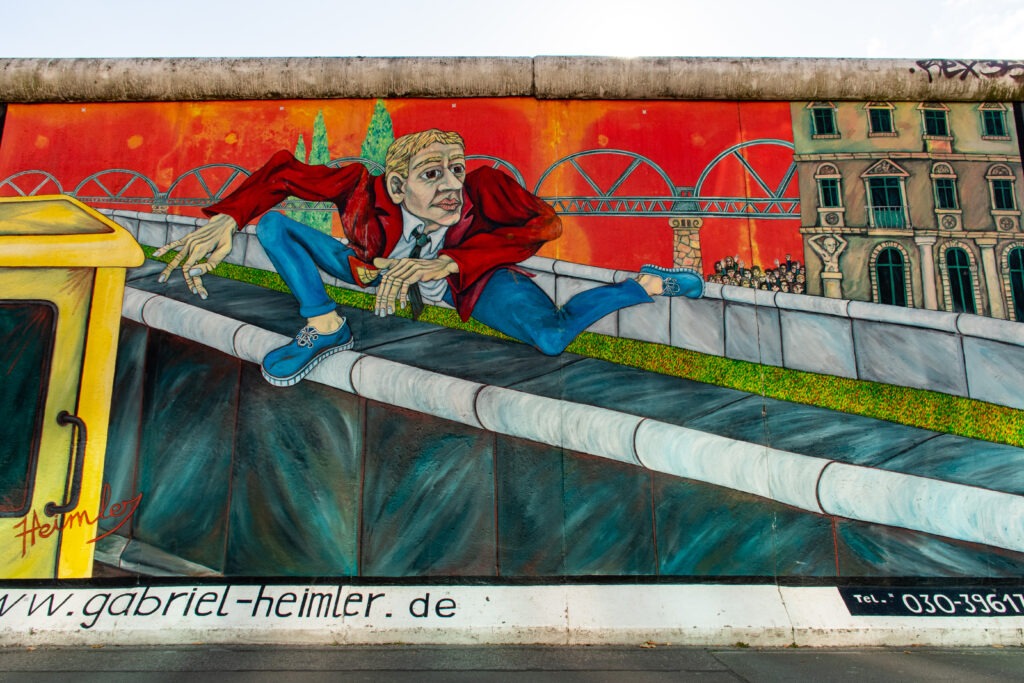
This art mural is meant to address the possibility of overcoming borders. But it might also represent the artist’s personal experience of living in multiple locations, having grown up in France, studying in East Berlin and working in West Berlin.
The Dancers by Sabine Kunz


This mural of “Die Tanzenden,” or the dancers, represents this former East Berlin artist’s joy and sense of freedom after the fall of the Wall. I immediately recognized her name as having visited her boutique, which features her abstract art on many lifestyle products, which make for great Berlin souvenirs.
Tribute to the Young Generation by Thierry Noir

The vivid and playful display of abstract faces and vibrant colours is meant to symbolize the spirit of youthful rebellion and creativity that helped shape the city of Berlin. This mural is one of the longest and shows the repetition of these faces about 13 times.
Test the Rest by Birgit Kinder

It is a whimsical and thought-provoking piece that shows a Trabant car, the iconic symbol of East Germany, breaking through the Wall. It’s meant to represent the desire for freedom and change during that moment in history. But I think the colours simply won me over!
Hands, Sky and Seeker, a Joint Venture by Margaret Hunter and Peter Russell
Two Scottish artists have 3 art murals side-by-side. The first one is a collaboration, and then they each have one individually.

Represents a striking visual of two hands reaching out to each other across the remnants of the Berlin Wall, encapsulating the universal longing for connection and unity.

It is meant to show Western consumer products in a shop window, showing how the West had such a commercialized lifestyle compared to the East.

These two large horizontal faces lie side by side and are meant to represent the communication lines between them.
It Happened In November by Kani Alavi

“Es geschah im November” captures the events of November 9, 1989, when the Berlin Wall finally came down, ending decades of division between East and West Berlin.
Doin’ it Cool for the East Side by Jim Avignon


It is meant to represent the celebration that occurred after the Berlin Wall fell. And its vivid colours and life exude that a party is happening! You can’t help but feel good when you look at this one!
Untitled by Peter Lorenz

This piece of abstract painting represents the fall of the Wall and chaotic scenes in the coming days, along with the rebirth. What caught my attention was the flags of the nations involved in reunification – Germany, Russia, and the United States.
Tolerance by Mary MacKey

This art mural has a timeless message of tolerance. The aspiration of open-mindedness towards people with different backgrounds. If you think it is similar to Thierry Noir’s heads (no. 7), you’re right, as the artist took inspiration from his signature artwork.
Amnesty International in DDR by Andrej Smolak

I loved the message of this art mural as it pays tribute to the work of the human rights organization that helped political prisoners in East Germany. There are so many symbols in just this one piece: from the ball at the end of the chain that turns into a rose to the dove, sun and prisoner’s hand holding up the peace sign.
How to Visit the East Side Gallery in Berlin

As someone who has walked this many times, I can attest that it’s longer than it looks. At 1.3 kilometres, the distance doesn’t sound like much, but mural fatigue sets in. By the halfway point, you may notice yourself speeding up without meaning to. That’s usually the moment to stop.
Find a section that holds your attention and stay there a little longer. You don’t need to “complete” the wall for it to matter.
I like to start at the Ostbahnhof end of Mühlenstraße, walking west toward the Oberbaumbrücke, so I end my walk by sitting on the steps next to Oberbaum. Most people start at this point and walk in the opposite direction, as many people have come from exploring the nearby Friedrichshain or Kreuzberg. But choose your starting point closest to your hotel.
The crowds change what you see. Near the most photographed murals, the experience changes. People cluster, queue, pose. It becomes about getting the shot. And when that happens, it’s harder to actually see what’s in front of you.
Walk another five minutes. You’ll find stretches where you can stand back, take it in, and notice details that disappear in the busy sections.
If you want to see the murals without the crowds, get here early. If photos matter to you, come early, before the crowds of people. Late afternoon light is beautiful, too, angled, gentle on colour, but it’s busier.
FAQs About Visiting the Berlin East Side Gallery
Is the East Side Gallery worth visiting if I’ve already seen other Berlin Wall sites?
Yes, but for a different reason. This isn’t about preserved history like Bernauer Straße. It’s about interpretation. You’re seeing how artists responded to the Wall after it fell, which adds a more emotional, human layer to everything else you’ll see in Berlin.
How long does it realistically take if I don’t rush?
Give it 60–90 minutes. Not because of the distance, but because you’ll stop more than you expect. The murals pull you in unevenly. Some you’ll pass quickly. Others will slow you down without you realizing it.
Where does the experience feel the most crowded, and how do I avoid it?
The area near Warschauer Straße is the busiest. Start at Ostbahnhof and walk west instead. You’ll ease into the gallery with fewer people and experience it before hitting the busier sections.
Is it better to walk the entire length or just see the highlights?
If time allows, walk the full stretch. The impact comes from the accumulation, not just the famous murals. If you only see highlights, it risks feeling like a checklist instead of a place.
Do I need a guide to understand the murals?
No. In fact, it’s often better without one. Let yourself react first. If something stays with you, look it up afterward. The experience is stronger when it’s not over-explained in the moment.
Where This Fits in Your Berlin Visit
I recommend you anchor this experience as part of your day in Berlin. Start at the East Side Gallery, then build out from there without overloading the day.
From there, cross over toward Kreuzberg and follow the Spree. This is where I shift out of “seeing” and into moving through the city. If you want a different perspective, this is the point where a short boat ride along the river makes sense. It connects what you just walked with what you’re about to see.
Late morning or early afternoon, make your way toward Checkpoint Charlie. It’s a contrast. But I include it because it adds context to what you’ve already experienced at the Wall.
From there, continue into Mitte, at Unter den Linden, where you will see at one end the Brandenburg Gate and at the opposite end is Museum Island, even if you don’t go inside anything. The setting alone is enough to shift the tone of the day.
If your itinerary feels packed, this is the kind of day I’d simplify rather than add to. And if you want help structuring your time in Berlin so it flows like this, you can explore my trip planning services.


